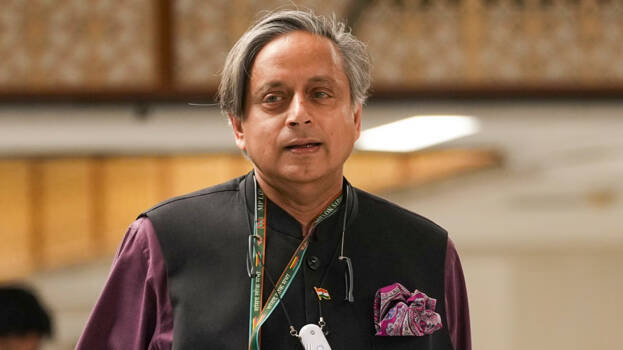
The resurfacing of disturbing CCTV footage showing the alleged custodial torture of Kerala Youth Congress leader VS Sujith has reignited political and public outrage. The incident, which took place two years ago at Kunnamkulam Police Station, gained national attention only recently after the surveillance video became publicly available. Congress MP Shashi Tharoor described the assault as “deeply disturbing” and highlighted that such acts are not only illegal but also inhumane, emphasizing that the officers involved should face strict disciplinary and criminal action. The episode has once again placed the state police under scrutiny and sparked widespread calls from opposition leaders and civil society demanding accountability and justice.
Shashi Tharoor and Congress Leaders Condemn the Assault
Shashi Tharoor, representing Thiruvananthapuram in Parliament, voiced his strong condemnation of the alleged violence against VS Sujith, stressing that assaulting a citizen for questioning the actions of law enforcement is fundamentally unacceptable. Posting on X, Shashi Tharoor stated that officers who violate the principles of justice and dignity “have no place in the police force” and that those involved have “forfeited the moral right to continue in service.” He further urged both the Chief Minister of Kerala and the state home department to take immediate and decisive action, asserting that “silence cannot be the shield for such brutality.”
The incident has prompted significant political mobilization within the Congress party. VD Satheesan, the leader of the opposition in the Kerala assembly, wrote to Chief Minister Pinarayi Vijayan demanding the dismissal of the officers implicated in the assault. Satheesan highlighted that despite Supreme Court rulings prohibiting custodial torture, there appear to have been attempts to shield the responsible police officers. According to his letter, senior officials allegedly omitted key names from the charge sheet and concealed reports, thereby undermining accountability and obstructing justice.
Congress leaders, including KPCC President Sunny Joseph, Chalakudy MP Benny Behnan, and TN Prathapan, visited VS Sujith following the release of the CCTV footage. During the meeting, Sujith alleged that the accused police personnel had even attempted to offer him ₹20 lakh to settle the matter quietly. He further emphasized that the case had been suppressed for years and that only minor offences were officially recorded, leaving the officials involved still in active service without any strict disciplinary measures. The sustained efforts to cover up the assault underscore the systemic challenges that victims face in securing justice within custodial frameworks, raising broader questions about accountability mechanisms in law enforcement.
CCTV Footage Reveals Brutal Assault and Subsequent Protests
The CCTV footage, which surfaced on Wednesday, provides a chilling visual record of the incident. It shows VS Sujith being escorted into the Kunnamkulam Police Station from a vehicle and repeatedly slapped and punched by police officers. The video captures the sustained physical abuse, underscoring the severity of the alleged custodial torture. The public release of these visuals has intensified calls for justice, demonstrating how modern technology and legal rights, such as the Right to Information Act, play a crucial role in exposing misconduct that might otherwise remain hidden.
Sujith revealed that the footage was obtained only after a prolonged legal battle under the RTI Act, highlighting attempts to suppress the case and shield the accused officials. He pointed out that despite the gravity of the assault, the officers involved were charged with minor offences, allowing them to remain in service. Sujith’s statements reflect a persistent struggle for transparency and justice within the Indian legal and policing system, illustrating the difficulties victims face in holding authorities accountable.
The public outrage extended beyond political statements, with Youth Congress members in Malappuram organizing a protest march to the residence of Sub-Inspector Nuhman, one of the accused officers. The march escalated into violence when protesters attempted to breach barricades set up by the police, resulting in a lathi charge and multiple injuries. Nuhman was not present at his residence during the protest, reportedly staying at the police quarters in Thrissur. This escalation underscores the heightened tension surrounding custodial abuse cases and reflects the deep frustration among citizens and political activists when official channels fail to deliver timely justice.
The incident has reignited debate over custodial torture in India, a longstanding human rights concern. Despite Supreme Court directives and legal provisions prohibiting inhuman treatment in custody, cases continue to surface across various states, often involving systemic lapses and attempts to shield culpable officers. The Kunnamkulam case, now widely circulated due to CCTV evidence, exemplifies how technological documentation can shift public discourse, prompting political action and civil society engagement. Congress leaders have emphasized that such episodes are not merely administrative failures but strike at the core principles of justice and human dignity, requiring immediate rectification.
Shashi Tharoor’s intervention, along with the coordinated response from senior Congress leaders, underscores the political and moral stakes involved. By framing the assault as “inhuman, not just unlawful,” Shashi Tharoor reinforces the argument that custodial torture violates basic human rights and erodes public trust in law enforcement institutions. The demand for the removal of officers involved aligns with broader calls for reform within policing structures, aimed at ensuring accountability and preventing similar incidents in the future.
The release of the CCTV footage has also highlighted gaps in institutional mechanisms intended to protect citizens. Allegations of omitted names in official records and attempts to conceal reports suggest that even where legal frameworks exist, enforcement remains inconsistent. This has sparked renewed discourse on the effectiveness of internal police oversight, judicial intervention, and citizen-led advocacy in curbing abuses of power. Experts and activists argue that transparency and public scrutiny are essential components in deterring misconduct and fostering a culture of accountability.
Political leaders across Kerala have used the case to press for systemic reforms. The heightened attention has prompted discussions on whether disciplinary procedures within the police need to be revisited and strengthened to prevent delays and cover-ups in cases involving custodial abuse. Sujith’s claims of monetary offers from the accused officers further raise ethical and legal concerns, pointing to possible attempts at coercion or bribery to suppress evidence, which, if substantiated, could result in criminal charges beyond the immediate assault.
The public release of the CCTV footage has also led to debates on the role of media, social advocacy, and citizen monitoring in highlighting cases of custodial violence. Without the persistent efforts to obtain records through the Right to Information Act, the incident might have remained obscured. This demonstrates the importance of legal tools that empower citizens to hold authorities accountable and underscores the transformative potential of transparency in governance.
The incident involving VS Sujith has drawn comparisons with other high-profile cases of custodial violence, where public exposure has prompted legal proceedings and political pressure. While systemic reforms have been discussed in policy circles, implementation often lags, leading to recurring allegations of abuse. The Kunnamkulam case, with its vivid CCTV evidence, has therefore become a flashpoint, reigniting discussions on the need for stronger safeguards, police accountability, and prompt judicial intervention in custodial abuse matters.
As protests continue and political leaders demand action, the episode has broader implications for governance and public trust in Kerala. It underscores the tension between law enforcement authority and citizen rights, highlighting the need for procedural safeguards, ethical policing standards, and vigilant oversight to prevent violations. The combined efforts of activists, political leaders, and concerned citizens illustrate the dynamic interplay between civil society and institutional accountability, demonstrating that public pressure can catalyze action even in long-suppressed cases.
Senior Congress leaders have reiterated that the assault is not just a localized incident but indicative of deeper structural issues in the policing system. The push for immediate dismissal of the officers and potential criminal action seeks to establish a precedent, signaling zero tolerance for custodial abuse. This aligns with constitutional safeguards ensuring protection against cruel, inhuman, or degrading treatment, emphasizing the broader legal and ethical obligations of law enforcement agencies in India.
The CCTV footage has brought VS Sujith’s ordeal to national attention, it has also opened up a larger debate about accountability, transparency, and human rights within law enforcement institutions. Shashi Tharoor’s strong condemnation, coupled with the mobilization of Congress leaders and Youth Congress workers, reflects a concerted effort to ensure that justice is not delayed or denied. The incident highlights both the potential and limitations of current legal and institutional frameworks in protecting citizens from abuse, and it serves as a reminder of the ongoing struggle to uphold dignity, justice, and accountability in the policing system.