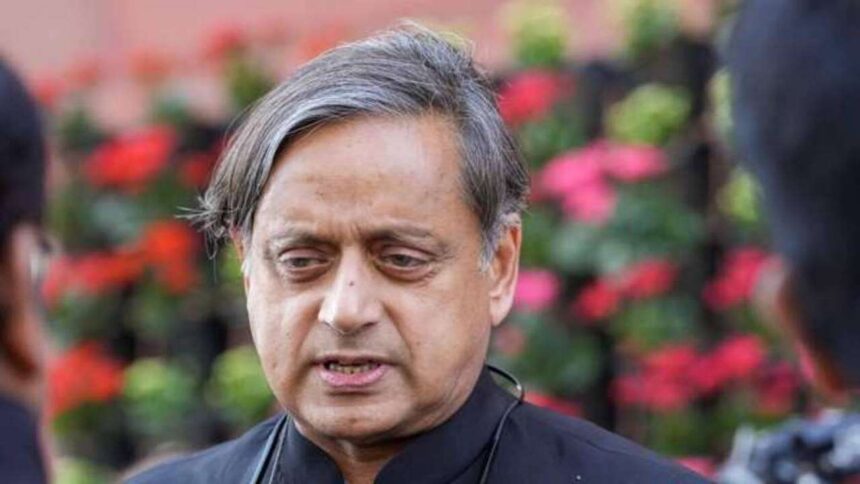
Senior Congress leader Shashi Tharoor has admitted to misjudging India’s stance on the Russia-Ukraine conflict, stating that he was left with “egg on his face” after initially opposing the country’s diplomatic approach. Shashi Tharoor, who had criticized India’s neutral position when the war began in 2022, now acknowledges that this strategy has strengthened India’s global standing, enabling it to play a constructive role in fostering peace.
Speaking at the Raisina Dialogue, Shashi Tharoor reflected on his past criticism, noting that he had called for India to condemn Russia’s aggression, citing violations of the United Nations Charter and the sovereignty of Ukraine. He argued that India had historically stood against the use of force to settle international disputes and had expected a stronger response in line with these principles. However, three years later, he admitted that India’s balanced approach has positioned it as a credible mediator.
Shashi Tharoor highlighted Prime Minister Narendra Modi’s diplomatic engagements, pointing out that he was able to meet both the Russian and Ukrainian presidents within weeks of each other, a testament to India’s acceptability in both camps. He remarked that very few countries hold the diplomatic leverage that India currently enjoys, allowing it to play a potential role in facilitating lasting peace between Russia and Ukraine.
India’s neutrality, according to Shashi Tharoor, is further reinforced by its geographical distance from Europe, enabling it to approach the conflict without the same geopolitical entanglements as Western nations. While clarifying that he was not speaking on behalf of the government, he suggested that India might consider deploying peacekeepers if a mutually agreed resolution between Russia and Ukraine were to emerge.
Shashi Tharoor also noted that Russia has explicitly ruled out accepting NATO peacekeepers, which means a solution would have to come from outside Europe. In this context, he speculated that India, with its extensive peacekeeping experience, could be a viable option. He recalled that India had previously rejected a request to send troops to Iraq in 2003, but suggested that Ukraine might not face the same level of domestic opposition if peacekeeping efforts were internationally supported.
With a track record of over 49 peacekeeping missions, India has established itself as a responsible global player committed to stability. Shashi Tharoor’s acknowledgment of India’s diplomatic prudence underscores the evolving geopolitical landscape and the country’s growing influence in international conflict resolution.