U.S. Secretary of State Marco Rubio is set to visit Israel early next week as tensions between Washington and Tehran remain high following inconclusive nuclear negotiations and a significant American military buildup in the Middle East. The visit comes amid mounting speculation about potential military action, heightened diplomatic maneuvering, and growing regional anxiety over the trajectory of U.S.-Iran relations.
The U.S. State Department confirmed that Rubio will travel to Israel on Monday and Tuesday for discussions on regional priorities, including Iran, Lebanon, and ongoing efforts related to President Donald Trump’s 20-Point Peace Plan for Gaza. The announcement followed a series of precautionary steps by the U.S. government, including authorizing the voluntary departure of non-essential embassy staff and their families from Israel. The timing of the trip has been widely interpreted as both a diplomatic engagement and a signal of continued coordination between Washington and Jerusalem at a sensitive moment.
The latest round of nuclear talks between the United States and Iran concluded in Geneva without a breakthrough, underscoring persistent gaps between the two sides. Technical discussions are scheduled to continue in Vienna, but neither side has announced concrete steps toward a comprehensive agreement. President Donald Trump has repeatedly warned that military action remains an option if Iran refuses to agree to a far-reaching nuclear deal. Tehran, for its part, maintains that its nuclear program is intended solely for peaceful purposes and insists on its right to enrich uranium under international law.
Diplomatic Pressure and Military Posturing Raise Regional Stakes
Rubio’s visit takes place against a backdrop of heightened military readiness in the region. The United States has assembled a substantial force presence in the Middle East, including an aircraft carrier already deployed and another en route. Additional warships and aircraft have reportedly been positioned to reinforce deterrence. Iran has responded with warnings that any American strike would trigger retaliation against U.S. forces stationed across the region, including bases in allied Arab states.
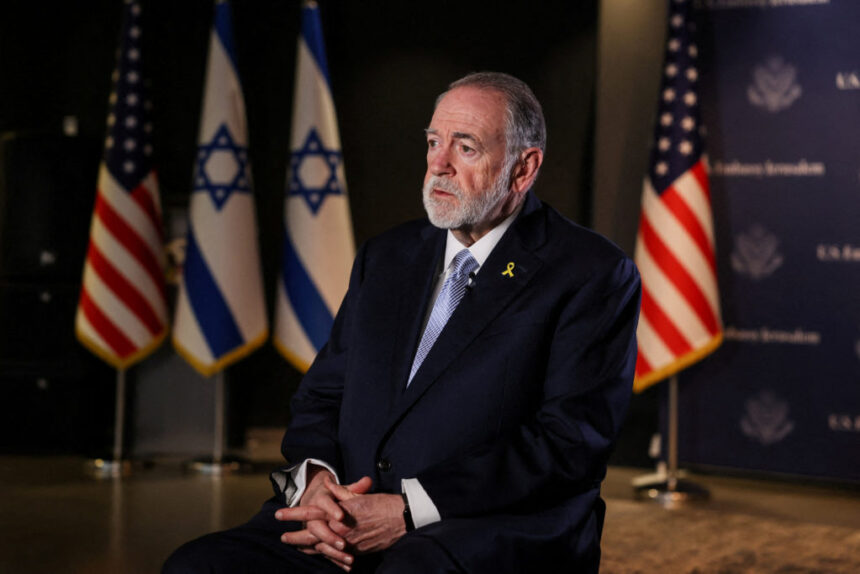
The U.S. Embassy in Jerusalem recently implemented authorized departure status for non-essential personnel and eligible family members, allowing them to leave voluntarily at government expense. In internal communications, U.S. Ambassador Mike Huckabee urged staff considering departure to act promptly, emphasizing uncertainty about outbound flight availability in the coming days. While the embassy continues operations, the measure reflects official concern about the evolving security environment.
The embassy’s advisory coincided with similar precautionary steps by other governments. Britain temporarily withdrew diplomatic staff from Iran, operating its embassy remotely due to security considerations. Australia directed the departure of dependents of officials posted to Israel, citing deteriorating conditions. China, India, and several European countries have advised their citizens to avoid travel to Iran, while China also urged nationals already there to leave.
Commercial airlines have begun adjusting operations in response to the uncertainty. Netherlands-based KLM announced plans to suspend flights from Tel Aviv’s Ben Gurion International Airport, while other carriers are reportedly reviewing their schedules. Such disruptions have added to public anxiety, particularly in Israel, where memories of past regional conflicts remain vivid.
Israeli Prime Minister Benjamin Netanyahu has long advocated for stronger action against Iran’s nuclear program, arguing that Tehran’s ambitions pose an existential threat to Israel. He has reiterated that Israel will respond decisively to any Iranian attack. Israel’s security establishment remains closely aligned with Washington in intelligence sharing and strategic planning, particularly regarding Iran’s nuclear activities and regional influence.
Amid the diplomatic and military maneuvering, Vice President JD Vance is scheduled to meet in Washington with Omani Foreign Minister Badr al-Busaidi, who has been serving as a mediator in the nuclear negotiations. Oman has historically played a quiet but influential role in facilitating dialogue between the United States and Iran. Though officials have described recent discussions as making “significant progress,” no formal agreement has emerged.
Iranian Foreign Minister Abbas Araghchi has stated that Tehran’s position has been clearly articulated but has refrained from detailing specific proposals. Iran continues to demand substantial sanctions relief in exchange for steps that would limit, though not completely dismantle, aspects of its nuclear program. Washington, meanwhile, seeks broader and more stringent restrictions, including long-term verification measures.
The stalled talks have fueled concerns that diplomacy may be running out of time. Analysts note that the presence of high-level American officials in the region, combined with the visible military buildup, could serve both as leverage in negotiations and as preparation for contingency scenarios.
Nuclear Oversight Concerns and Regional Fallout
Complicating the diplomatic landscape is a confidential report from the United Nations nuclear watchdog indicating that Iran has not granted inspectors access to certain sensitive sites since they were heavily bombed during a 12-day conflict launched by Israel last June. According to the report, inspectors have been unable to verify Iran’s claim that it halted uranium enrichment following U.S. and Israeli strikes. The document, circulated to member states, underscores the ongoing challenges in monitoring Iran’s nuclear activities.
The absence of inspector access raises critical questions about transparency and compliance. International monitoring mechanisms are designed to provide assurance that nuclear programs remain peaceful. Without direct inspection, confidence erodes, increasing suspicion and diplomatic friction. Tehran has argued that security concerns following the bombings have limited its ability to facilitate inspections, while critics contend that the restrictions hinder verification efforts.
Economic pressures inside Iran add another layer of complexity. Sanctions have severely strained the country’s economy, leading to rising prices for food and essential goods. The prospect of renewed conflict has intensified domestic uncertainty. Iranian officials have sought to portray resilience while warning that external aggression would be met with firm retaliation.
In Israel, public debate centers on security preparedness and the implications of potential escalation. Civil defense protocols have been reviewed, and security forces remain on heightened alert. The possibility of Iranian retaliation, whether direct or through allied groups in Lebanon and elsewhere, looms large in strategic calculations.
Rubio’s upcoming discussions in Israel are expected to address not only the nuclear file but also broader regional dynamics, including Lebanon’s stability and Gaza-related diplomatic initiatives. President Trump’s 20-Point Peace Plan for Gaza remains part of Washington’s broader Middle East agenda, though its implementation faces significant political and security hurdles.
Observers suggest that Rubio’s presence in Israel could serve multiple purposes: reinforcing diplomatic solidarity, coordinating contingency planning, and signaling commitment to Israel’s security. At the same time, the visit may indicate that Washington is still prioritizing diplomacy over immediate military action, given the importance of high-level consultations before any decisive steps.
The international community continues to watch developments closely. European governments have urged restraint and emphasized the need for a negotiated settlement. Global energy markets are sensitive to instability in the region, with any conflict threatening to disrupt supply routes and drive price volatility.
As negotiations prepare to resume in Vienna, uncertainty defines the moment. The interplay between diplomatic engagement, military readiness, and political rhetoric has created a precarious balance. Each side appears intent on demonstrating resolve while leaving space, however narrow, for a negotiated outcome.