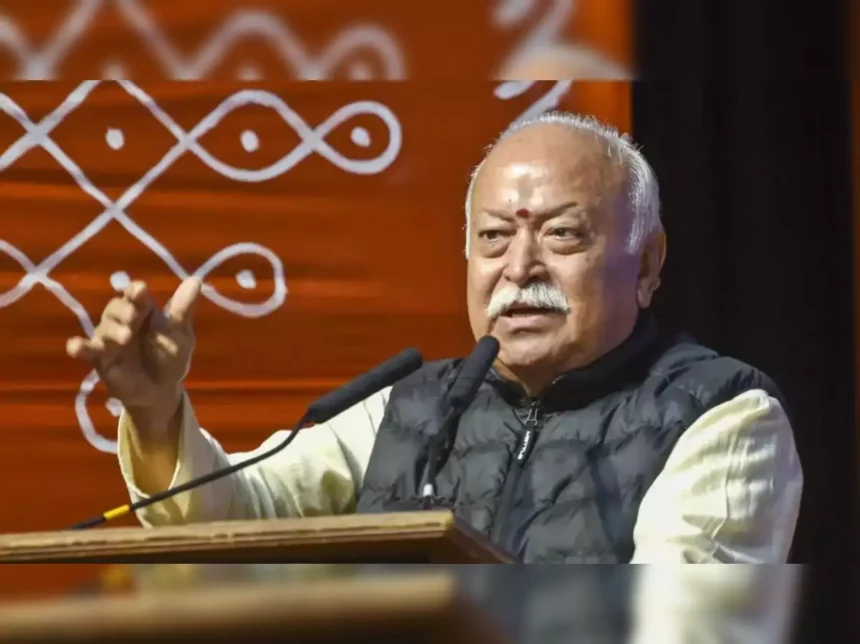
India’s unity and resilience have repeatedly defied predictions of fragmentation, and RSS chief Mohan Bhagwat emphasized this while addressing a gathering in Indore, Madhya Pradesh. Speaking at the launch of state minister Prahlad Singh Patel’s book, Parikrama Kripa Saar, Mohan Bhagwat recalled former British Prime Minister Winston Churchill’s remark that India would be unable to survive as a united nation after independence. According to Mohan Bhagwat, not only has India remained united, but it has also demonstrated remarkable progress and stability, proving skeptics wrong. His remarks resonated strongly with the audience, highlighting India’s unique cultural, spiritual, and philosophical foundations that have guided its development and cohesion over centuries.
Defying Predictions: India’s Historical and Spiritual Foundation
Addressing the gathering, Mohan Bhagwat said that after independence, many foreign observers, including Winston Churchill, had predicted India’s collapse due to its size, diversity, and complex social structure. “Winston Churchill once said that after independence, India would not survive and would be divided. However, this did not happen. Today, England itself faces internal divisions, but India remains united and continues to move forward,” he remarked. He stressed that India’s unity is rooted in its deep spiritual and cultural values, which have historically provided the cohesion necessary for a diverse society to thrive.
Mohan Bhagwat highlighted the Indian approach of balancing knowledge, action, and devotion, which he described as a foundational philosophy for sustaining progress. “India has continuously followed the path of development by adhering to the traditional philosophy of the balanced trinity of knowledge, action, and devotion, proving the predictions of collapse wrong,” he stated. He underlined that India’s strength lies not just in governance or economic policies, but in the spiritual and moral framework that binds its people together across regions, languages, and religions.
The RSS chief also drew attention to the world’s current state, where global conflicts are primarily driven by personal and nationalistic interests rather than collective well-being. He contrasted India’s approach with that of other nations, emphasizing that the country’s spiritual and ethical foundations have preserved its unity and fostered resilience. “While conflicts in the world arise from self-interest and competition, India’s spiritual heritage has sustained its unity,” he noted, stressing that the nation’s ability to remain cohesive despite external pressures is a testament to its enduring philosophical principles.
Cultural Reverence, Environmental Wisdom, and Modern Challenges
Mohan Bhagwat further elaborated on India’s unique cultural respect for nature and the environment, a principle that has endured for centuries. He explained that while much of the world has historically been driven by power and dominance, often disregarding ethical considerations, India’s spiritual worldview emphasizes harmony with the natural world. “The present world is craving for a relationship with nature similar to India’s. For the past 300–350 years, nations have been told that everyone is separate and only the strong will survive, trampling over others without consideration,” he remarked. By highlighting India’s spiritual and ethical engagement with the environment, he underlined that the country’s cultural practices offer a model for sustainable and balanced development.
Mohan Bhagwat’s address also stressed the broader societal cohesion that arises from India’s philosophical and spiritual roots. He suggested that unity is not merely a political or administrative achievement but an organic outcome of centuries of shared cultural values, religious tolerance, and social interdependence. These values, according to him, have enabled India to navigate internal and external challenges, preserving its sovereignty and social fabric while fostering economic and technological progress.
The RSS chief’s remarks were made in the context of the launch of Parikrama Kripa Saar, a book by Madhya Pradesh minister Prahlad Singh Patel. The book, inspired by Patel’s circumambulation journeys along the Narmada River, reflects on spiritual, cultural, and historical aspects of India, further emphasizing the importance of preserving traditional wisdom alongside modern development. Mohan Bhagwat connected the themes of the book to his larger narrative about India’s resilience and unity, asserting that national cohesion is reinforced when citizens remain connected to cultural and spiritual heritage.
The event in Indore was attended by Chief Minister Mohan Yadav, members of his cabinet, and citizens from various walks of life. Mohan Bhagwat’s address underscored the enduring relevance of India’s philosophical principles in contemporary governance and public life. He suggested that while material development is necessary, it must be guided by ethical and spiritual considerations to ensure lasting social harmony and national unity.
Highlighting historical examples, Mohan Bhagwat noted that India had faced multiple internal and external threats in the past but consistently managed to maintain its integrity due to its deeply rooted cultural and spiritual systems. He observed that the diversity of languages, religions, and ethnicities in India has often been cited as a potential source of division by foreign commentators, yet these very differences have been harmonized by shared values and a collective sense of purpose. He argued that India’s resilience comes from its ability to integrate diverse communities under a common framework of ethical, spiritual, and philosophical principles, ensuring unity without suppressing pluralism.
Mohan Bhagwat’s reflections on the global stage were particularly notable. He argued that while many nations continue to experience fragmentation, conflict, and competition driven by materialism and power politics, India’s approach remains distinctive. By integrating knowledge, action, and devotion, the country not only sustains unity but also promotes development that is inclusive and ethically grounded. He suggested that India’s example could serve as a model for other nations struggling with division and social unrest.
In his speech, Mohan Bhagwat also addressed the role of leadership and citizen participation in strengthening national unity. He emphasized that political leaders, social organizations, and citizens all have a responsibility to uphold India’s ethical and cultural values while advancing development objectives. This perspective aligns with his broader vision of a nation where governance, social cohesion, and cultural heritage are mutually reinforcing rather than conflicting priorities.
The RSS chief underscored that the preservation of India’s unity is an ongoing responsibility that requires vigilance, education, and engagement with the principles that have historically guided the nation. By nurturing a collective sense of identity rooted in spiritual and ethical traditions, India can continue to thrive in the face of global challenges, internal pressures, and evolving societal dynamics. He suggested that this holistic approach, combining development with ethical and spiritual grounding, represents the true path toward a strong, resilient, and united nation.
Mohan Bhagwat concluded his address by reaffirming India’s trajectory of progress, emphasizing that unity, cultural wisdom, and spiritual values are central to sustaining development and social cohesion. He highlighted that the nation’s capacity to integrate diverse communities, uphold ethical principles, and balance modernity with tradition ensures that India remains a unified, thriving, and forward-looking country. The RSS chief’s comments resonated with attendees, reinforcing the message that India’s unity is not accidental but the product of deliberate cultural, ethical, and spiritual foundations that continue to guide the nation.