The controversy surrounding football icon Lionel Messi’s Kolkata appearance has deepened after the arrested main organiser told investigators that the global star was unhappy with excessive physical contact during the event, prompting an early departure and triggering a wide-ranging probe into crowd control failures, access violations, and financial dealings linked to the programme.
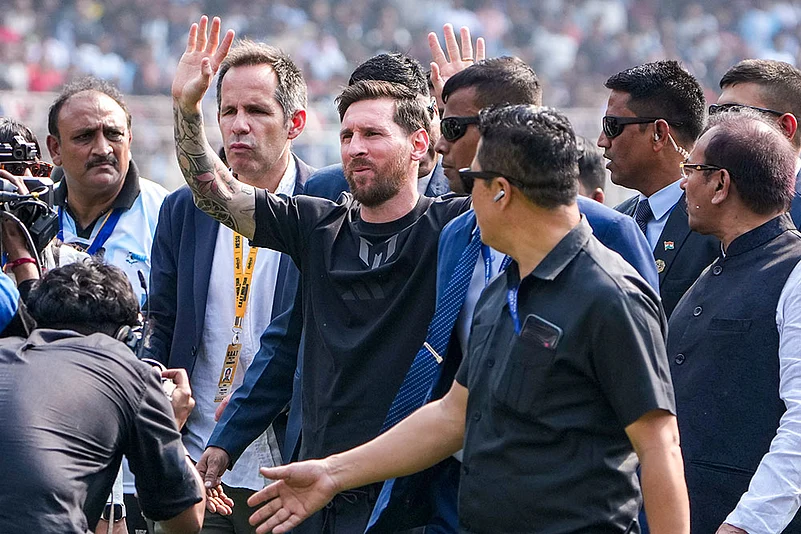
The revelation has emerged amid an ongoing investigation by a Special Investigation Team into the chaos that unfolded during Messi’s appearance at the Vivekananda Yuba Bharati Krirangan, commonly known as Salt Lake Stadium, during his GOAT India Tour. The event, initially billed as a carefully curated celebration of one of football’s greatest players, quickly spiralled into disorder as large numbers of people breached restricted areas, surrounding the footballer on the ground and severely disrupting the programme.
organiser’s statements and unfolding security concerns
Satadru Dutta, the main organiser of Messi’s Kolkata event who has since been arrested, told officers of the Special Investigation Team during prolonged questioning that the footballer was visibly uncomfortable with being touched or hugged during his brief appearance on the field. According to investigators, Dutta said Messi “did not like being touched on the back or being hugged,” a concern that had reportedly been communicated in advance by foreign security officials responsible for the player’s protection.
Despite repeated public announcements urging people to restrain themselves and maintain distance, the crowd’s behaviour reportedly remained unchanged. Investigators were told that Messi was quickly surrounded by individuals who breached security protocols, leaving him barely visible to spectators seated in the galleries. The organiser claimed that the manner in which the footballer was encircled and embraced was unacceptable to a World Cup-winning athlete accustomed to strict security norms at international events.
Dutta informed the SIT that because of the breakdown in crowd control and the failure to enforce restricted access, Messi chose not to remain at the venue for the full duration originally planned. The incident has raised serious questions about how event management, security agencies, and officials coordinated for a programme involving a global sports icon whose presence naturally attracts intense public attention.
Visuals from the event further added to the controversy, showing West Bengal Sports Minister Aroop Biswas in close proximity to Messi throughout the programme, including moments when he appeared to be holding the footballer around the waist while posing for photographs. The images circulated widely on social media, drawing criticism from fans and opposition leaders who accused the organisers and authorities of failing to maintain professional boundaries and security discipline.
Amid mounting political and public pressure, Aroop Biswas resigned from his post as sports minister pending completion of the investigation. The resignation has been viewed as a significant development, signalling the seriousness of the allegations and the potential accountability of senior officials in connection with the event’s mismanagement.
Investigators are also examining how such a large number of individuals gained access to the ground area, which was supposed to be tightly controlled. Dutta claimed that while only 150 ground passes were initially issued, the number was later tripled after a “very influential person” arrived at the stadium and overpowered him. According to the organiser, once this individual intervened, the entire flow-chart and security plan for the programme was disrupted, leaving him unable to manage the situation.
Police are probing whether the sudden expansion of ground access directly contributed to the collapse of crowd control measures. Officials believe that the dilution of access restrictions may have played a crucial role in allowing unauthorised individuals to get close to Messi, creating an unsafe and chaotic environment.
political fallout, financial trail, and SIT investigation
The incident has also sparked political fallout in West Bengal, with opposition leaders staging protests over what they describe as gross mismanagement of a high-profile international event. Leader of the Opposition in the state Assembly Suvendu Adhikari, along with several BJP MLAs, led a protest rally outside the Salt Lake Stadium, accusing the state government and organisers of failing to ensure security and proper planning during Messi’s visit.
The chaos at the venue left many ticket-paying spectators angry and disappointed. Thousands of fans had purchased high-priced tickets in the hope of seeing the football legend up close, but the disorder on the field meant that Messi was barely visible from the stands. The frustration later spilled over into vandalism at parts of the stadium, further escalating the situation and prompting the state government to constitute a Special Investigation Team to probe the incident comprehensively.
Beyond security lapses, the SIT is also scrutinising the financial aspects of Messi’s India tour. During questioning, Dutta disclosed details of the payments made to the footballer and the overall expenditure involved. He told investigators that Messi was paid ₹89 crore for the tour, while ₹11 crore was paid as tax to the Indian government, placing the total cost of the visit at ₹100 crore. According to sources, around 30 percent of this amount came from sponsors, while another 30 percent was generated through ticket sales.
The financial trail has become a key focus of the investigation after officers of the SIT found more than ₹20 crore in Dutta’s frozen bank accounts. During raids conducted at his residence, investigators seized several documents that are now being examined to verify the organiser’s claims regarding ticket sales, sponsorship receipts, and fund utilisation.
Dutta has reportedly claimed that the money in his bank accounts was generated from ticket sales for Messi’s events in Kolkata and Hyderabad, as well as from sponsors associated with the tour. Officials have said that these assertions are being carefully verified to determine whether there were any financial irregularities or violations of applicable laws.
The Special Investigation Team, comprising senior IPS officers, has been tasked with examining multiple aspects of the incident, including vandalism at the stadium, security failures, unauthorised access to restricted areas, and the role of organisers and officials. Investigators are also expected to assess whether standard operating procedures for high-profile international events were followed and whether warnings from foreign security personnel were adequately addressed.
As the probe continues, the revelations made by the arrested organiser have added a new layer to the controversy, shifting attention not only to crowd behaviour but also to planning, governance, and accountability. The episode has sparked a broader debate about how large-scale sporting and celebrity events are managed in India, especially when they involve global figures whose safety and dignity are paramount.