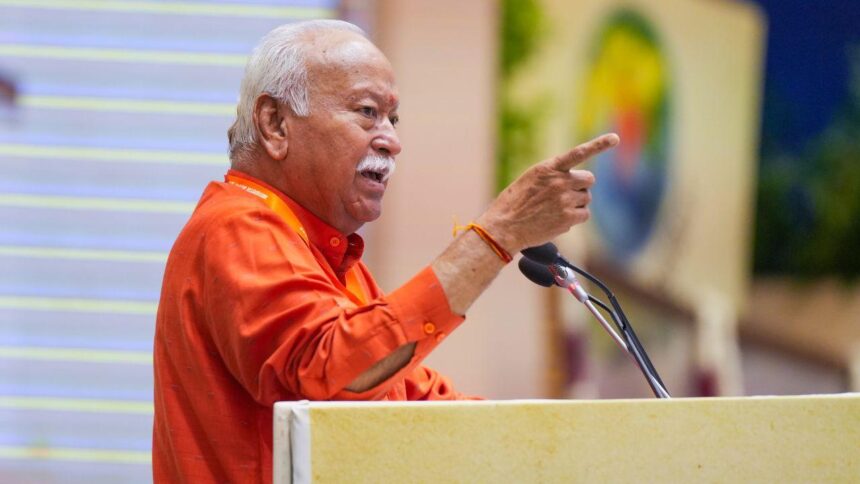
RSS chief Mohan Bhagwat has emphasized the importance of integrating Gurukul education into the mainstream education system during the centenary celebrations of the Rashtriya Swayamsevak Sangh. Addressing a large gathering, he clarified that Gurukul education is not about living in ashrams in isolation, but about understanding India’s cultural heritage, traditions, and historical knowledge. According to him, the 64 aspects of the Vedic era that are relevant in today’s context must be taught to students, while modern technology and contemporary education should complement rather than replace traditional learning methods. Mohan Bhagwat praised the recently introduced National Education Policy (NEP), describing it as a step in the right direction, capable of reviving the country’s long-neglected education system and instilling pride in Indian culture and achievements among students. Highlighting the necessity of understanding Sanskrit for accessing original texts and grasping India’s rich cultural past, Mohan Bhagwat urged the public to treat technology as a tool under human control rather than a dominating force, stressing that education must go beyond rote learning to nurture informed, responsible, and culturally aware citizens.
Integrating Gurukul Principles with Modern Education for Cultural and Academic Enrichment
During his speech, Mohan Bhagwat elaborated on the ways in which Gurukul education can coexist with mainstream education, drawing comparisons with the Finnish education system. He noted that in Finland, which consistently ranks among the top nations in global education, teacher training is conducted through specialized universities, and education up to the eighth grade is provided in students’ mother tongues. Similarly, the Gurukul model can be adapted for contemporary classrooms to ensure students are connected to their cultural roots while receiving modern academic knowledge. Mohan Bhagwat clarified that integration does not imply replacing mainstream schooling, but enriching it with traditional wisdom and Vedic knowledge, which would provide students with a holistic understanding of India’s historical and cultural narrative. By teaching relevant aspects of Vedic knowledge alongside modern science, mathematics, and technology, he argued that students would develop a well-rounded perspective, capable of appreciating the achievements of their ancestors while thriving in a contemporary global context. He stressed that such integration can instill pride in the youth, reinforcing the notion that Indian civilization has made significant contributions to human knowledge and development.
Mohan Bhagwat also touched upon the misconception that Gurukul education requires students to live in isolation or detach from modern society. He emphasized that this approach is about knowledge acquisition, character-building, and cultivating an appreciation for India’s traditions. He cited Finland as an example of a country successfully blending local cultural understanding with globally relevant education, arguing that India could similarly create a system that respects cultural roots while embracing scientific innovation. Additionally, Mohan Bhagwat highlighted that modern education, technological literacy, and English language skills are essential tools that, when combined with traditional knowledge, can produce capable, adaptable, and culturally grounded citizens. He noted that technology should be under human control, not the other way around, and its effective use depends on the educational foundation of the people employing it.
National Education Policy and the Revival of Indian Knowledge Systems
Mohan Bhagwat praised the National Education Policy as a transformative initiative aimed at correcting decades of systemic neglect in the Indian education system, which, he argued, had been designed by colonial rulers to maintain control rather than develop intellectual or cultural capabilities. According to him, India’s historical educational models were dismantled, and knowledge systems suppressed, leaving students disconnected from their cultural heritage. The NEP, he stated, is a corrective measure that seeks to provide students with both contemporary academic skills and a thorough understanding of India’s traditions and history. Mohan Bhagwat emphasized that knowledge of Sanskrit is crucial to access original texts and understand Indian philosophy, sciences, and literature without relying on translations, which may contain inaccuracies. Understanding Sanskrit, he said, allows students to connect with India’s intellectual heritage and gain insights that are vital for informed citizenship and cultural pride.
He also underscored the importance of imparting knowledge about India’s past to instill self-confidence and a sense of national pride among students. Mohan Bhagwat emphasized that education should not merely focus on memorization but should foster analytical thinking, ethical understanding, and human development. By connecting Gurukul principles with contemporary schooling and the NEP’s vision, students can acquire the tools needed to navigate modern challenges while remaining rooted in their cultural identity. The integration of traditional knowledge and modern technology, according to him, is key to producing a generation capable of harnessing innovation while preserving national heritage.
The RSS chief further elaborated on the significance of balancing modern technological advancements with cultural awareness. He cautioned that technology, when misused or left in the hands of the uneducated, can have adverse effects. Therefore, education must equip citizens not only with skills but with values, judgment, and cultural literacy. While he expressed no opposition to English language learning, he insisted that it should complement rather than replace understanding of India’s traditions. Mohan Bhagwat’s vision encompasses an education system that respects the past, embraces the present, and equips students to face future challenges effectively.
Mohan Bhagwat’s remarks reflect the RSS’s broader philosophy of education, which seeks to integrate moral and ethical values, traditional knowledge, and modern scientific learning. By promoting the Gurukul system alongside contemporary education, the objective is to create an environment where students are culturally grounded, technologically competent, and capable of contributing positively to society. The NEP’s reforms, in his view, provide a framework for achieving this integration, ensuring that India’s educational policies align with both global standards and indigenous knowledge systems.
Throughout his address, Mohan Bhagwat highlighted the transformative potential of merging Gurukul education with the mainstream curriculum. He described this approach as a means to revitalize the education system, encourage critical thinking, and reinforce India’s cultural identity among students. By integrating relevant Vedic knowledge with modern pedagogy, the education system can produce citizens who are proud of their heritage, ethically responsible, and capable of leveraging contemporary tools for national development. Mohan Bhagwat stressed that such an educational philosophy requires collaboration between policymakers, educators, and communities to ensure that the values of the past inform the learning of the future, creating a generation that is both knowledgeable and culturally rooted.
In addition to curriculum integration, Mohan Bhagwat also emphasized the need for administrative reforms and policy measures to support this vision. He suggested that teacher training, resource development, and innovative pedagogy are essential to successfully implement the integration of Gurukul education into mainstream schools. By equipping educators with both traditional knowledge and modern teaching skills, the system can ensure that students receive a balanced education that promotes both intellectual growth and cultural awareness. The alignment of administrative mechanisms with educational reforms, he noted, is vital for the sustainability and effectiveness of this integrated approach.
Mohan Bhagwat’s statements further underlined the RSS’s long-term vision for education in India: one that harmonizes cultural heritage, ethical values, and technological proficiency. He advocated for a system where students are aware of their historical roots, capable of critical reasoning, and equipped to contribute meaningfully to society and the nation. His emphasis on the NEP reflects a recognition of the need for systemic change, moving beyond rote learning toward a more holistic educational model that nurtures human potential and cultural literacy. By doing so, India can cultivate citizens who are competent, confident, and rooted in their heritage while being prepared for the challenges of the modern world.
The address also touched upon global best practices, emphasizing the need to adapt successful educational models like Finland’s while contextualizing them within India’s cultural framework. Mohan Bhagwat argued that such an approach ensures students benefit from global advancements without losing sight of their cultural identity. The integration of traditional knowledge, modern pedagogy, and technology, he stated, is the cornerstone of a progressive, inclusive, and forward-looking education system.
By advocating for the inclusion of 64 relevant aspects of Vedic knowledge in the mainstream curriculum, Mohan Bhagwat emphasized the depth and richness of India’s educational heritage. He highlighted the importance of teaching students about the country’s achievements, values, and contributions to human knowledge, thereby fostering a sense of pride and responsibility. This integration, when implemented alongside contemporary education, has the potential to produce well-rounded individuals who are both globally competent and culturally aware.
RSS chief Mohan Bhagwat’s address represents a vision of education that seeks to reconcile India’s rich past with its aspirations for the future. By blending Gurukul principles, Sanskrit learning, modern technology, and contemporary pedagogy, he outlined a comprehensive approach to building a resilient, culturally grounded, and innovation-driven education system. The National Education Policy, in this framework, serves as a vehicle for implementing these reforms, ensuring that India’s youth are prepared for the challenges and opportunities of the 21st century while remaining connected to their heritage and values.
The vision articulated by Mohan Bhagwat underscores the belief that education should serve as a means to develop informed, responsible, and culturally literate citizens who can navigate modern complexities while honoring India’s historical and philosophical traditions. This approach advocates a balanced integration of traditional and modern knowledge, aiming to produce individuals capable of leadership, innovation, and ethical decision-making. By highlighting the relevance of Gurukul education, the importance of Sanskrit, and the potential of the NEP, Mohan Bhagwat presented a roadmap for a transformative educational paradigm that bridges India’s past, present, and future.
The integration of traditional Gurukul teachings with modern curricula, according to Mohan Bhagwat, is not merely an educational reform but a strategic investment in India’s future. He emphasized that nurturing pride in India’s cultural achievements, fostering ethical values, and equipping students with technological competence are interdependent goals that can collectively strengthen the nation. By promoting holistic education through the NEP and supporting initiatives that link Gurukul principles with contemporary schooling, Mohan Bhagwat articulated a comprehensive vision for cultivating an enlightened, capable, and culturally grounded generation of Indians.
Education, as articulated by Mohan Bhagwat, must not only convey information but also develop critical thinking, ethical reasoning, and an understanding of India’s cultural identity. By combining Gurukul teachings, modern pedagogy, and technological literacy, the proposed system aims to produce citizens who are adaptable, responsible, and deeply aware of their heritage. The NEP, in this context, provides a platform for implementing these changes, ensuring that India’s education system evolves in a manner that is both globally competitive and culturally rooted.
This vision reflects the RSS’s ongoing commitment to revitalizing India’s educational landscape, bridging historical knowledge and modern competencies to prepare students for the challenges and opportunities of the contemporary world. Mohan Bhagwat’s remarks offer a detailed framework for integrating traditional values with innovative educational practices, emphasizing the importance of teacher training, curriculum design, and student-centered learning. The approach seeks to cultivate well-rounded individuals capable of contributing meaningfully to society while maintaining a strong sense of national identity and cultural pride.
By emphasizing the need to teach relevant Vedic aspects, foster Sanskrit literacy, integrate Gurukul principles, and complement them with modern education and technology, Mohan Bhagwat outlined a roadmap for a comprehensive transformation of India’s educational system. The ultimate goal, as he described, is to produce culturally grounded, ethically informed, and intellectually competent citizens who can navigate the complexities of the modern world while remaining rooted in India’s rich heritage.