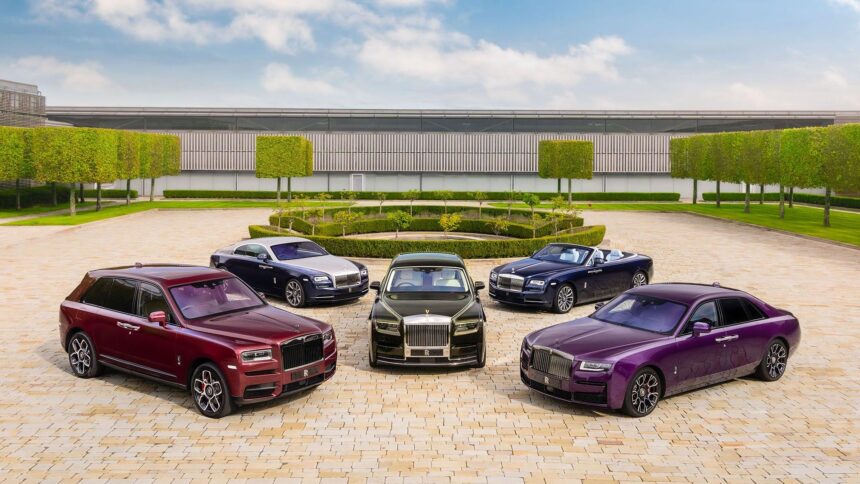
Luxury automaker Rolls-Royce has announced a £300 million investment to expand its Goodwood factory and global headquarters, aiming to meet the increasing demand for highly customised vehicles. The British brand, now fully controlled by German carmaker BMW since 2003, seeks to boost production of its bespoke cars, which have become a symbol of wealth and exclusivity among the super-rich clientele.
The expansion of Rolls-Royce’s manufacturing facility in West Sussex, where the company has operated since 2003, marks a pivotal move to secure the brand’s future in the UK and respond to the growing trend of personalised luxury vehicles. The company is set to increase the production of its bespoke models, which are renowned for their extraordinary customisation options that include rare materials, intricate detailing, and exclusive features. Rolls-Royce’s Chief Executive, Chris Brownridge, described this investment as “our most substantial financial commitment to Goodwood since its opening,” emphasizing that it reflects a significant vote of confidence in the Rolls-Royce marque.
Despite producing a relatively small number of cars, Rolls-Royce operates in an ultra-rarefied market where high-end luxury is synonymous with exclusivity. In 2024, Rolls-Royce sold 5,712 cars, the third-highest sales figure in the brand’s history. While this number might seem modest compared to mass-market manufacturers, Rolls-Royce’s appeal lies in its ability to craft cars that cater to a very select group of customers willing to pay extraordinary amounts for a truly one-of-a-kind automobile.
The prices for Rolls-Royce models are among the highest in the automotive industry. While the company does not publicly disclose exact prices, industry estimates suggest that the brand’s most affordable model, the Ghost saloon, starts at around £250,000, with more exclusive models such as the Cullinan sports utility vehicle and the electric Spectre retailing from approximately £340,000. By comparison, the average price of a house in the UK was £297,000 last year, highlighting the level of wealth required to purchase a Rolls-Royce.
For many of Rolls-Royce’s affluent customers, simply owning a luxury car is no longer enough. As the demand for bespoke, highly-customised vehicles continues to rise, the brand has focused on offering exceptional personalisation options. The bespoke models are often adorned with rare and luxurious materials, such as holographic paint, one-off artworks, and intricate hand-stitched embroidery. For example, one of Rolls-Royce’s bespoke creations was designed as a tribute to the 1964 James Bond film Goldfinger, incorporating solid 18-carat gold features. This level of customisation not only adds to the exclusivity of the brand but also significantly increases the final price, with some bespoke creations reaching several times the base cost of the vehicle.
Celebrities and high-profile individuals are among the few who can afford such extravagant vehicles. Stars like Kim Kardashian, Nicki Minaj, and British rapper Stormzy, who was banned from driving his Wraith after using a mobile phone behind the wheel, are known to own Rolls-Royce cars. Their willingness to flaunt their wealth has helped maintain the allure of the brand among the ultra-wealthy.
As the luxury carmaker focuses on high-end customisation, the challenge lies in maintaining a balance between bespoke craftsmanship and the ongoing shift toward electric vehicles. Rolls-Royce is preparing for the transition to an all-electric future, which necessitates further investment in research, development, and manufacturing infrastructure. The expansion of the Goodwood factory will provide the space required to support these increasingly complex bespoke projects, while also preparing the facility for the brand’s electric vehicle transition.
The expansion plan includes increasing production capacity to accommodate not only more bespoke orders but also the growing demand for electric vehicles. Rolls-Royce has already received planning permission for the extension, which will enable the company to further scale up its operations. The Goodwood facility, which originally housed 300 workers, now employs over 2,500 people. The company’s emphasis on high-quality craftsmanship and attention to detail ensures that each vehicle meets the precise specifications of its wealthy clients, with many of the cars requiring extensive handwork and long production times.
As Rolls-Royce moves forward with its expansion, it faces the challenge of maintaining its position in an increasingly competitive luxury car market. Other high-end manufacturers, such as Bentley, McLaren, and Ferrari, also offer bespoke services, which means Rolls-Royce must continue to innovate and provide its clients with unparalleled exclusivity. However, unlike these competitors, Rolls-Royce is insulated from many of the challenges currently affecting the broader European motor industry, thanks to its focus on export markets and high-net-worth individuals.
Nonetheless, Rolls-Royce has not been immune to the decline in demand from China, one of its largest markets. In response to this downturn, the company has focused on expanding its bespoke offerings as a way to mitigate the impact of the drop in demand. Brownridge recently stated that rising demand for personalised vehicles has helped offset the decline in sales from China, suggesting that customisation is a key driver of the brand’s success in difficult times.
This announcement from Rolls-Royce comes on the heels of similar news from Jaguar, another iconic British brand, which recently revealed plans to relaunch as an all-electric marque and move further upmarket. Jaguar’s decision to shift towards electric vehicles, combined with a dramatic redesign and a new marketing strategy, sparked significant controversy, particularly on social media.
For Rolls-Royce, the future lies in its ability to continue offering exceptional, tailor-made vehicles while embracing the shift towards electric mobility. As the brand continues to expand its Goodwood factory, it is clear that the demand for bespoke cars remains strong among the ultra-wealthy, and Rolls-Royce is committed to maintaining its position as the leading luxury carmaker in the world. The expansion represents not only a commitment to craftsmanship and exclusivity but also a bold step towards ensuring the brand’s future in an evolving automotive landscape.