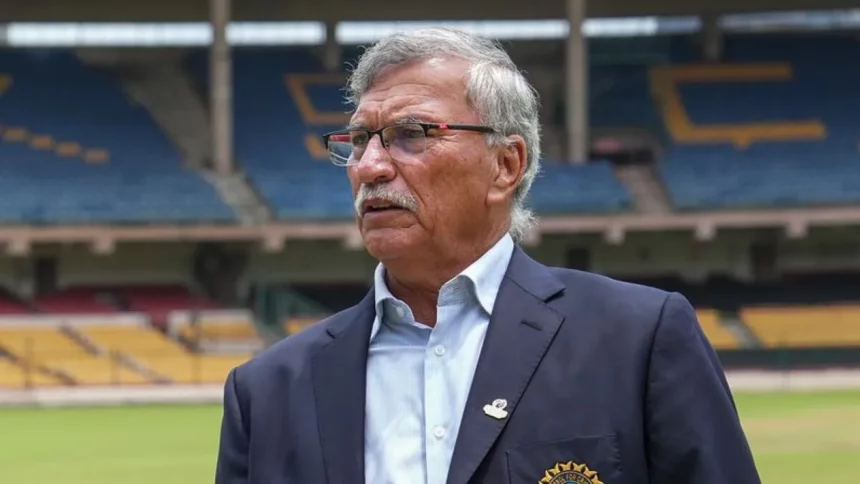
Roger Binny, president of the Board of Control for Cricket in India (BCCI), has found himself at a crossroads just days after turning 70, with constitutional limits technically disqualifying him from continuing in the role while a proposed National Sports Bill in Parliament could offer a possible extension of his tenure. As discussions swirl within the BCCI’s corridors, the board’s leadership finds itself navigating legal, procedural, and sentimental arguments over who should lead Indian cricket next, even as Roger Binny himself remains silent, vacationing in Thailand.
Roger Binny, who took over as BCCI president in October 2022, celebrated his 70th birthday on July 19, triggering the age-limit clause approved by the Supreme Court under the BCCI constitution that disqualifies any office-bearer upon turning 70. While this rule is clear on paper, practical confusion has engulfed the board, with discussions underway about whether Roger Binny should continue in a caretaker capacity until the Annual General Meeting (AGM) in September, or whether vice-president Rajeev Shukla should be appointed interim president in the meantime.
Proposed Sports Bill Could Alter BCCI’s Leadership Equation
Amid this uncertainty, the proposed National Sports Bill, set to be tabled in Parliament during the ongoing Monsoon Session by Union Sports Minister Mansukh Mandaviya, has emerged as a potential game-changer. The bill aims to increase the upper age limit for office-bearers of national sports federations from 70 to 75, allowing individuals aged between 70 and 75 to contest elections and hold office unless prevented by international charters or the concerned body’s by-laws.
If passed, this legislation could enable Roger Binny to continue as BCCI president, provided there is no conflicting age cap under the International Cricket Council (ICC), which currently has no such provision restricting age for its members. A PTI report suggests that Roger Binny plans to consult BCCI secretary Devajit Saikia and the board’s legal department to clarify his standing in light of the proposed bill, the existing constitution, and the timing of any changes that Parliament may approve.
The bill’s draft also clarifies that if a person aged 69 years and 364 days is elected, they can serve a full term beyond the age of 70 once the bill takes effect. Although Roger Binny turned 70 last Saturday, there are indications that if the bill passes without amendments restricting retroactive application, he could potentially continue for at least another three years, possibly even five, subject to legal interpretations.
The BCCI has yet to issue an official statement on the matter. Top officials recently returned from the ICC Annual Conference in Singapore, and internal discussions have reportedly weighed the pros and cons of having Shukla step in temporarily or waiting for the Sports Bill to clear Parliament, allowing Roger Binny to continue uninterrupted.
Sentiment Favors a Cricketer President
Beyond legal interpretations and parliamentary developments, there is a prevailing sentiment within the BCCI that the president’s role should ideally remain with a former India cricketer, as was the case with Sourav Ganguly and Roger Binny. This preference is seen as crucial for maintaining the board’s public credibility and sporting vision, with the belief that a cricketer at the helm understands the players’ needs and the game’s requirements better than a purely administrative leader.
This sentiment could play a role in the final decision on Roger Binny’s future, especially given the board’s history and the larger optics associated with BCCI leadership. While Rajeev Shukla has extensive administrative and political experience within cricket governance, he is not a former player, and his interim leadership could be seen as a departure from the current precedent unless explicitly positioned as a stop-gap until the Sports Bill clears legal hurdles.
Adding another layer to the complexity, the BCCI’s unique status as an autonomous body not reliant on government grants while being recognized under the National Sports Federation (NSF) framework means that the National Sports Bill, once enacted, would likely apply to its functioning. This would bring the BCCI further within the purview of sports governance norms, potentially overriding parts of its existing constitution that limit office-bearers’ age.
Roger Binny, who recently returned from the Lord’s Test in London before leaving for a family vacation in Thailand, has yet to make any public comment regarding his future. Sources close to him indicate that he will engage with Devajit Saikia and legal advisors upon his return to evaluate the timing of the Sports Bill, potential legal options, and his desire to continue in the role amidst mounting speculation.
As the BCCI heads towards its AGM in September, the uncertainty around the presidency has generated a buzz within Indian cricket, with stakeholders monitoring Parliament’s proceedings closely. Whether Roger Binny steps aside immediately, remains as a caretaker president, or returns with a renewed mandate post-bill passage could shape the leadership narrative in Indian cricket in the coming months, setting precedents for the governance of sports bodies across the country.