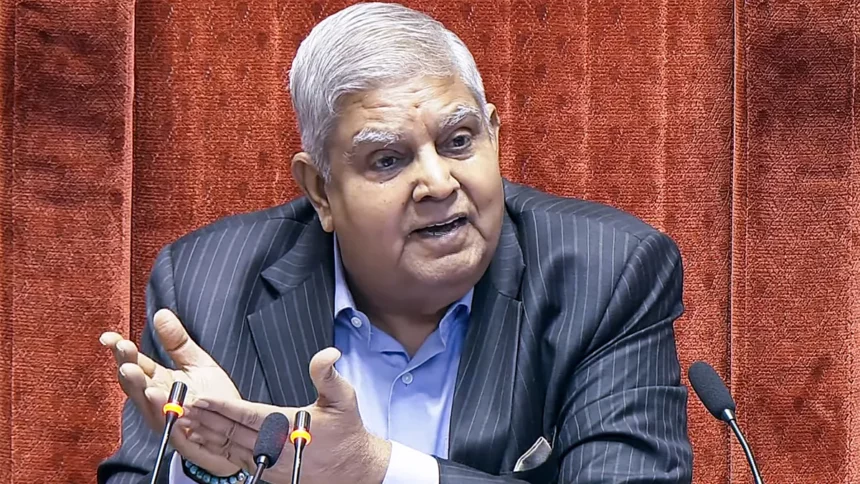
The sudden resignation of Vice President Jagdeep Dhankhar has triggered a political storm across India, with opposition leaders openly questioning the official explanation of “health reasons” behind his exit and speculating on deeper political motives. While the ruling BJP appeared unprepared for the late-night move, the opposition, including the Congress, has urged Prime Minister Narendra Modi to persuade Jagdeep Dhankhar to reconsider, citing the timing and pressing national issues requiring his presence in the Rajya Sabha.
At 74, Jagdeep Dhankhar had nearly two years left in his term after assuming office in August 2022. Known for his assertive approach and frequent clashes with the opposition, his resignation came on a day he had chaired proceedings in the Rajya Sabha, without showing any signs of visible discomfort. His letter to President Droupadi Murmu cited the need to “prioritise healthcare,” but this has done little to quiet the undercurrents of suspicion within political circles about the timing and reasons for his departure.
Opposition Raises Questions Over Timing and Motives
Several opposition leaders, including those from the Congress and JMM, expressed shock, calling the resignation both unexpected and concerning. Congress MP Mallu Ravi noted that Jagdeep Dhankhar had conducted the two-day Rajya Sabha session efficiently, showing no visible signs of ill health, and argued that the resignation may reflect “political ill-health” rather than physical discomfort, especially given its timing ahead of the Bihar elections.
Congress leader Udit Raj also questioned the timing, referencing critical matters like Operation Sindoor and issues surrounding Bihar’s voter list that required Jagdeep Dhankhar’s presence. JMM MP Mahua Maji told ANI that the opposition was caught off guard, stating, “There are speculations that there may be another reason behind it… We all want him to reconsider.”
Danish Ali from Congress suggested that the resignation could be linked to “political motives,” with some circles hinting at theories that it was intended to pressure Prime Minister Modi to resign before turning 75. Anish Gawande of NCP (SP) highlighted the significance of the move, pointing out that Jagdeep Dhankhar is only the third Vice President in India’s history to resign, with the previous two going on to become Presidents, raising further questions about the intent and implications of this resignation.
The sudden nature of the move, combined with Jagdeep Dhankhar’s active presence in the Rajya Sabha until hours before his resignation, has created a narrative of suspicion within the opposition, which believes that the move may have been orchestrated to manage political outcomes, particularly with elections on the horizon.
Congress Appeals to PM Modi to Persuade Jagdeep Dhankhar
Congress general secretary Jairam Ramesh described the resignation as “shocking and inexplicable,” noting that Jagdeep Dhankhar was scheduled to hold a Business Advisory Committee meeting and make key announcements related to the judiciary the following day. While acknowledging that health concerns must take priority, Ramesh added, “There is clearly far more to this totally unexpected resignation than meets the eye.”
The Congress officially appealed to Prime Minister Modi to convince Jagdeep Dhankhar to reconsider, stating that it would be in the nation’s interest for him to continue, particularly as his presence would bring relief to farmers, who regarded him as an advocate of their rights.
Other opposition leaders, while expressing personal concern for Jagdeep Dhankhar’s health, echoed the sentiment that the resignation raised more questions than answers. AIMIM leader Waris Pathan offered prayers for Jagdeep Dhankhar’s health, while CPI MP P Sandosh Kumar described the resignation as “quite unexpected” and suggested it might stem from dissatisfaction with certain developments within the government.
Senior leaders also shared personal reactions beyond the political speculations. Rajya Sabha MP Kapil Sibal expressed sadness, citing a long-standing relationship of over 30 years with Jagdeep Dhankhar, whom he described as a nationalist who wished to see the government and opposition work together to enhance India’s global standing. P Chidambaram extended his wishes for Jagdeep Dhankhar’s good health and long life, underscoring the respect Jagdeep Dhankhar commanded across party lines despite ideological differences.
The resignation of Jagdeep Dhankhar, arriving without prior signals on a politically sensitive evening, has left both Parliament and political observers grappling with its timing and intent. It comes at a time when the Rajya Sabha is set to take up key bills, and the government, as well as the opposition, will now have to navigate parliamentary proceedings without a full-time Vice President presiding over debates, until a new election is held under constitutional mandate.
As discussions continue, Jagdeep Dhankhar’s departure has highlighted the fragile balance of political power within India’s parliamentary system, reminding all parties of the importance of leadership continuity even as the nation moves towards an election season, with the underlying tensions between governance and politics coming to the forefront once again.