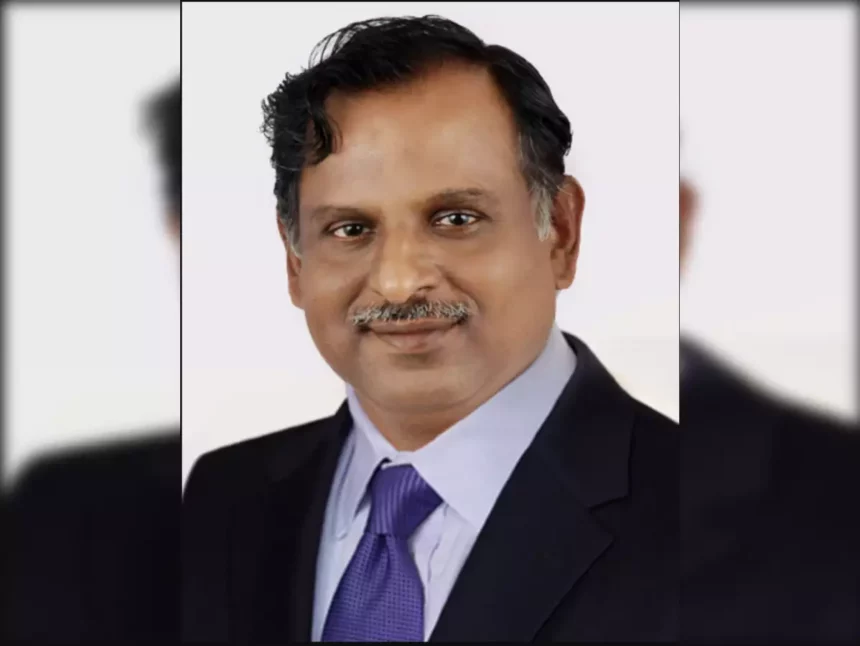
Rocket scientist V Narayanan is set to take over as the new chief of the Indian Space Research Organisation (ISRO) on January 14, succeeding S Somanath. His appointment was announced by the Appointments Committee of the Cabinet, and the announcement has been met with great anticipation within the scientific and space research community. Rocket scientist V Narayanan’s elevation to this prestigious position comes after a remarkable career in both academia and ISRO, where his contributions have significantly advanced India’s space and propulsion technologies.
Rocket scientist V Narayanan, an alumnus of the Indian Institute of Technology (IIT) Kharagpur, has an extensive academic background. He completed his M Tech in Cryogenic Engineering and a PhD in Aerospace Engineering from IIT Kharagpur, where his academic prowess was recognized with a Silver Medal for securing the first rank in his M Tech program. His academic qualifications laid a strong foundation for his illustrious career, making him a standout figure in India’s space community.
His journey with ISRO began in 1984, when he joined the organization and began his work in the development of solid propulsion systems. His expertise in rocket and spacecraft propulsion would soon take him to greater heights. Rocket scientist V Narayanan made notable contributions to various key projects, including Sounding Rockets and the Augmented Satellite Launch Vehicle (ASLV) and Polar Satellite Launch Vehicle (PSLV) at the Vikram Sarabhai Space Centre (VSSC). His work in these areas played a crucial role in India’s space missions, particularly in launching satellites into orbit.
One of Rocket scientist V Narayanan’s most significant achievements came with the development of the cryogenic engine, a technology that India had long been denied access to. His work in this field allowed India to develop the necessary technology to build advanced rockets, significantly reducing the country’s dependence on foreign technology for launching satellites and space missions. This breakthrough in cryogenic engine development marked a turning point in India’s space ambitions and helped strengthen ISRO’s global standing.
In addition to his work in propulsion systems, Rocket scientist V Narayanan also contributed to the design and development of ablative nozzle systems, composite motor cases, and composite igniter cases. His contributions in process planning, process control, and the realization of these complex systems further enhanced India’s space capabilities and propelled ISRO’s growth.
Rocket scientist V Narayanan’s leadership and problem-solving skills were also showcased when he headed the Failure Analysis Committee for the Chandrayaan-2 mission. The mission, which initially faced setbacks with the Vikram Lander crash-landing, was later a resounding success with the Chandrayaan-3 mission. Rocket scientist V Narayanan’s insights into the issues that caused the failure of Chandrayaan-2 were instrumental in overcoming challenges, paving the way for the successful landing of Vikram on the Shiv Shakti Point during Chandrayaan-3.
Since 2018, Rocket scientist V Narayanan has been the head of the Liquid Propulsion Systems Centre (LPSC) in Kerala’s Valiamala, where he has overseen the development of liquid, semi-cryogenic, and cryogenic propulsion stages for ISRO’s launch vehicles. Under his leadership, the LPSC has also focused on the development of propulsion systems for satellites and transducer technologies for space systems health monitoring.
Rocket scientist V Narayanan’s career trajectory at ISRO has earned him the distinguished position of an APEX Scale scientist and the senior-most director within the organization. His responsibilities have extended beyond technical roles to include leadership in project management and space transportation systems. He serves as the Chairman of the Project Management Council-Space Transportation System (PMC-STS), a decision-making body overseeing all launch vehicle projects and programs.
Additionally, Rocket scientist V Narayanan plays a key role in India’s human spaceflight ambitions as the Chairman of the National Level Human Rated Certification Board (HRCB) for Gaganyaan, India’s planned human spaceflight mission. His expertise in both space propulsion systems and human-rated spaceflight positions him as a central figure in ensuring the success of India’s first crewed space mission.
As he takes on the mantle of ISRO’s chief, Rocket scientist V Narayanan has expressed his vision for the organization, emphasizing India’s clear roadmap for future space endeavors. He remains optimistic about ISRO’s ability to achieve even greater success, citing the immense talent within the organization as a key driver of progress. His two-year tenure as ISRO chief will be crucial in determining the trajectory of India’s space programs and exploring new frontiers in space exploration.
Rocket scientist V Narayanan’s appointment as ISRO chief marks the beginning of an exciting new chapter for India’s space program. His leadership, technical expertise, and commitment to innovation are expected to guide ISRO to even greater achievements, continuing India’s remarkable space journey on the global stage. With his deep understanding of rocket propulsion and space systems, Rocket scientist V Narayanan is well-positioned to take ISRO to new heights, ensuring its place at the forefront of global space exploration.