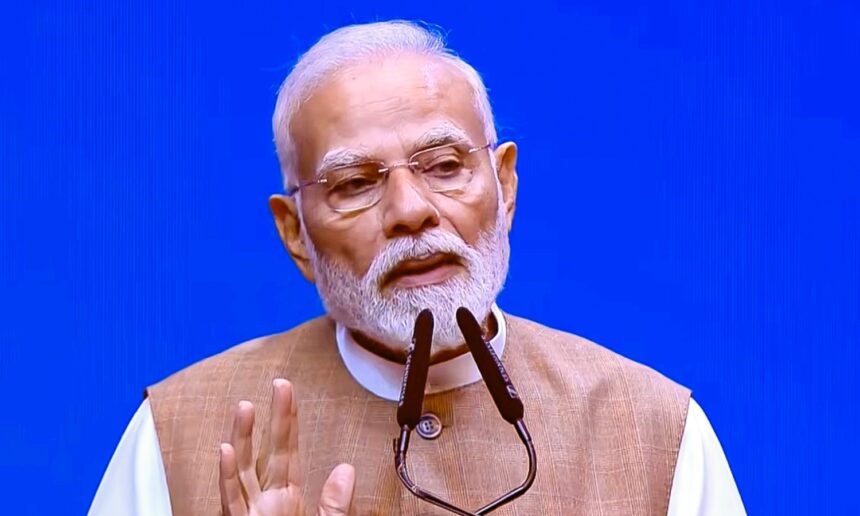
Prime Minister Narendra Modi’s three-day visit to South Africa for the G20 Summit in Johannesburg marks a defining moment in India’s evolving global leadership. This is the first time the G20 Summit is being hosted on African soil, making it a historic gathering that symbolizes the growing influence of the Global South in international affairs. Modi has stated that he will present India’s perspective aligned with the enduring philosophy of “Vasudhaiva Kutumbakam” and the expanded vision of “One Earth, One Family, One Future.” At a time when global politics is witnessing strategic shifts, economic fragility, climate-related upheavals, and competitive realignments, India’s presence at this summit is seen as both symbolic and substantive, underscoring its commitment to inclusive development, multilateralism, sustainability, and international cooperation.
India’s Vision for the G20, Modi’s Broader Agenda, and the Significance of the Summit in Africa
Prime Minister Modi emphasized, before departing for Johannesburg, that the G20 Summit holds unique importance as it convenes for the first time in Africa. This comes immediately after India’s highly impactful G20 Presidency in 2023, during which the African Union was inducted as a permanent member of the group—an achievement widely praised as a diplomatic milestone that significantly elevated the representation of the Global South.
Modi’s visit to South Africa is in response to the invitation extended by President Cyril Ramaphosa, who is presiding over the 20th G20 Leaders’ Summit under South Africa’s presidency. This geographical shift to Africa is not merely symbolic but represents a conscious recognition of the continent’s centrality to the future of global development, climate action, political cooperation, and economic growth.
Upon arriving in Johannesburg, Modi is expected to engage in a series of bilateral meetings with several heads of state and government present at the summit. These interactions are aimed at strengthening India’s collaboration across Asia, Africa, Europe, and Latin America. India is also expected to leverage its strategic partnerships to push forward discussions on critical global challenges that require coordinated multi-country efforts.
Modi will additionally participate in the sixth IBSA Summit—a trilateral dialogue platform involving India, Brazil, and South Africa. IBSA remains a unique grouping of three major democracies from the Global South that cooperate on governance, development, and international coordination. Modi’s presence at this forum aligns with India’s commitment to South-South cooperation, which remains a cornerstone of its foreign policy.
Another notable aspect of the visit is Modi’s scheduled interaction with the Indian diaspora in South Africa, one of the largest Indian-origin communities outside India. Historically, South Africa has deep cultural and political ties with India, shaped by centuries of human movement and the shared legacy of Mahatma Gandhi’s struggle against colonial injustice. Modi’s engagement with the diaspora underscores India’s view that its global partnerships are strengthened by people-to-people ties as much as by governmental diplomacy.
The Ministry of External Affairs confirmed that the Prime Minister will address all three major sessions of the G20 Summit. Each session focuses on a critically important, deeply interconnected global theme that requires urgent collective response. These themes echo India’s priorities from its 2023 presidency, during which it emphasized sustainable development, climate justice, digital public infrastructure, women-led development, multilateral reforms, and inclusive economic growth.
Modi, addressing his departure statement, reiterated that India’s approach at the summit will remain rooted in its civilizational ethos of unity, global harmony, sustainable living, and equity. The idea of “One Earth, One Family, One Future” is not merely a slogan but a guiding principle for tackling contemporary global challenges, particularly at a time when fragmentation and geopolitical tensions threaten multilateral cooperation.
Key G20 Sessions, Global Challenges, and India’s Strategic Priorities in Johannesburg
The G20 Summit in Johannesburg arrives at a time when the world is facing multiple, overlapping crises—from inflationary pressures and debt distress in developing countries to destabilizing geopolitical conflicts and severe climate disruptions. Against this backdrop, the summit aims to create a platform for constructive dialogue, data-driven policymaking, and coordinated international action. Each of the three sessions to be addressed by the Indian Prime Minister carries strategic significance and reflects India’s growing leadership role.
The first session, titled “Inclusive and Sustainable Economic Growth Leaving No One Behind,” focuses on the pressing need to ensure that global recovery after the pandemic is equitable and broad-based. Many developing nations continue to grapple with debt burdens, unpredictable economic cycles, supply chain vulnerabilities, and financial instability. India has consistently advocated for prioritizing the needs of the most vulnerable nations, highlighting that sustainable global development cannot take place if a large section of the world remains economically marginalized.
India’s own successful adoption of digital public infrastructure—through initiatives such as UPI, Aadhaar, and other large-scale digital solutions—has garnered global recognition. These platforms have revolutionized financial inclusion, governance, public service delivery, and economic accessibility. Modi is expected to share India’s experiences in using technology to democratize opportunities, reduce inequality, and build resilient economies. The first session will also emphasize trade, financing for development, and strategies for addressing the growing debt crisis that disproportionately impacts lower-income countries.
The second major session, titled “A Resilient World – the G20’s Contribution,” focuses on climate change, disaster risk reduction, food security, and just energy transitions. India has been a vocal proponent of climate justice, urging developed nations to take responsibility for their historical emissions and assist developing countries through financial support, capacity building, and technology transfer.
With heatwaves, floods, droughts, and climate-induced disasters rising at alarming rates, building a resilient global system has become imperative. India’s leadership in global initiatives such as the International Solar Alliance and the Coalition for Disaster Resilient Infrastructure positions it as a key player in shaping planetary solutions. Modi is expected to stress that resilience must be built through cooperation rather than competition, with special priority given to countries in Africa, Asia, and small island nations facing existential climate threats.
The third session, titled “A Fair and a Just Future For All,” explores issues central to the future of global development. These include equitable access to critical minerals essential for modern clean-energy technologies, the evolving global workforce, and the responsible development and deployment of artificial intelligence. AI poses significant opportunities for enhanced productivity, healthcare innovation, education, and economic growth, but also carries risks linked to data privacy, ethical governance, and job displacement. India, with its rapidly expanding digital ecosystem, intends to highlight the need for global AI regulation frameworks that prioritize safety, fairness, transparency, and accessibility for all countries.
This session will also focus on ensuring that economic transitions—whether oil to green energy, traditional industry to automation, or physical to digital—do not leave large populations behind. India’s emphasis on skill development, employment generation, and technological inclusivity aligns closely with the priorities of the session.
The MEA has noted that although it is premature to predict the contents of the final declaration, India will ensure that the concerns of the Global South, particularly regarding sustainability, food security, financial stability, and technology democratization, remain central to the summit’s discourse.
This summit is also historically significant because it marks the fourth consecutive G20 hosted in the Global South, following Indonesia in 2022, India in 2023, and Brazil in 2024. This shift reflects an emerging global consensus that developing nations must have a stronger voice in shaping global governance structures.
India’s pivotal role was evident during the 2023 New Delhi G20 Summit, where it spearheaded the effort to grant the African Union permanent membership in the G20. That decision was widely praised for democratizing global governance and acknowledging Africa’s potential in the coming decades. Now, with South Africa holding the presidency, India’s collaborative momentum continues to influence policy frameworks that prioritize fairness, partnership, and sustainability.
The G20 collectively represents nearly 85 percent of global GDP, 75 percent of international trade, and two-thirds of the world’s population. Its member nations—including Argentina, Australia, Brazil, Canada, China, France, Germany, India, Indonesia, Italy, Japan, South Korea, Mexico, Russia, Saudi Arabia, South Africa, Türkiye, the UK, the US, the European Union, and the African Union—shape the economic and political direction of the world. Modi’s participation in this summit reinforces India’s increasingly central role in shaping these dynamics, not just for its own national interest but for the welfare and development of the broader Global South.
Highlights (10 words each)
India presents inclusive vision rooted in shared humanity at Africa-hosted G20.
Modi emphasizes sustainability, technology, resilience, and global cooperation for development.
Hashtags:
#IndiaAtG20 #GlobalSouthLeadershi