The shocking explosion near Delhi’s iconic Red Fort on November 10 has reignited tensions between India and Pakistan, with new claims emerging that terror groups linked to Pakistan were behind the attack. The blast, which killed ten people and injured many more, has been described by security agencies as part of a larger “white-collar terror module” connected to Jaish-e-Mohammed, the extremist group founded by Masood Azhar and designated as a global terrorist by the United Nations. The recent public statement by Anwarul Haq, former prime minister of Pakistan-occupied Kashmir, asserting that attacks have been carried out “from the Red Fort to the forests of Kashmir,” has created a storm in diplomatic and security circles, highlighting the increasingly complex and dangerous web of cross-border terrorism and political provocations between the two neighboring nations.
Pakistan-Linked Terror Groups Claim Responsibility
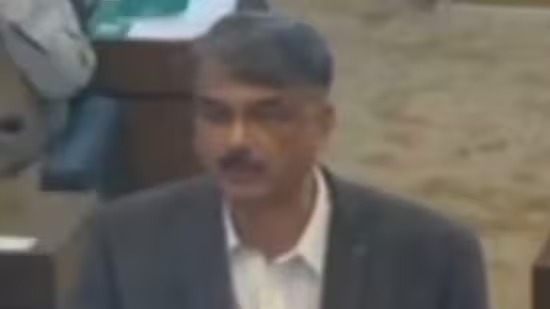
In a video that has gone viral across social media platforms, Anwarul Haq, addressing a session in the PoK Assembly, claimed that terror groups affiliated with Pakistan executed attacks on Indian soil as retaliation for India’s alleged actions in Balochistan. He stated, “I earlier said that if you keep bleeding Balochistan, we’ll hit India from Red Fort to the forests of Kashmir. By the grace of Allah, we’ve done it and they’re still unable to count bodies.” The remarks have drawn sharp attention because they constitute one of the first direct admissions by a political leader in Pakistan acknowledging the involvement of terror groups operating from across the border in attacks on Indian territory.
Haq’s reference encompassed two major terror incidents in India this year: the April attack in Pahalgam and the recent suicide bombing near Delhi’s Red Fort. Security agencies investigating the Red Fort blast have indicated that the attack was carefully orchestrated as part of a coordinated plan involving individuals and networks with clear links to Jaish-e-Mohammed. The group, led by Masood Azhar, has long been implicated in numerous attacks on Indian soil, and its operations often exploit weaknesses in border security and intelligence coordination.
The attack near Red Fort involved a vehicle laden with explosives, detonated in a public area, causing widespread panic and casualties. Investigators later identified the driver as Umar Un Nabi, a doctor originally from Kashmir, whose remains were found with part of his leg trapped in the car’s accelerator and steering system. Further investigation revealed that Nabi had been connected to two other individuals, Dr. Muzammil Shakeel Ganaie and Dr. Adeel Rather, who were recently apprehended in Jammu and Kashmir. The authorities discovered a significant cache of explosives, including over 2,900 kilograms of ammonium nitrate, along with detonators, timers, and assault rifles, stored in Faridabad. This discovery underscores the high level of planning and operational sophistication involved in the attack, and further confirms links to cross-border terror networks.
Haq’s statement also highlighted the broader narrative propagated by some Pakistan-linked elements, suggesting that the attacks were retribution for India’s policies and alleged involvement in the unrest in Balochistan. Pakistan has historically accused India of supporting insurgency and unrest in Balochistan, claims which New Delhi has repeatedly rejected. Indian officials have dismissed these accusations as diversionary tactics to mask Islamabad’s own role in sponsoring terrorism across the border. Nonetheless, Haq’s public remarks have added a provocative dimension to these long-standing allegations, complicating efforts to maintain peace and security along the sensitive borders between the two nations.
Rising Tensions and Military Alerts
Anwarul Haq’s statements come at a time when Pakistan’s Defence Minister Khawaja Asif has warned that the country cannot ignore the possibility of an “all-out war” with India, emphasizing that Islamabad must remain on “full alert.” Speaking to Samaa TV, Asif stressed that India cannot be trusted, citing potential threats of direct intervention or continued attacks from strategic locations such as Afghanistan. He stated, “We cannot ignore (India) in any way… we are not ignoring India, and our preparation and alert are at maximum. We cannot trust India in any way. We cannot rule out (attack) as India can directly intervene. It can continue attacks from there and it can go for an all-out war as per its strategy.”
This heightened rhetoric coincides with a period of intense scrutiny in India over its internal security protocols and counterterrorism mechanisms. The Red Fort attack exposed vulnerabilities in urban security infrastructure, particularly in highly symbolic and heavily visited locations. The Delhi Police, along with national intelligence agencies, have conducted detailed forensic examinations of the blast site, confirming that the attack was meticulously planned and executed. Beyond the immediate security implications, the incident has reignited broader concerns about the operational reach of Pakistan-based terror groups within India, and the continuing challenge of preventing radicalized individuals from carrying out sophisticated attacks in densely populated areas.
Investigators have traced the operational network linked to the Red Fort blast to a “white-collar terror module,” which, according to security officials, involved highly educated individuals with professional backgrounds, such as doctors and engineers, who were radicalized and recruited into extremist operations. This represents a shift from traditional militancy patterns, highlighting the evolving strategies of terror organizations that exploit professional skills, technological expertise, and urban anonymity to plan high-casualty attacks. The identification of Umar Un Nabi, a medical professional and assistant professor at Al Falah University, underscores the adaptability and covert operational capacity of these networks.
The arrest of Dr. Muzammil Shakeel Ganaie and Dr. Adeel Rather further revealed the scale of the threat, with explosives, weapons, and materials capable of causing mass destruction being stockpiled in civilian areas. Security agencies are now working to dismantle similar networks across northern India and are coordinating intelligence-sharing mechanisms with regional and central authorities to prevent future attacks. Analysts have also warned that Haq’s public admission may embolden further propaganda and recruitment efforts by Pakistan-linked terror groups, making counterterrorism vigilance critical for India.
Meanwhile, political and diplomatic tensions between India and Pakistan have escalated. Haq’s statement has been perceived as a deliberate provocation, intended to exert psychological pressure on Indian authorities and inflame public opinion. At the same time, Pakistani claims regarding India’s alleged role in Balochistan continue to be a source of friction, with New Delhi reiterating that Islamabad is attempting to deflect attention from its own state-sponsored terrorism. The Red Fort incident, combined with Haq’s admission, has amplified existing security challenges while influencing broader strategic and diplomatic calculations in the region.
In Delhi, security forces have ramped up measures around critical landmarks, borders, and areas prone to militant infiltration. Intelligence units are monitoring communication channels and suspicious activities, while central and state authorities are coordinating rapid response teams to ensure readiness for any potential incidents. The Red Fort blast has also sparked debates about urban counterterrorism preparedness, surveillance systems, and community policing strategies. Public awareness campaigns and emergency response drills have been intensified in light of the evolving threat landscape.
The broader geopolitical implications of the incident cannot be understated. Pakistan’s acknowledgment of involvement, even indirectly, underscores the persistent challenge India faces in addressing cross-border terrorism and the complexities of bilateral relations with Islamabad. Analysts note that the narrative promoted by Haq and other figures in Pakistan reflects a deliberate attempt to project strength while simultaneously signaling domestic audiences of their capability to act against perceived adversaries. This has implications not only for India’s security policies but also for diplomatic engagement, regional stability, and international counterterrorism cooperation.
The Red Fort blast, coupled with Haq’s statement, serves as a grim reminder of the enduring threats posed by transnational terror networks and the importance of robust counterterrorism preparedness. India continues to strengthen its urban security infrastructure, intelligence capabilities, and inter-agency coordination to prevent similar attacks in the future. As investigators analyze the links between the perpetrators and external terror groups, national and regional security strategies are being reassessed to ensure that urban centers, critical infrastructure, and symbolic landmarks are protected against evolving threats.
The incident also underscores the role of radicalization among educated professionals and the increasing complexity of modern terror operations. Security agencies are emphasizing early detection, monitoring, and rehabilitation strategies to counter the recruitment of skilled individuals into extremist networks. Simultaneously, diplomatic and strategic measures are being explored to prevent escalation along the India-Pakistan border, balancing the need for security with broader regional stability considerations.
Haq’s video, now viral, has drawn international attention and condemnation, illustrating the power of propaganda in modern terrorism. While the Indian government has condemned the remarks, emphasizing that India will not be intimidated by such statements, the event highlights the necessity of proactive security measures, intelligence vigilance, and comprehensive counterterrorism policies that address both domestic and transnational threats. Analysts continue to monitor the situation closely, noting that the Red Fort incident is part of a wider pattern of coordinated attacks by Pakistan-linked terror organizations seeking to destabilize India and assert influence over geopolitical narratives in the region.