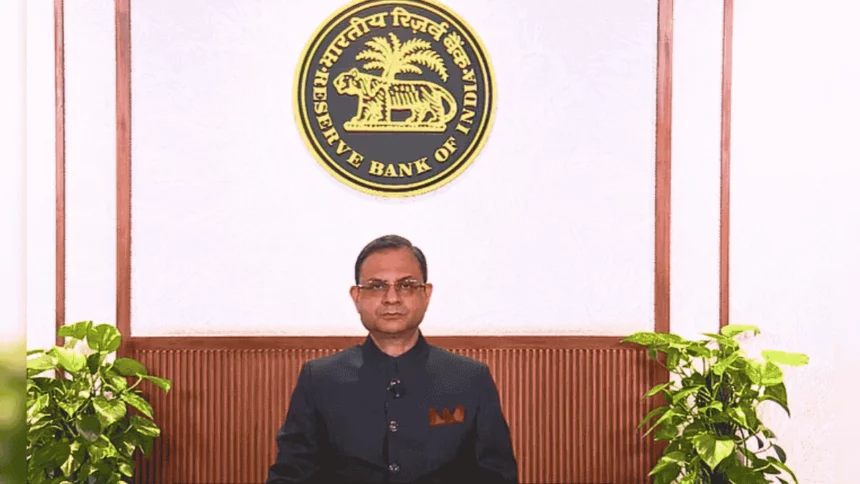
The Reserve Bank of India’s Monetary Policy Committee has kept the repo rate unchanged at 5.25 percent in its first bi-monthly policy review of FY27, reflecting a cautious stance amid rising global uncertainties and inflation risks. The decision, announced by RBI Governor Sanjay Malhotra on April 8, 2026, signals the central bank’s focus on maintaining stability while closely monitoring evolving economic conditions.
The MPC, which met from April 6 to April 8, unanimously voted to hold the key policy rate steady, continuing its “neutral” stance. This marks a continuation of the pause in rate changes seen in recent policy cycles, indicating that the RBI is adopting a wait-and-watch approach in the face of global volatility and domestic economic considerations.
The decision comes at a time when geopolitical tensions, particularly in West Asia, have disrupted global markets and pushed up crude oil prices, creating uncertainty around inflation and growth trajectories. The RBI’s move reflects a balancing act between supporting economic growth and keeping inflation within its target range.
Inflation Risks, Global Tensions and Economic Outlook
One of the key factors influencing the RBI’s decision is the rising uncertainty in the global economic environment. Ongoing geopolitical conflicts have led to volatility in commodity prices, especially crude oil, which directly impacts inflation in India.
The central bank has projected inflation for FY27 at around 4.6 percent, keeping it within the target band of 2 to 6 percent but acknowledging potential upside risks. Elevated oil prices, supply chain disruptions, and external shocks could push inflation higher in the coming months, making it necessary for the RBI to remain cautious.
At the same time, the RBI has revised India’s GDP growth forecast for FY27 to approximately 6.9 percent, slightly lower than previous estimates. This reflects concerns about the impact of global instability on domestic economic momentum, even though underlying fundamentals such as consumption and investment remain strong.
Governor Sanjay Malhotra emphasized that while inflation is currently under control, the risks have increased due to external factors. The central bank has therefore chosen to prioritize stability over aggressive policy changes, ensuring that growth is not disrupted while inflation remains manageable.
Impact on Borrowers, Markets and Policy Direction
The decision to keep the repo rate unchanged provides temporary relief to borrowers, especially those with loans linked to external benchmark rates. With no immediate change in lending rates, EMIs for home and other loans are expected to remain stable for now.
However, the RBI’s cautious stance also suggests that future rate movements will depend heavily on incoming data, particularly inflation trends and global developments. If inflationary pressures intensify, the central bank may consider tightening policy, while a stable environment could open the door for rate cuts later.
Financial markets reacted calmly to the announcement, indicating that the decision was largely in line with expectations. Investors are now focusing more on the RBI’s commentary and forward guidance rather than the rate decision itself.
The policy also underscores the RBI’s commitment to maintaining a “neutral” stance, allowing flexibility to respond to changing economic conditions. This approach reflects the central bank’s recognition of the complex global environment, where sudden shocks can quickly alter economic outlooks.
The April 2026 MPC decision highlights the RBI’s effort to strike a balance between growth and inflation control in an uncertain world. By holding rates steady, the central bank has signaled stability, while keeping its options open for future policy adjustments depending on how global and domestic conditions evolve.