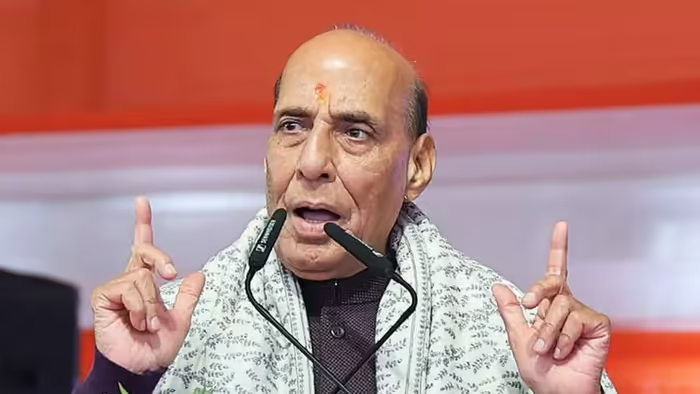
With Assembly elections approaching in two politically significant states, Assam and Kerala, the Bharatiya Janata Party (BJP) has intensified its campaign efforts by deploying senior leadership to strengthen voter outreach. Defence Minister Rajnath Singh is set to campaign in Assam on March 31 and in Kerala on April 1 and 2, signalling the party’s strategic push to consolidate its position in the Northeast while attempting to expand its footprint in southern India.
The upcoming elections, scheduled to be held in a single phase on April 9, are expected to be closely contested, with major national and regional parties mobilising their resources to influence voter sentiment. The results, which will be declared on May 4 as per the Election Commission of India, will play a crucial role in shaping the political landscape in both states.
BJP Intensifies Campaign in Assam
In Assam, the BJP-led National Democratic Alliance (NDA) is aiming to secure a third consecutive term in power. The state has emerged as a stronghold for the party in recent years, and the leadership is keen to maintain its dominance.
Union Home Minister Amit Shah recently conducted a large-scale roadshow in Guwahati, drawing significant crowds and energising party workers. The roadshow witnessed enthusiastic participation, with supporters lining the streets to greet the senior leader. Shah’s interaction with the public, including showering flower petals on the crowd, was seen as an effort to boost morale and reinforce the party’s connection with voters.
The political contest in Assam is expected to be primarily between the ruling BJP-led NDA and the Congress. The NDA, which includes the BJP, Asom Gana Parishad (AGP), and United People’s Party Liberal (UPPL), had secured a decisive victory in the 2021 Assembly elections, winning 75 out of 126 seats. The BJP alone had won 60 seats, establishing itself as the dominant force in the state.
Chief Minister Himanta Biswa Sarma, who played a key role in the party’s previous success, is once again at the forefront of the campaign. He is expected to contest from his traditional Jalukbari constituency, where he has maintained a strong electoral presence.
The Congress, on the other hand, is attempting to stage a comeback after its disappointing performance in the last election. In 2021, the Congress-led alliance, which included the All India United Democratic Front (AIUDF), Bodoland People’s Front (BPF), and Left parties, managed to secure only 16 seats. The party is now focusing on rebuilding its base and presenting itself as a viable alternative to the ruling government.
Voter participation is expected to play a crucial role in determining the outcome. In the previous election, Assam recorded a high voter turnout of 86.2 percent, with over 2.2 crore registered voters. Political analysts believe that a similar or higher turnout could significantly influence the electoral dynamics.
Kerala Polls: A Three-Way Political Battle
In Kerala, the political scenario presents a different challenge for the BJP. The state has traditionally been dominated by two major alliances—the Left Democratic Front (LDF) led by the Communist Party of India (Marxist), and the United Democratic Front (UDF) led by the Congress.
The 2026 Kerala Assembly elections will also be held in a single phase on April 9, covering all 140 constituencies of the Kerala Legislative Assembly, also known as the Kerala Niyamasabha. The current assembly’s tenure is set to end on May 23, making this election a crucial test for all major political players.
The incumbent LDF government, which has been in power for nearly a decade, is seeking to retain its position. The alliance’s governance record and welfare policies are expected to be key factors in its campaign.
Meanwhile, the Congress-led UDF is aiming to unseat the LDF and return to power. The party is focusing on issues such as governance, economic challenges, and public dissatisfaction to strengthen its campaign narrative.
For the BJP, Kerala represents an opportunity to expand its influence in a state where it has historically struggled to make significant electoral gains. The party’s decision to deploy senior leaders like Rajnath Singh reflects its intent to strengthen its presence and connect with voters.
The Model Code of Conduct has already come into effect, ensuring that all political parties adhere to election guidelines during the campaign period. This includes restrictions on the use of government resources, regulation of campaign activities, and enforcement of ethical practices.
High Stakes and Strategic Importance
The simultaneous elections in Assam and Kerala highlight the diverse political landscape of India, where regional dynamics and voter priorities vary significantly from one state to another. For the BJP, retaining Assam and making inroads in Kerala are both strategically important objectives.
Assam serves as a gateway to the Northeast and holds significant political and strategic value. A victory in the state would reinforce the BJP’s dominance in the region and strengthen its national standing.
Kerala, on the other hand, represents a long-term strategic goal for the party. While immediate electoral success may be challenging, increased vote share and organisational growth could lay the foundation for future gains.
The involvement of senior leaders like Rajnath Singh and Amit Shah underscores the importance the BJP places on these elections. Their campaigns are expected to focus on development, governance, and national issues, while also addressing local concerns.
At the same time, opposition parties are intensifying their efforts to counter the BJP’s narrative. The Congress, in particular, is aiming to regain lost ground in Assam and maintain its relevance in Kerala.
Political observers note that these elections will not only determine state-level leadership but also have broader implications for national politics. The outcomes could influence party strategies, alliances, and voter perceptions in the run-up to future elections.
As campaigning gains momentum, all eyes will be on how effectively parties engage with voters and address key issues. The coming days are expected to witness a series of rallies, roadshows, and outreach programmes as political leaders seek to maximise their impact.
Ultimately, the elections in Assam and Kerala will serve as a test of political strategies, leadership effectiveness, and voter sentiment. With high stakes for all major parties, the results are likely to have far-reaching consequences for India’s political landscape.