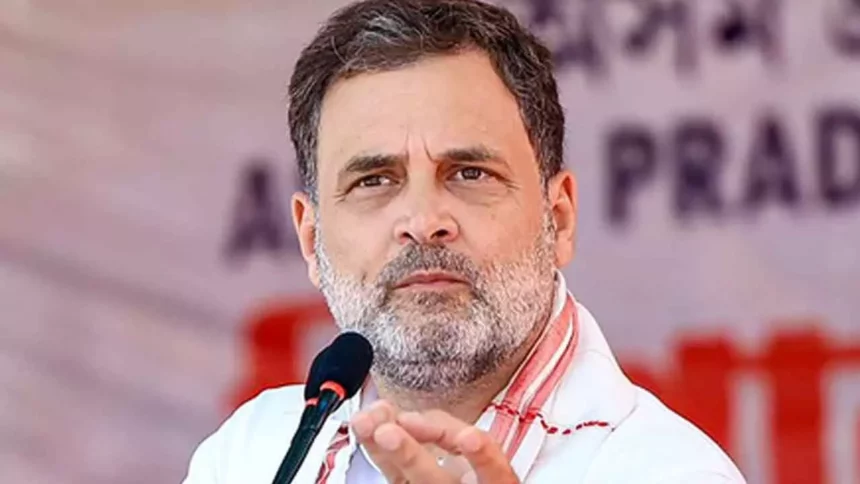
The political temperature in Assam has surged sharply after Rahul Gandhi launched a fierce attack on Chief Minister Himanta Biswa Sarma during a high-profile election rally. Addressing supporters, the Congress leader did not hold back, calling Sarma the “most corrupt Chief Minister” in the country and accusing his government of promoting divisive politics. The remarks have triggered a fresh political storm, further intensifying an already heated election battle in the state, where rhetoric, allegations, and counter-allegations are shaping the campaign narrative.
sharp accusations and escalating political rhetoric
Rahul Gandhi’s remarks were part of a broader strategy by the Congress to target the Bharatiya Janata Party-led government in Assam on issues of governance, corruption, and social cohesion. During his speech, Gandhi alleged that the state leadership was involved in widespread corruption and misuse of power, framing the election as a fight between accountability and alleged misconduct.
He went further by accusing the chief minister of encouraging divisive politics, claiming that such an approach undermines social harmony in a diverse state like Assam. In another rally, Gandhi described Sarma as a “hate-spreading CM,” reinforcing his narrative that the current administration is focused more on polarization than development.
The Congress leader also used strong imagery and language to energize party workers, suggesting that those responsible for corruption would eventually face legal consequences. These statements reflect a combative campaign style aimed at mobilizing voters and drawing clear political contrasts ahead of the elections.
Such rhetoric is not unusual during election season, but the intensity of the language signals how crucial the Assam polls are for both national parties. For Congress, it represents an opportunity to regain political ground, while for the BJP, it is about consolidating its hold in the Northeast.
counterattacks, allegations, and a deepening political clash
The response from Himanta Biswa Sarma and the BJP camp has been equally aggressive, turning the contest into a full-scale war of words. Sarma has dismissed the allegations as politically motivated, accusing the Congress of running smear campaigns and spreading misinformation to influence voters.
The political battle has also extended beyond policy debates into personal allegations and counterclaims. Issues such as asset disclosures, campaign promises, and alleged irregularities have become central talking points, reflecting the increasingly confrontational nature of the election discourse.
At the same time, the BJP has sought to shift focus toward its governance record, highlighting development initiatives and welfare schemes to counter opposition criticism. Sarma has emphasized policies aimed at social integration and economic growth, positioning his administration as one focused on long-term stability and progress.
The clash between Rahul Gandhi and Himanta Biswa Sarma underscores the broader political dynamics at play, where elections are not just about local issues but also about national narratives and leadership battles. The exchange of sharp remarks, allegations, and counter-allegations reflects a high-stakes contest that is likely to intensify further as polling approaches.