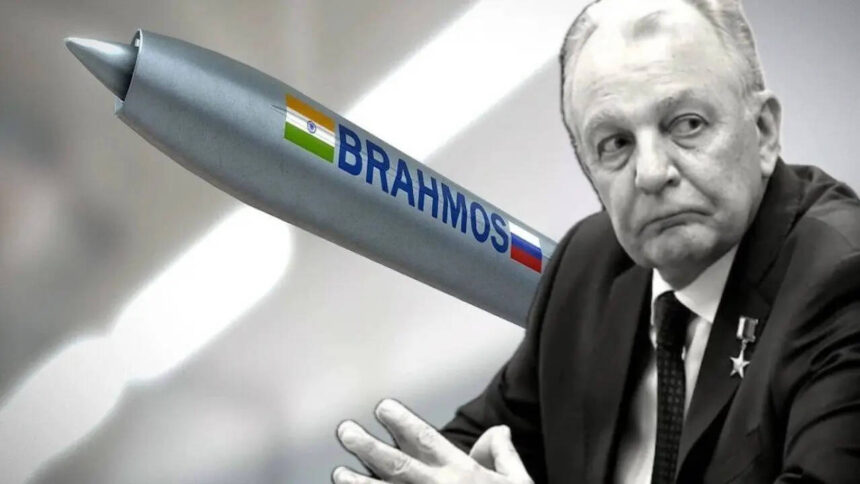
The global defence community has been struck by the passing of Alexander Leonov, a key architect behind the Indo-Russian BrahMos missile programme, who died at the age of 74. His death marks a significant moment not only for Russia but also for India, given his deep association with one of the most successful joint defence ventures between the two nations. As the CEO and Chief Designer of NPO Mashinostroyenia, Leonov played a pivotal role in shaping advanced missile technologies that have influenced modern warfare and strategic deterrence capabilities.
A visionary behind brahmos and hypersonic missile innovation
Alexander Leonov was widely regarded as one of the leading minds in missile technology, with decades of experience in designing and developing cutting-edge defence systems. As the head of NPO Mashinostroyenia, the Russian partner in BrahMos Aerospace, he contributed significantly to the evolution of the BrahMos cruise missile—one of the fastest and most precise supersonic missiles in the world.
The BrahMos project itself stands as a symbol of successful international collaboration, combining Indian and Russian expertise to create a weapon system known for its speed, precision, and versatility. Leonov’s leadership ensured that the project not only met but often exceeded expectations, making it a cornerstone of India’s defence capabilities.
Beyond BrahMos, Leonov was instrumental in the development of the Zircon hypersonic missile, a next-generation weapon capable of traveling at speeds up to Mach 9. This achievement placed him at the forefront of a new era in military technology, where speed and maneuverability redefine strategic advantage. His work extended to several other advanced missile systems, including coastal defence platforms and naval strike capabilities, reflecting a career dedicated to pushing the boundaries of engineering and innovation.
His contributions were not limited to technical design alone. Leonov also played a crucial role in overseeing large-scale projects, integrating complex systems, and guiding teams of engineers and scientists. His ability to translate theoretical concepts into practical, deployable technologies earned him widespread recognition and respect within the defence community.
legacy in india-russia defence ties and future implications
Leonov’s association with the BrahMos programme highlights the importance of Indo-Russian cooperation in defence technology. The joint venture between India’s Defence Research and Development Organisation and Russia’s NPO Mashinostroyenia has been a cornerstone of strategic collaboration for decades. His leadership helped strengthen this partnership, ensuring the continued development of advanced missile systems tailored to evolving security needs.
The impact of his work is evident in the widespread adoption and export potential of the BrahMos missile, which has become a key component of India’s military arsenal. It has also positioned India as a significant player in the global defence market, showcasing the success of collaborative innovation.
Leonov’s passing comes at a time when the world is witnessing rapid advancements in hypersonic technology and strategic weapon systems. His contributions to this field have laid the groundwork for future developments, influencing both current projects and those yet to come. While his absence will undoubtedly be felt, the systems he helped create will continue to shape defence strategies for years.
The news of his death has resonated across both India and Russia, reflecting the deep professional and strategic ties he helped foster. As nations continue to invest in advanced military technologies, the legacy of Alexander Leonov serves as a reminder of the critical role played by visionary engineers and scientists in shaping the future of global security.