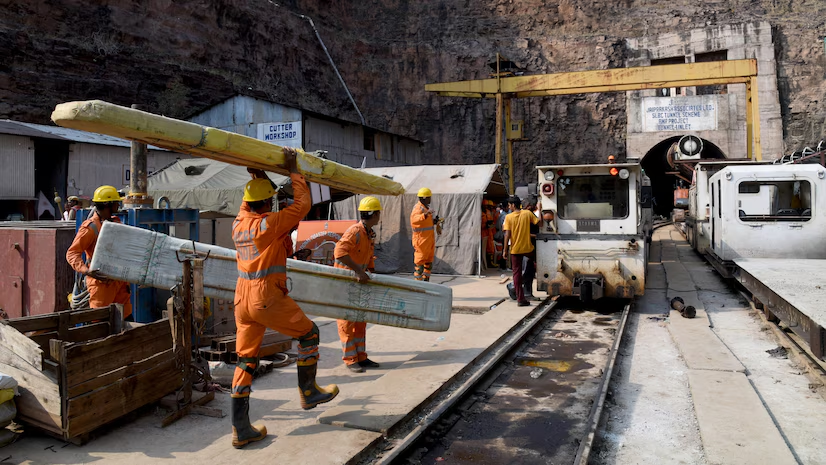
The rescue operation to evacuate eight workers trapped inside the Srisailam Left Bank Canal (SLBC) tunnel in Telangana’s Nagarkurnool district has now entered its fourth day, with no major breakthrough achieved so far. The collapse, which occurred on Saturday morning during excavation work using a tunnel boring machine (TBM), has made rescue efforts extremely challenging, with water and mud continuously obstructing the path. The trapped workers, hailing from Jammu and Kashmir, Uttar Pradesh, and Jharkhand, remain out of contact, further complicating the operation.
Multiple agencies, including the Indian Army, National Disaster Response Force (NDRF), State Disaster Response Force (SDRF), Singareni Collieries, and the National Highways & Infrastructure Development Corporation Limited (NHIDCL), are engaged in the rescue effort. Additionally, six members from the team behind the successful Silkyara tunnel rescue operation in Uttarakhand in November 2023 have joined the mission, bringing their expertise to the ongoing efforts. However, despite extensive work, no significant progress has been made in reaching the trapped workers.
Rescuers have faced several obstacles that have slowed down the operation. Officials stated that the conditions inside the tunnel have worsened drastically, with a heavy inflow of water and mud making it nearly impossible to move forward. The NDRF’s 10th Battalion Commandant, Prasanna Kumar, revealed that a meeting was held between officials of the Indian Army, Navy, and other agencies to discuss possible strategies, but no viable plan has been found to penetrate the thick wall of slush. The situation has become more critical as the height of the mud wall has risen to nearly 11 feet, reducing visibility to zero. The Navy commandos attempted to cut through the debris but were not equipped to handle such a massive mud barrier.
Reports suggest that the trapped workers are believed to be only 5 to 10 meters away from the rescue teams. However, the conditions inside the tunnel have made it dangerous to proceed further. Authorities have deployed probe scopes and sonar equipment, which have detected the presence of dangerous debris, including twisted metal, chunks of concrete, and other materials that could pose serious risks to rescuers. The use of rat-hole miners—who played a crucial role in the Uttarakhand tunnel rescue—was also considered. However, experts noted that these miners can only operate in dry conditions, while the Telangana tunnel is filled with a thick mixture of mud and water, making their usual techniques ineffective.
The collapse was triggered by loosened natural rock formations, which caused a sudden inflow of water and mud, filling around 12 to 13 feet of the tunnel. Irrigation Minister Uttam Kumar Reddy stated that the terrain has made it difficult to bring in heavy equipment that could remove the slush more efficiently. The tunnel boring machines, which could help clear the debris, are expected to take several days to complete the task.
Among those trapped inside the tunnel are Sunny Singh from Gurha Manhasan, Jammu & Kashmir, and Gurpreet Singh from Taran Taran, Punjab, both engineers with the American tunneling firm The Robbins Company. Engineers Manoj Kumar and Sri Niwas from Uttar Pradesh, working with Jaiprakash Associates, are also among the trapped. The remaining four workers—Sandeep Sahu, Jagta Xess, Santosh Sahu, and Anuj Sahu—are construction laborers from Jharkhand.
Despite the challenges, rescue teams remain determined to find a breakthrough. With time running out and conditions worsening, the focus remains on finding the safest and most effective way to reach the trapped workers. Authorities continue to explore all possible avenues to ensure a successful rescue operation, as families of the workers anxiously await any news of their loved ones.