The internal conflict within the Aam Aadmi Party has intensified as senior leader Raghav Chadha launched a sharp counterattack against his own party leadership, rejecting allegations made against him and hinting at a deeper rift within the organization. Once considered a close aide of Arvind Kejriwal, Chadha has now openly accused party leaders of orchestrating a “scripted campaign” to target him, signaling a significant moment of internal dissent ahead of crucial political developments.
Chadha Rejects Allegations, Defends Parliamentary Conduct
Raghav Chadha did not hold back as he addressed the allegations leveled against him by party colleagues, using strong rhetoric and even referencing popular culture to underline his stance. Borrowing a line from the film Dhurandhar, he remarked that he is “wounded but still dangerous,” signaling that he intends to fight back against what he described as coordinated attacks.
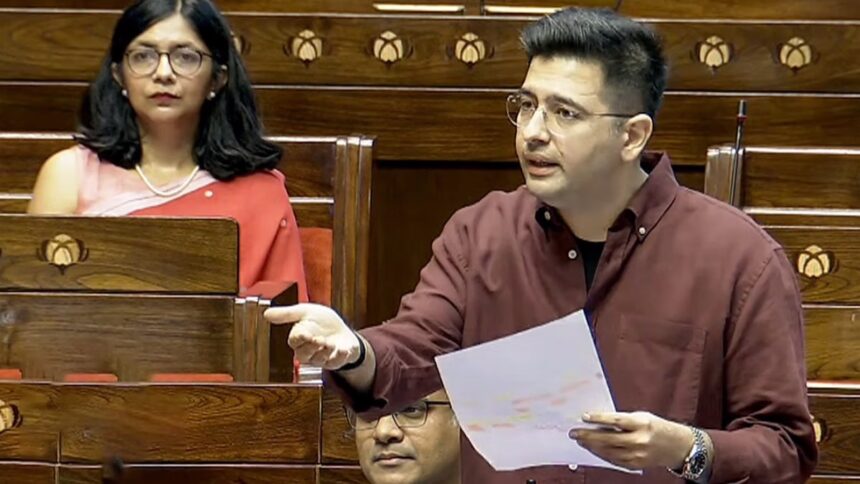
Chadha categorically denied claims that he failed to participate in opposition walkouts in the Rajya Sabha. He termed such accusations “completely false” and challenged critics to produce evidence, pointing to the presence of CCTV cameras in Parliament as a means to verify his participation. His response reflects an attempt to counter narratives questioning his commitment to party strategy and parliamentary coordination.
He also dismissed allegations that he refused to sign a motion related to the impeachment of Chief Election Commissioner Gyanesh Kumar. According to Chadha, no formal or informal request was made to him to sign such a motion, and he further argued that several other party MPs had also not signed it. By raising this point, he questioned why the criticism was being directed specifically at him.
On the charge of raising “trivial issues” in Parliament, Chadha strongly defended his record. He emphasized that his interventions have consistently focused on public concerns such as taxation, environmental challenges in Delhi, Punjab’s water crisis, the condition of government schools, healthcare infrastructure, and issues affecting railway passengers. He also highlighted his efforts to bring attention to topics often overlooked in political discourse, including menstrual health, unemployment, and inflation. Through this defense, Chadha positioned himself as a leader focused on substantive issues rather than political theatrics.
Escalation Within AAP and Leadership Tensions Come to Surface
The controversy has unfolded against the backdrop of a significant organizational change within the Aam Aadmi Party. Chadha’s removal from the position of Rajya Sabha deputy leader and the appointment of Ashok Mittal in his place marked a turning point in the internal dynamics of the party. The decision, communicated to the Rajya Sabha secretariat, has been widely interpreted as a sign of growing differences between Chadha and the party leadership.
Senior party members have accused Chadha of deviating from the party line, suggesting that he was not assertive enough in targeting the ruling National Democratic Alliance and Prime Minister Narendra Modi. Some leaders went as far as to question his political stance, alleging that his actions did not align with the party’s broader strategy in Parliament.
The rhetoric from within the party has also turned sharp, with remarks implying that Chadha’s approach reflects hesitation or fear in confronting political opponents. Such statements indicate a widening gap between Chadha and sections of the party leadership, raising questions about unity and cohesion within the organization.
Chadha, however, has countered these accusations by asserting his independence and commitment to raising genuine public issues. In a video message shared publicly, he warned against interpreting his silence as weakness, suggesting that he remains capable of mounting a strong response when necessary. His remarks indicate a willingness to challenge the party’s internal narrative and assert his political identity.
The situation further escalated as Chadha questioned whether speaking about common citizens’ problems in Parliament had become unacceptable within his own party. He listed various issues he had raised, from rising costs of everyday services to challenges faced by delivery workers and the middle class, arguing that these concerns are central to public welfare and deserve attention.
As tensions continue to unfold, the Raghav Chadha AAP controversy highlights a rare instance of open dissent within the party, bringing internal disagreements into the public domain. The developments underscore the challenges political organizations face in balancing internal discipline with individual expression, especially during periods of heightened political activity.