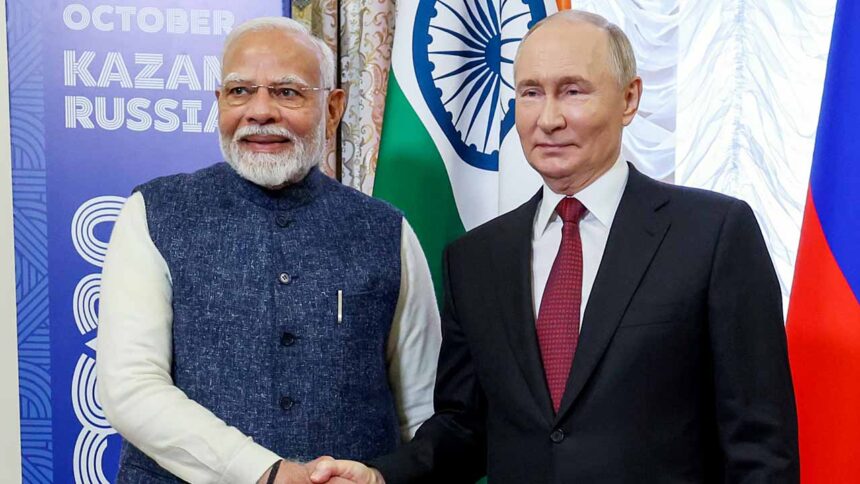
Russian President Vladimir Putin is set to visit New Delhi in September to participate in the BRICS Summit 2026, marking another significant chapter in the evolving strategic relationship between India and Russia. The announcement, confirmed by Kremlin aide Yuri Ushakov, comes at a time when the global geopolitical landscape is witnessing rapid realignment driven by wars, economic uncertainty, sanctions and the growing influence of emerging powers.
The summit, scheduled for September 12 and 13, is expected to draw world attention as India hosts leaders of some of the world’s most influential developing economies under the BRICS platform. Putin’s arrival in Delhi will also mark his second visit to India within a year, underlining the continued importance Moscow places on its partnership with New Delhi despite rising global tensions and Russia’s prolonged confrontation with Western nations.
The visit is likely to focus not only on BRICS cooperation but also on defence ties, energy partnerships, global trade reforms and strategic coordination across Asia and beyond. Analysts believe the summit could become one of the most consequential diplomatic gatherings of the year as BRICS increasingly positions itself as a counterbalance to Western dominated global institutions.
BRICS Expands Its Global Influence
The BRICS grouping was originally formed by Brazil, Russia, India, China and South Africa with the objective of strengthening cooperation among major emerging economies. Over the years, the alliance has evolved far beyond an economic forum and now represents a major geopolitical platform advocating reforms in global governance, trade systems and financial institutions.
The bloc has recently expanded significantly with the inclusion of countries such as Egypt, Ethiopia, Iran, Saudi Arabia and the United Arab Emirates. This expansion has broadened BRICS influence across West Asia, Africa and strategic energy markets, increasing its global relevance at a time when multipolar diplomacy is gaining momentum.
India’s presidency of BRICS in 2026 comes during a period of heightened international uncertainty. The wars in Ukraine and West Asia, disruptions in energy markets, global inflation and increasing tensions between major powers have intensified discussions around alternative financial systems and new diplomatic alignments.
Diplomatic observers expect the Delhi summit to focus heavily on trade cooperation, energy security, digital infrastructure, local currency settlements and institutional reforms aimed at reducing excessive dependence on Western financial systems.
Putin’s Visit Reflects Enduring India Russia Partnership
Putin’s decision to visit India again within months reflects the resilience of India Russia relations despite changing global equations. While India has expanded ties with the United States, Europe and Indo Pacific partners in recent years, New Delhi continues to view Moscow as an indispensable strategic ally.
The India Russia partnership has historically been rooted in defence cooperation. A large percentage of India’s military equipment remains Russian in origin, including fighter aircraft, missile systems, submarines and advanced air defence platforms.
One of the most important examples is the S 400 air defence system, which significantly strengthened India’s strategic deterrence capabilities. The jointly developed BrahMos missile programme has also become a symbol of deep technological and defence collaboration between the two countries.
Even as Western countries imposed sweeping sanctions on Russia following the Ukraine conflict, India maintained diplomatic engagement with Moscow and continued strategic cooperation. This balancing approach highlighted India’s preference for maintaining strategic autonomy rather than aligning completely with any single geopolitical bloc.
Energy Cooperation Became Even More Important
Energy has emerged as another major pillar of India Russia relations in recent years. Following sanctions on Russian oil exports, India dramatically increased imports of discounted Russian crude.
The move helped India protect itself from volatile international energy prices and stabilise domestic fuel costs during a period of global inflationary pressure. Russian oil quickly became a significant component of India’s energy basket, reshaping trade dynamics between the two countries.
Experts believe energy cooperation will remain a major discussion point during Putin’s visit. India continues to require reliable and affordable energy supplies to support economic growth, while Russia seeks stable buyers as European markets reduce dependence on Russian energy exports.
Beyond crude oil, cooperation in nuclear energy, liquefied natural gas and long term infrastructure investments is also expected to feature in bilateral discussions.
Strategic Balance In A Polarised World
India’s engagement with Russia carries significance far beyond trade and defence. Geopolitically, New Delhi views Moscow as an important balancing force in an increasingly polarised global environment.
One major concern for Indian policymakers has been the growing closeness between Russia and China following the Ukraine war. By maintaining strong bilateral relations with Moscow, India hopes to ensure that Russia does not drift entirely into Beijing’s strategic orbit.
Russia has also consistently supported India on several sensitive diplomatic issues at the United Nations Security Council. As a permanent member with veto power, Moscow remains an influential partner in global diplomacy.
For Russia, India represents one of the few major economies maintaining robust engagement despite Western isolation efforts. Strong ties with New Delhi also allow Moscow to demonstrate that it still retains significant global partnerships.
Delhi Summit Could Shape Future Of Emerging Economies
The BRICS Summit in Delhi is expected to carry enormous diplomatic significance because of the bloc’s growing influence within the Global South. Many developing countries increasingly view BRICS as an alternative platform capable of amplifying their voice in international affairs.
The previous summit in Rio de Janeiro focused on inclusive governance and stronger cooperation among developing economies. India is expected to continue that narrative while emphasising digital innovation, climate resilience, trade connectivity and reform of international institutions.
Leaders attending the summit are also expected to discuss ongoing global conflicts and their economic impact. The wars in Ukraine and West Asia have disrupted supply chains, energy markets and food security across multiple regions.
Diplomatic analysts believe India will attempt to position itself as a bridge between competing global powers during the summit. New Delhi has maintained communication with both Western governments and Russia while also strengthening engagement with developing nations.
Security And Diplomatic Preparations Intensify
Preparations for the summit are already underway across Delhi and several other Indian cities hosting BRICS related meetings. Security arrangements are expected to be extensive considering the participation of multiple world leaders and the sensitive geopolitical environment surrounding the gathering.
Putin’s visit in particular will attract enormous international attention due to ongoing tensions involving Russia and the West. The summit may also witness several bilateral meetings between participating leaders on the sidelines.
Diplomatic sources suggest India may use the occasion to deepen cooperation in trade corridors, technology sharing and financial systems among BRICS nations. Discussions around reducing dependence on the United States dollar in international transactions may also gain momentum.
Symbolism Beyond Diplomacy
Putin’s upcoming visit is not merely another diplomatic engagement. It reflects how India continues to navigate a complex foreign policy balancing multiple strategic partnerships simultaneously.
At a time when global alliances are shifting rapidly, India’s ability to maintain strong relations with Russia while also expanding ties with Western nations highlights New Delhi’s growing diplomatic confidence and strategic independence.
For Russia, participation in the Delhi summit provides an opportunity to strengthen ties with emerging economies and counter narratives of international isolation. For India, hosting the summit reinforces its ambition to play a leading role in shaping the future global order.
As the world watches the evolving balance between major powers, the September summit in Delhi could emerge as one of the defining geopolitical events of 2026.