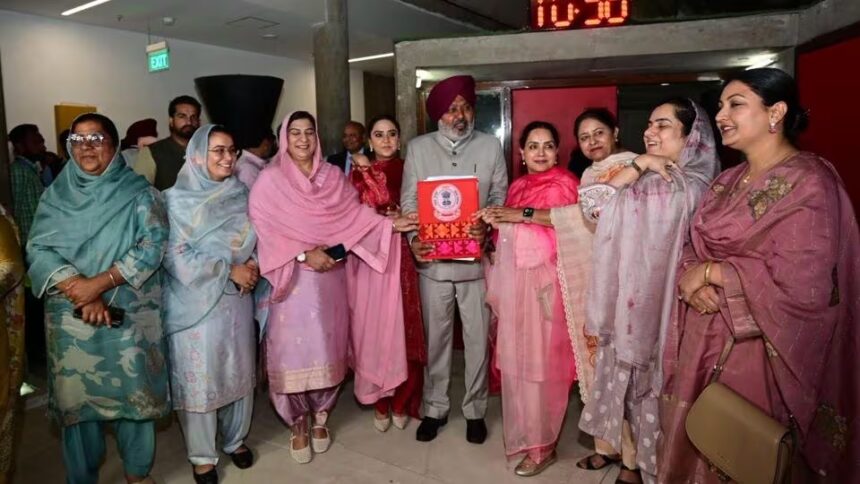
The Punjab government led by the Aam Aadmi Party (AAP) has announced a major welfare initiative providing a monthly cash transfer to women across the state. The scheme, unveiled during the presentation of the state budget on International Women’s Day, aims to provide financial assistance to adult women and is expected to cover nearly 97 percent of all eligible women in Punjab.
Punjab Finance Minister Harpal Singh Cheema introduced the scheme during the budget session in the state assembly. Named the ‘Mukh Mantri Mawan Dhian Satikar Yojana’, the programme proposes a monthly transfer of ₹1,000 to adult women across the state. Women belonging to Scheduled Caste communities will receive ₹1,500 per month under the scheme.
The government has allocated approximately ₹9,300 crore for the scheme in the upcoming financial year. According to Cheema, the programme is designed to provide financial support to a vast majority of women in the state, making it one of the most extensive cash transfer initiatives for women in India.
The scheme will be implemented through a direct benefit transfer (DBT) system, ensuring that the funds are deposited directly into the bank accounts of beneficiaries. Officials stated that the initiative will cover women aged 18 years and above, with only a few categories excluded from eligibility.
According to the finance minister, women who are current or former permanent government employees, current or former Members of Parliament and Members of Legislative Assemblies, and income tax payers will not be eligible for the scheme. Apart from these exceptions, most adult women in the state will be able to enroll.
Importantly, women already receiving benefits under existing social security pension schemes will still be eligible to receive the monthly assistance. This includes beneficiaries of old-age pensions, widow pensions, and disability pensions. The government said this measure aims to ensure that financial support reaches a wider section of society.
The announcement comes at a politically significant time, with Punjab expected to hold assembly elections in about a year. The AAP government had promised a monthly financial assistance scheme for women during its election campaign, and the latest announcement fulfills a key electoral commitment.
Presenting the budget, Cheema described the financial plan as a tribute to the “mothers and daughters” of Punjab. The state government has proposed a total budget expenditure of ₹2,60,437 crore for the financial year 2026–27.
In addition to the women’s welfare scheme, the budget outlines major allocations for social welfare programmes. The finance minister proposed ₹18,304 crore for the Department of Social Welfare and Justice, marking the highest allocation for the department so far.
The budget includes ₹360 crore for the Ashirwad Scheme, which provides financial assistance for the marriages of women from economically weaker sections. Another ₹261 crore has been allocated for post-matric scholarships to support students from disadvantaged communities.
At the same time, the government has slightly reduced the allocation for power subsidies. The budget proposes ₹15,550 crore for power subsidies, compared to ₹20,500 crore in the previous financial year. The reduction follows a recent order by the Punjab State Electricity Regulatory Commission.
The budget also places emphasis on infrastructure development. Under the Rangla Punjab Vikas Scheme, the allocation has been doubled to ₹1,170 crore. Each of the state’s 117 assembly constituencies will receive ₹10 crore to support local development projects.
In rural areas, the government has announced plans to continue upgrading village road networks. After improving more than 40,000 kilometres of village roads in recent years, the state now plans to complete the remaining 19,876 kilometres at an estimated cost of ₹7,606 crore.
Agriculture continues to remain a major focus area for the Punjab government. The budget allocates ₹15,377 crore for agriculture and allied sectors. Among the initiatives announced is a ₹40 crore programme to promote direct seeded rice (DSR), a farming technique aimed at conserving groundwater.
The government has also proposed significant investments in the healthcare sector. A total of ₹2,000 crore has been allocated for the Mukh Mantri Sehat Yojna, which will provide health insurance coverage of up to ₹10 lakh per family annually.
Another ₹1,220 crore has been earmarked for medical education and research. The state government also announced plans to establish a new university at Sri Anandpur Sahib to mark the 350th martyrdom anniversary of Guru Tegh Bahadur.
Along with the university, the government plans to build a modern trauma centre and a dedicated Mother and Child Care Hospital in the holy city. The health sector will also see the addition of 100 new Aam Aadmi Clinics across the state.
Education received a major boost in the budget, with an allocation of ₹19,279 crore. This represents a seven percent increase compared to the previous year’s allocation.
Despite the expansion in welfare spending, the government stated that it aims to maintain fiscal discipline. The fiscal deficit for the financial year 2026–27 is estimated at 4.08 percent of the Gross State Domestic Product (GSDP), while the effective revenue deficit is projected at 2.06 percent.
Punjab’s total outstanding debt is projected to reach ₹4,47,754.78 crore by March 31, 2027. This represents an increase from the revised estimate of ₹4,07,784.14 crore for the financial year 2025–26.
The state’s Gross State Domestic Product is projected to reach ₹9,80,635 crore in the 2026–27 financial year, reflecting an expected growth rate of around 10 percent. Cheema attributed this growth to improved agricultural productivity and the expanding services sector.
The budget also addresses the issue of drug abuse in the state. The government announced that a comprehensive Drug and Socio-Economic Survey will be launched in April 2026 to better understand and address the challenges related to narcotics.