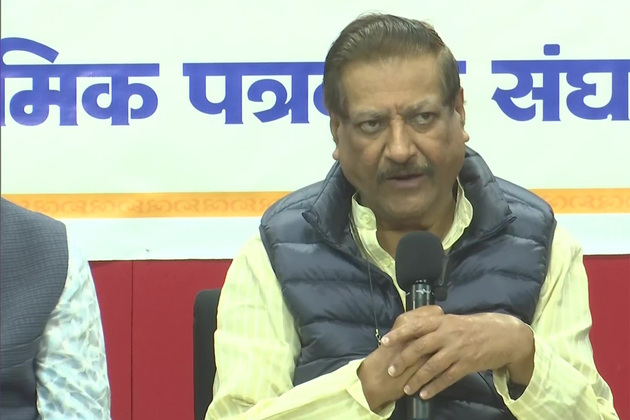
Former Maharashtra chief minister and senior Congress leader Prithviraj Chavan triggered a fierce political storm after describing India as having been “defeated on day one” during Operation Sindoor, remarks that drew sharp condemnation from the Bharatiya Janata Party and reopened a contentious national debate on how military operations, dissent, and democratic scrutiny intersect in public life. The controversy, which erupted in mid-December 2025, has rapidly escalated beyond an exchange of statements into a wider ideological confrontation between the ruling party and the opposition over patriotism, freedom of speech, and the limits of political criticism in matters related to national defence.
Remarks on Operation Sindoor spark outrage and sharpen political fault lines
The controversy began when Prithviraj Chavan, speaking at a public forum, questioned the outcome and handling of Operation Sindoor, a recent military engagement linked to national security. By stating that India was “completely defeated on day one,” Chavan offered a blunt and controversial assessment that immediately attracted attention across political and media circles. His remarks stood out not only for their severity but also for coming from a veteran leader who has previously served as a chief minister and held senior positions within the Congress party.
Within hours, the ruling Bharatiya Janata Party responded strongly, framing Chavan’s statement as an insult to the armed forces and a demoralising narrative that undermined national unity. BJP leaders accused him of trivialising the sacrifices of soldiers and weakening public confidence in the country’s defence institutions. For the BJP, the issue was not merely one of political disagreement but of national sentiment, with party spokespersons arguing that such remarks risked emboldening hostile forces and spreading doubt about India’s military capabilities.
The intensity of the response reflected the highly sensitive nature of defence-related discourse in India, where criticism of military operations often becomes entangled with questions of patriotism. BJP leaders asserted that Chavan’s language went beyond constructive criticism and crossed into what they described as an “anti-army mindset.” Some within the party demanded disciplinary action, while others questioned why the Congress leadership had not publicly distanced itself from the statement.
As the debate widened, Chavan’s additional comments on defence strategy further fuelled the controversy. He questioned the need for maintaining a large standing army in an era increasingly defined by air power, technology-driven warfare, and precision strikes. While his remarks were framed as a strategic observation about future conflicts, critics seized on them as evidence of what they described as a dismissive attitude toward the armed forces. Supporters, however, argued that such discussions were legitimate in a democracy and necessary for evolving defence policy in a rapidly changing global environment.
The Congress party found itself under pressure to respond. While it did not issue a formal apology or retract Chavan’s remarks, the episode once again highlighted the party’s ongoing struggle to navigate national security debates in a political climate where the ruling party has consistently positioned itself as the primary custodian of patriotism and defence credibility. The absence of an immediate distancing statement allowed the BJP to frame the controversy as emblematic of a deeper ideological divide between the two parties.
BJP counterattack and Chavan’s defence revive debate on dissent and democracy
As criticism mounted, the BJP intensified its counterattack, portraying Chavan’s remarks as symptomatic of what it called the Congress party’s long-standing tendency to question or downplay military achievements. Party leaders argued that such statements were damaging not only domestically but also internationally, as they could be amplified by adversaries to question India’s strategic resolve. The controversy was repeatedly framed as a matter of national morale, with BJP representatives insisting that public confidence in the armed forces must be protected at all costs.
This narrative resonated strongly with sections of the public discourse, particularly on social media, where defence issues often evoke emotional responses. Supporters of the BJP accused Chavan of politicising national security and using provocative language for political relevance. Some went further, alleging that such remarks reflected an outdated or elitist mindset disconnected from the realities faced by soldiers on the ground.
In response, Prithviraj Chavan refused to apologise or withdraw his statement, standing firmly by his right to question government actions. He clarified that his remarks were directed at policy decisions and strategic outcomes rather than at the armed forces themselves. According to Chavan, questioning the execution and consequences of military operations is a fundamental aspect of democratic accountability and does not amount to disrespect for soldiers or institutions.
Chavan framed the controversy as a test of India’s democratic maturity, arguing that blind consensus on national security issues weakens, rather than strengthens, governance. He emphasised that elected representatives have a constitutional duty to scrutinise government decisions, including those related to defence, especially when such decisions carry long-term implications for national policy and public resources. In his view, equating criticism with disloyalty undermines the very democratic values that the country claims to uphold.
The episode has once again exposed the tension that defines contemporary Indian politics, where national security has become a central political theme. For the ruling party, projecting strength and unity on defence matters is a core element of its political identity. For the opposition, asserting the right to question and debate these issues is equally central to its role in a parliamentary democracy. The clash over Operation Sindoor reflects how these competing narratives collide, often leaving little room for nuanced discussion.
Beyond the immediate controversy, the debate has broader implications for public discourse. It raises questions about where the line should be drawn between responsible criticism and rhetoric that may harm national interests. It also highlights the shrinking space for dissenting views on defence policy, as political narratives increasingly frame disagreement as disloyalty. For many observers, the storm over Chavan’s remarks is less about one leader’s words and more about the evolving nature of political debate in India.
As media coverage and political exchanges continue, Operation Sindoor has become a symbol of deeper ideological conflict between the Congress and the BJP. The ruling party’s aggressive response underscores its strategy of framing opposition criticism as a threat to national unity, while Chavan’s defiance reflects the opposition’s attempt to reclaim space for debate on sensitive issues. The controversy shows no signs of fading quickly, as it touches upon core questions of governance, accountability, and the balance between security and democratic freedoms in modern India.