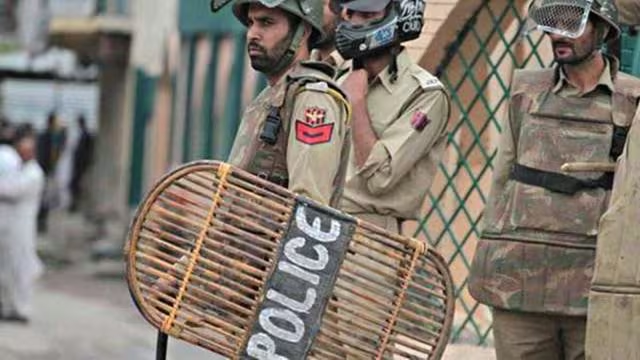
A fresh controversy has erupted in Jammu and Kashmir as authorities escalated their actions following the recent ban on 25 books, with police teams conducting raids across bookstores in the Valley. The move, which has sparked strong reactions from regional political leaders and civil society, is being seen as part of a broader campaign by the administration to curb what it calls “false narratives and secessionist content.” Bookstores in both north and south Kashmir were visited by the police, who seized multiple copies of the banned books, many of which are well-known works by reputed Indian and international authors.
Crackdown Follows Government Notification
The sweeping police drive on Thursday came a day after the Jammu and Kashmir Home Department issued an official notification banning the publication and circulation of 25 books under Section 98 of the Bhartiya Nagarik Suraksha Sanhita (BNSS), 2023. The government accused the books of promoting anti-national sentiments, spreading misinformation, and fueling separatist ideology.
The list of banned books includes significant scholarly works and political commentaries on the Kashmir issue. Among them are A G Noorani’s comprehensive account “The Kashmir Dispute 1947-2012,” Sumantra Bose’s analytical works “Kashmir at Crossroads” and “Contested Lands,” David Devdas’s “In Search of Future — The Kashmir Story,” Arundhati Roy’s collection of essays titled “Azadi,” and Anuradha Bhasin’s “A Dismantled State — The Untold Story of Kashmir After Article 370.” While one of the banned titles was published in Pakistan, the rest were published in India.
Police personnel reportedly visited multiple bookstores from Baramulla in the north to Anantnag in the south, checking shelves and storerooms for the blacklisted titles. Several copies were seized during these operations, which officials say were carried out as part of implementing the ban order.
Voices of Dissent and Political Backlash
The government action has drawn sharp criticism from prominent political figures and rights advocates in the region, who view the ban as an attack on freedom of expression and academic discourse. Former Chief Minister and PDP president Mehbooba Mufti condemned the ban, stating that democratic societies must encourage the open exchange of ideas, not censor them.
“Democracy thrives on the free exchange of ideas. Banning books cannot erase history; it only fuels division,” Mufti stated in a post. She emphasized that in Kashmir, where political sentiment is already complex and sensitive, such crackdowns only increase alienation among the people and deepen mistrust in the system.
Similarly, Mirwaiz Umar Farooq, the head of the Hurriyat Conference and Kashmir’s chief cleric, decried the government’s move as an insecure and authoritarian gesture. According to him, banning scholarly books does not erase the historical experiences of Kashmiris but highlights the government’s lack of understanding of the region’s nuances. He also criticized the irony of the government promoting a book festival at the same time it is banning literature.
Farooq pointed out that the banned titles represent a wide range of perspectives on the region’s troubled past and ongoing political struggles. Removing them from circulation, he argued, not only curtails access to alternative viewpoints but also sets a dangerous precedent for censorship of academic and literary voices.
Historical Context and Previous Raids
This is not the first time that bookstores in Kashmir have come under police scrutiny. In the past, authorities have conducted similar raids, particularly targeting literature and publications linked to groups like Jamaat-e-Islami, which was banned by the Indian government in 2019.
Kashmir has long been a region of contested narratives, where literature, media, and even art are closely monitored for content deemed subversive or provocative. The latest development reflects the increasingly tight control the administration is exerting over information flow in the Valley, especially following the abrogation of Article 370 in August 2019. Since then, Jammu and Kashmir has seen several shifts in its political, legal, and civil landscape, with growing concerns among residents about shrinking democratic space.
Critics argue that banning books not only contradicts democratic principles but also limits the intellectual capacity of society to engage with its own history. Many of the banned books, they note, have been available in academic institutions and public libraries for years and have contributed meaningfully to national and international understanding of the Kashmir conflict.
While the administration maintains that the ban and subsequent police action are legal and justified under the new BNSS framework, it has yet to issue any detailed explanation regarding the criteria used to blacklist the specific titles. In the absence of such clarity, fears persist that future censorship may expand to other forms of dissent, including journalism, art, and academic research.
As police continue their drive across the Valley to ensure compliance with the ban, bookstore owners remain cautious. Some have started removing controversial titles preemptively, while others are seeking legal counsel to understand their rights and obligations under the new law. For now, the literary landscape in Kashmir appears under tighter scrutiny than ever before.