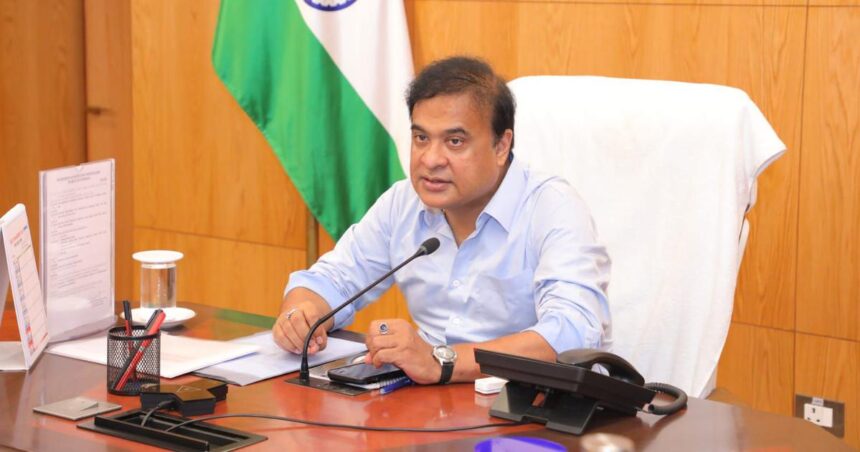
A recent internal suggestion to drop Foreigners Tribunal (FT) cases against individuals from six religious communities protected under the Citizenship Amendment Act (CAA) has sparked political and public outcry in Assam. While the idea was discussed in a departmental meeting, the state government has clarified that no formal instruction or cabinet directive has been issued to withdraw such cases. Chief Minister Himanta Biswa Sarma reiterated that existing protections under the CAA are already in place and require no separate government action.
The issue surfaced following a high-level meeting held on July 17 by the Assam Home and Political Department, chaired by the Additional Chief Secretary and attended by top officials from Assam Police, Health, and Home departments. Although the meeting was primarily focused on administrative reforms and technical implementation of new criminal laws, the Citizenship Amendment Act and its impact on Foreigners Tribunal cases were added to the discussion agenda.
What the Meeting Records Say
Minutes of the July 17 meeting reportedly suggested that cases against members of Hindu, Sikh, Buddhist, Jain, Parsi, and Christian communities who had entered India before December 31, 2014, should be dropped in line with the provisions of the CAA. These records were shared with District Commissioners (DCs) and Superintendents of Police (SPs) across Assam, triggering speculation that a blanket withdrawal of cases was imminent.
The minutes stated that the Foreigners Tribunals should not pursue cases involving individuals from the six communities if they arrived in India on or before the 2014 cut-off. It was recommended that local authorities convene meetings with FT members to review these cases and submit action-taken reports. The document further noted that such individuals should be guided and supported in applying for Indian citizenship under the amended law.
This internal note has led to considerable backlash, especially from local organizations like the All Assam Students’ Union (AASU), which has accused the government of shielding illegal immigrants selectively based on religion. AASU has announced statewide protests, questioning what it sees as an attempt to dilute the provisions of the Assam Accord, which sets March 24, 1971, as the cut-off for identifying foreign nationals.
Chief Minister’s Clarification and Government’s Position
Responding to media questions after a cabinet meeting on Thursday night, Chief Minister Himanta Biswa Sarma stated that the CAA already provides legal protection to people from these communities who arrived in India before 2014. He added that the state government had not passed any special resolution or issued any new instructions beyond what is stated in the central law.
He emphasized that the only instances where cabinet-level decisions were taken involved specific cases—such as the withdrawal of FT cases against Gorkha and Koch Rajbongshi communities—where formal orders were issued by the Home and Political Department. In contrast, the current discussion around the six religious groups has not led to any such actionable directive.
According to a senior official from the Home and Political Department who was present at the July 17 meeting, any future decision to formally withdraw cases will require a written and specific order from the state headquarters in Dispur. The official clarified that while discussions were held and suggestions were recorded, they do not translate into immediate or enforceable action.
The state government had, however, last year advised the border police not to directly refer new FT cases involving individuals from these six communities—if they had entered Assam before the 2014 CAA cut-off date. This guidance was limited to newly detected cases and did not affect the over 90,000 cases already pending before various Foreigners Tribunals across the state.
Background and Political Sensitivity
The foreigner identification process in Assam has always been politically sensitive. Assam shares a long international border with Bangladesh, and concerns over illegal immigration have been central to the state’s political discourse. The Assam Accord of 1985 established March 24, 1971, as the official cut-off date for identifying foreign nationals, a benchmark that differs from the CAA’s 2014 deadline.
Foreigners Tribunals play a crucial role in determining the citizenship status of individuals flagged by the border police as suspected illegal immigrants. Each case is adjudicated on merit, and individuals declared as foreigners face the risk of detention or deportation.
The CAA, passed by Parliament in 2019, amended the Citizenship Act to grant a pathway to Indian citizenship for undocumented non-Muslim migrants from Pakistan, Bangladesh, and Afghanistan, provided they entered India before December 31, 2014. While the law applies nationwide, its implementation in Assam has faced resistance from civil society groups who argue it undermines the Assam Accord and the state’s unique historical and demographic context.
The latest controversy illustrates the ongoing tension between the central legislation and Assam’s state-specific immigration policies. Even internal administrative discussions—if perceived as policy shifts—can trigger widespread concern among stakeholders. The government’s current position is that no formal withdrawal of existing FT cases has occurred and that any such decision would require a clearly communicated and officially sanctioned process.