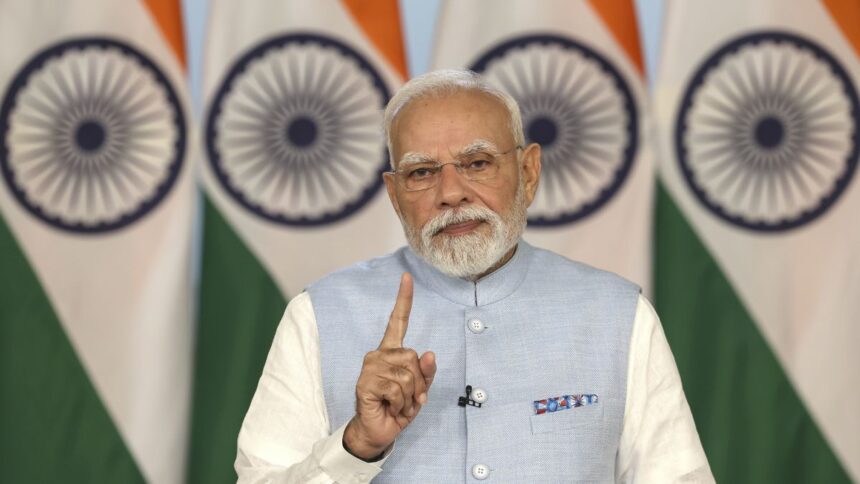
The Narendra Modi government has rolled out a sweeping reform of the Goods and Services Tax (GST), marking the most significant restructuring of India’s indirect tax system since its inception in 2017. Branded as a “Bachat Utsav” or festival of savings, the reform came into force on September 22, coinciding with the first day of Navaratri, and is expected to reshape consumer behavior, ease pressure on households, and inject fresh momentum into the economy. With the GST rates revised across 375 items and the slab system simplified into two primary categories, the Prime Minister assured that Indian households could collectively save up to ₹2.5 lakh crore annually, a figure that combines the benefits of GST revisions with the income tax reforms announced earlier this year. Positioned as both pro-poor and pro-middle class, the reforms promise cheaper essentials, affordable aspirational goods, and a competitive boost for small and medium businesses, even as critics in the Opposition remain unconvinced.
A New Tax Framework for a Growing Economy
The new GST framework, dubbed GST 2.0, introduces a streamlined two-tier rate structure in place of the earlier four slabs. Until now, goods and services were taxed at 5%, 12%, 18%, and 28%, with luxury and so-called “sin” goods such as tobacco attracting an additional compensation cess. Under the revised structure, most goods and services will now fall into just two categories — 5% and 18% — while ultra-luxury items face a 40% levy. Essential items consumed by households across the country, from ghee, paneer, and butter to snacks, ketchup, jam, coffee, and dry fruits, are taxed at the lower rate, bringing much-needed relief to consumers. Aspirational products such as air conditioners, televisions, and washing machines, which once symbolized the growing middle-class appetite for modern comforts, have also become more affordable. Medicines, kitchen essentials, and daily consumables are included in the reduced bracket, easing the burden on the poor and the expanding middle class that forms the backbone of India’s consumption-driven growth.
The government has positioned this reform as more than just a tax cut. It has been framed as a structural overhaul aimed at creating a predictable, transparent, and business-friendly tax regime. Prime Minister Modi highlighted in his address that the revised system would not only reduce the cost of living for ordinary citizens but also make it easier for businesses — particularly small and medium enterprises — to operate without navigating a complex multi-slab structure. By lowering compliance costs and ensuring uniformity, policymakers believe that GST 2.0 will provide India with a stable foundation to attract foreign investment while also stimulating domestic consumption.
For the government, the timing of the reform is significant. With the festive season underway, consumer spending typically sees a sharp rise, especially in sectors such as fast-moving consumer goods (FMCG), retail, e-commerce, and automobiles. The decision to implement the changes at the start of Navaratri was strategic, designed to maximize the psychological impact of lower prices and encourage spending on both essentials and aspirational goods. Lower prices on household appliances and electronics, coupled with reductions in the cost of everyday food items, are expected to spark demand at retail outlets and online platforms alike, providing a much-needed boost to the economy at a time of global uncertainty.
The reform also has geopolitical undertones. As the United States imposes tariffs on Indian merchandise exports, policymakers in New Delhi hope that stronger domestic demand will act as a cushion against potential external shocks. By focusing on boosting consumption at home, India aims to offset some of the pressures created by the changing dynamics of international trade.
Political Debate and the Road Ahead
While the government has hailed GST 2.0 as a festival of savings and a milestone in economic reform, the Opposition has been quick to challenge the narrative. Opposition leaders criticized the move as “a band-aid on deep wounds,” arguing that the government should never have imposed high taxes on essential goods in the first place. They contend that while the new rates may bring temporary relief, the structural issues within India’s tax system and broader economy remain unresolved. Some critics also see the reform as a populist measure timed to coincide with the festive season and upcoming political campaigns, rather than a bold, long-term economic strategy.
Nevertheless, for consumers and businesses, the immediate impact is tangible. Automobiles, long considered aspirational yet financially burdensome for many households, are now more affordable. This reduction is expected to draw in first-time buyers while also encouraging existing car owners to consider upgrades. Industry experts suggest that such a shift could have a multiplier effect, benefiting not just automobile manufacturers but also component suppliers, financing companies, and dealerships. Similarly, the FMCG sector anticipates a surge in demand as lower taxes on packaged foods, beverages, and household goods attract price-sensitive buyers. Retail chains and e-commerce platforms are gearing up for higher sales volumes, with the festive discounts combining with GST reductions to create unprecedented bargains for consumers.
From a business perspective, the reforms are particularly significant for India’s small and medium enterprises (SMEs). With simplified tax structures and reduced rates, SMEs gain an edge in competitiveness, enabling them to scale up operations, expand markets, and contribute more robustly to the national economy. Since SMEs constitute the backbone of India’s manufacturing and service industries, accounting for a substantial portion of employment and exports, their revitalization through GST 2.0 could have far-reaching consequences for economic growth.
Prime Minister Modi, in his address, emphasized the dual nature of the government’s recent reforms. The income tax revisions announced earlier in the year primarily benefited the middle class, offering relief to salaried households and encouraging savings. The GST reforms, he stressed, were designed to extend benefits to the poor and the emerging middle class, ensuring that the gains of economic growth are distributed across a wider spectrum of society. He urged citizens to embrace swadeshi products, asserting that the combination of tax reforms and domestic purchasing would strengthen the economy, create jobs, and enhance India’s global competitiveness.
The broader narrative woven around the “Bachat Utsav” is one of empowerment and optimism. By positioning tax reforms as a festival of savings, the government is not only easing economic burdens but also attempting to instill a sense of shared national progress. The branding aligns with the larger political messaging of the PM Modi administration, which has often framed economic measures as steps toward self-reliance, inclusivity, and long-term prosperity.
Industry analysts remain divided on the long-term implications of the reform. Some argue that the simplification of slabs and the reduction of rates could widen the fiscal deficit if not balanced by a corresponding increase in tax compliance and consumption. Others, however, view the reform as a pragmatic step toward aligning India’s tax system with global best practices while simultaneously energizing its domestic markets. For households already grappling with inflationary pressures, the immediate relief of cheaper goods and lower tax outgo provides welcome respite, reinforcing consumer confidence at a critical juncture.
The implementation of GST 2.0 represents more than just a numerical adjustment of rates. It reflects a conscious policy decision to tilt India’s economic model toward domestic demand, household relief, and small-business competitiveness. By anchoring the reform in the cultural context of Navaratri and labeling it a festival of savings, the government has attempted to ensure that the policy resonates not only in economic terms but also in the public imagination.