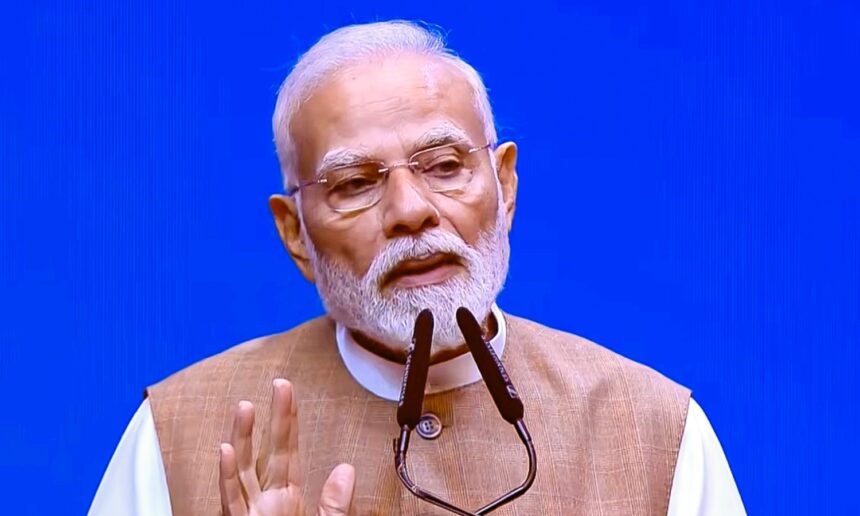
Prime Minister Narendra Modi has embarked on a three-day visit to South Africa to participate in the G20 Summit being held in Johannesburg, marking the first time the prestigious gathering is taking place on African soil. Before leaving for South Africa, the Prime Minister stated that he would present India’s perspective grounded in the philosophy of “Vasudhaiva Kutumbakam” and the guiding theme “One Earth, One Family, One Future.” This year’s summit holds exceptional diplomatic relevance, not only because of its historic African location but also due to the deepening partnership between India and Africa and the continuity it provides following India’s presidency of the G20 in 2023. For New Delhi, the summit represents a continued effort to strengthen the voice of the Global South, advance inclusive global governance, and shape the world’s economic and political agenda.
PM Modi’s Agenda in Johannesburg, Bilateral Engagements, and Participation in the IBSA Summit
Prime Minister Modi expressed enthusiasm for the Johannesburg meeting in a post on X, describing it as particularly special because Africa is hosting the G20 Summit for the first time. He said that the event would bring together world leaders for discussions on pressing global issues and provide opportunities for several bilateral meetings with key strategic partners. Alongside the main summit, the Prime Minister will also take part in the sixth IBSA Summit, a trilateral platform involving India, Brazil, and South Africa that focuses on cooperation among three major democracies of the Global South.
Modi’s visit comes at the invitation of South African President Cyril Ramaphosa, who is hosting the 20th G20 Leaders’ Summit under South Africa’s presidency. In his departure statement, Prime Minister Modi emphasized that India would stay committed to presenting its vision of global unity and collective progress. He highlighted that India’s approach to global diplomacy is driven by the belief that the world is one family, and solutions to modern crises must be universal, just, and inclusive.
He also recalled that during India’s presidency of the G20 in 2023, the African Union was officially inducted as a permanent member of the group—an unprecedented step that strengthened the voice of Africa and the Global South in global decision-making. South Africa, as chair this year, has continued this trajectory with the summit’s theme, “solidarity, equality, and sustainability,” aligning closely with the priorities set in earlier summits held in New Delhi and Rio de Janeiro.
Prime Minister Modi noted that he is also looking forward to interacting with the Indian diaspora in South Africa, one of the largest Indian-origin communities outside India. He acknowledged their significant contributions to South Africa’s society, culture, and economy, and emphasized the emotional connection India shares with its diaspora.
The Ministry of External Affairs earlier confirmed that the Prime Minister is expected to address all three sessions of the summit. These sessions will cover a wide range of global challenges—such as inclusive growth, sustainable development, climate resilience, disaster risk reduction, transitions to clean energy, food system reforms, the future of work, the role of critical minerals, and the regulation and potential of artificial intelligence.
A senior MEA official said that while he would not pre-judge what would appear in the leaders’ joint declaration, India would highlight all issues of relevance to the Global South. India’s position as a leading advocate for developing nations has shaped its diplomatic engagements over the last few years, and this summit is viewed as another critical platform for advancing these priorities.
This summit is the fourth consecutive G20 gathering held in the Global South. Before South Africa, presidencies were held by Brazil in 2024, India in 2023, and Indonesia in 2022. The continuity represents a geopolitical shift where emerging economies are increasingly taking the lead in shaping global governance frameworks.
The G20 represents the world’s largest and most powerful economies, accounting for 85 percent of global GDP, 75 percent of international trade, and two-thirds of the world’s population. Its members include Argentina, Australia, Brazil, Canada, China, France, Germany, India, Indonesia, Italy, Japan, South Korea, Mexico, Russia, Saudi Arabia, South Africa, Turkiye, the United Kingdom, the United States, the European Union, and the African Union.
Key Summit Themes, Global Challenges, and India’s Strategic Priorities
The Johannesburg G20 Summit serves as a pivotal global forum where economic recovery, geopolitical tensions, and long-term sustainability are central to the agenda. The summit features three major sessions covering inclusive growth, global resilience, and long-term fairness in global economic transformations. These discussions come at a time when the world is grappling with economic uncertainty, climate disasters, technological disruptions, and widening inequality.
The first session, titled “inclusive and sustainable economic growth leaving no one behind,” will examine how nations can rebuild their economies through fair trade, accessible financing, and responsible borrowing practices. As many countries continue to face heavy debt burdens and volatile financial markets, this session seeks to identify pathways for sustainable development. India is expected to emphasize digital public infrastructure, inclusive digital payments, financial transparency, and the need for global reforms that ensure developing nations are not left behind.
The second session, “a resilient world – the G20’s contribution,” will focus on disaster risk reduction, climate adaptation, energy transitions, and the creation of robust food systems. India has long advocated for climate justice, arguing that developing countries must be supported with technology transfer, climate finance, and equitable transition frameworks. India’s experience with early warning systems, renewable energy expansion, and community-led disaster management will be shared as models for international cooperation.
The third session, “a fair and a just future for all,” will address the role of critical minerals, emerging global employment trends, and the regulation and opportunities of artificial intelligence. As AI transforms industries and job markets, India is expected to advocate for ethical AI governance that ensures transparency, accountability, and access for developing countries. The conversation on critical minerals—essential for electric vehicles, batteries, and renewable technologies—is also likely to be central to India’s engagement, given the strategic competition over mineral supply chains worldwide.
India’s presence at the summit is particularly significant because of its expanding influence in shaping the priorities of the Global South. India’s diplomatic outreach has been increasingly focused on advocating for fair representation, transparency in global governance, and equitable resource distribution. India’s initiatives during its 2023 G20 presidency—such as the Global Biofuel Alliance, the Green Development Pact, and a renewed focus on digital innovation—continue to influence global policies and discussions.
India’s participation in this summit is not only about diplomatic visibility but also about shaping long-term global reforms. From energy security to food security, from sustainable financing to digital transformation, India stands at the forefront of advocating solutions that benefit both developed and developing nations. The partnership between India and Africa, reinforced by the African Union’s permanent membership, gives additional weight to India’s efforts to promote global equity.
As the summit unfolds, India aims to use this platform to articulate a balanced approach to growth—one that encourages innovation, environmental responsibility, and inclusive development. Prime Minister Modi’s engagement with global leaders is expected to reinforce India’s message that collective challenges require collective solutions grounded in fairness and shared humanity.