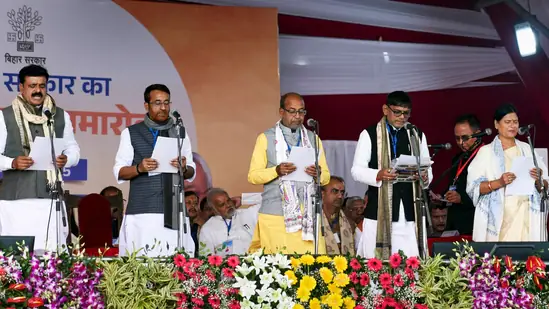
After taking oath as Bihar Chief Minister for the 10th time in a grand ceremony at Patna’s Gandhi Maidan on Thursday, Nitish Kumar has set the stage for his new cabinet under the National Democratic Alliance (NDA). The event, attended by Prime Minister Narendra Modi, Home Minister Amit Shah, BJP President JP Nadda, and other dignitaries, saw 26 ministers join the JD(U) supremo in the oath-taking ceremony. While the portfolios for the ministers are set to be announced later, the composition of the new cabinet reflects political balancing, caste considerations, and minority representation, with three women ministers and a single Muslim member retaining their presence from the previous term. As Bihar enters its next chapter under Nitish Kumar, attention now shifts to how the cabinet positions will be distributed and the policy priorities that will follow.
Nitish Kumar’s New Cabinet: Composition and Representation
The new Bihar cabinet, sworn in as part of the NDA government, brings together a total of 27 ministers, including Chief Minister Nitish Kumar. While the final constitutionally mandated limit of 36 will be reached after nine more ministers are inducted, the current composition already demonstrates a deliberate approach to caste and community representation. Among the ministers, eight belong to upper-caste communities, including four Rajputs, two Bhumihars, and one each from Brahmin and Kayasth communities. In addition, the cabinet includes significant representation from Other Backward Classes (OBCs), with three berths for Kushwaha, two each for Kurmi, Vaishya, and Yadav communities.
The representation of Extremely Backward Classes (EBCs) includes three ministers, two of whom are from the Nishad community, while five cabinet berths have been allocated to Dalits. In total, 13 ministers, including the Chief Minister, hail from the OBC and EBC categories, reflecting Nitish Kumar’s continued focus on social inclusivity and political representation of backward communities.
Religious representation is also evident, albeit limited, with Zama Khan of the JD(U) remaining the sole Muslim member in the council of ministers. Khan, representing the Chainpur constituency, has retained his position from the previous cabinet, marking continuity in the political inclusion of minority communities. On the gender front, the new cabinet includes three women ministers: Leshi Singh from JD(U), who has previously held ministerial responsibilities, and newcomers Shreyashi Singh and Rama Nishad, both from the BJP. This blend of experience and fresh faces signals the government’s attempt to incorporate diverse perspectives while maintaining political balance among allied parties.
The coalition composition further highlights the NDA’s political partnerships in Bihar. While JD(U) has eight ministers in the new cabinet, the BJP accounts for 14, reflecting its dominant role within the alliance. The Lok Janshakti Party (Ram Vilas) contributes two ministers, while the Hindustani Awam Morcha (Secular) and Rashtriya Lok Morcha each have a single representative. This arrangement underscores the coalition’s strategy of distributing power among allies while ensuring JD(U) maintains its leadership role in the government.
The Mega Swearing-In and Anticipated Portfolio Allocation
The swearing-in ceremony at Gandhi Maidan was a significant event, showcasing the grandeur and political importance of Bihar’s leadership transition. Chief Minister Nitish Kumar, a veteran politician with a decade-spanning tenure, took oath in front of thousands, including top political figures and party leaders. Alongside him, 26 ministers were sworn in in batches of six, with each batch representing a cross-section of the NDA coalition.
Among the ministers taking oath, the BJP leaders Samrat Choudhury and Vijay Kumar Sinha are expected to continue as deputy chief ministers, ensuring continuity in leadership roles and the coalition’s internal power dynamics. The ceremony also signified a symbolic balancing act between senior leaders and new entrants, reflecting political strategy and alliance management.
While the ceremonial aspect of the oath-taking captured public and media attention, the real focus now shifts to portfolio allocation, which is expected to be announced soon. The distribution of ministries will play a crucial role in determining the government’s priorities, policy implementation, and administrative efficiency. Historically, Nitish Kumar has emphasized inclusive governance, and the forthcoming portfolio announcement is likely to reflect this approach, with key departments being assigned to experienced ministers and strategically important constituencies.
The cabinet’s composition, with its mix of experienced leaders, political allies, women, backward communities, and minority representation, is being viewed as a carefully curated structure aimed at maintaining political stability while addressing social equity. By retaining prominent faces like Zama Khan and Leshi Singh and introducing new leaders from both JD(U) and BJP, the government signals its commitment to continuity alongside innovation in governance.
The next nine cabinet berths, yet to be filled, are expected to further strengthen the coalition’s balance and ensure representation across Bihar’s diverse social fabric. Analysts predict that these appointments will also reflect Nitish Kumar’s political calculations ahead of future elections, as well as his efforts to solidify the NDA’s presence across key constituencies.
As the NDA-led government in Bihar takes shape, the strategic blend of experienced ministers and fresh entrants, coupled with social and political representation, positions Nitish Kumar’s cabinet as a critical element in shaping the state’s governance trajectory. The upcoming portfolio allocation will provide a clearer picture of the administration’s priorities, marking the start of a new chapter in Bihar’s political landscape under one of its most enduring leaders.