In a landmark development aimed at transforming connectivity in the Delhi-NCR region, Prime Minister Narendra Modi is set to inaugurate two major expressway projects on Sunday that promise to drastically reduce travel time to the Indira Gandhi International Airport (IGI) from Noida and surrounding areas. The Urban Extension Road-II (UER-II) and the Delhi segment of the Dwarka Expressway are poised to redefine commuter experiences in the capital, providing smooth, uninterrupted travel while easing congestion on some of the city’s busiest arterial roads. These projects mark a crucial step in enhancing regional infrastructure, facilitating rapid movement across Delhi and its suburbs, and offering commuters a far more efficient alternative to existing routes. With the opening of these expressways, travel from Noida to IGI Airport is expected to take as little as 20 minutes, a remarkable reduction from the current travel time, thus improving connectivity for domestic and international travelers alike. Beyond airport access, these expressways are designed to support the flow of traffic toward Gurugram, Jaipur, and western Delhi, addressing long-standing bottlenecks that have plagued daily commuters.
Enhanced Connectivity and Features of UER-II
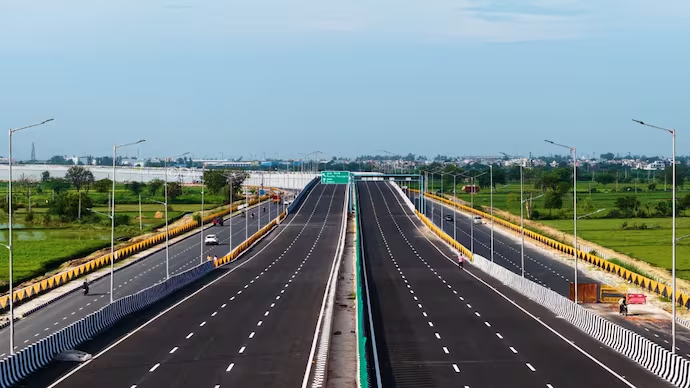
The Urban Extension Road-II, a 76-kilometre corridor developed at an estimated cost of Rs 7,716 crore, has been envisioned as Delhi’s new “outer ring road.” Stretching from Alipur in the north to Mahipalpur near the airport, UER-II provides a high-capacity alternative to the existing congested road network. The expressway connects key regions including Mundka, Bakkarwala, Najafgarh, and Dwarka, while integrating seamlessly with major highways such as Delhi-Chandigarh, Delhi-Rohtak, and Sonipat. This strategically designed corridor features four-to-six lanes in its main carriageway, complemented by service roads, multiple underpasses, and eight-lane stretches to facilitate uninterrupted traffic flow. Additionally, the corridor includes four multi-level interchanges aimed at reducing congestion at junctions and enabling smoother merging of local and highway traffic. Officials from the National Highways Authority of India have emphasized that the expressway’s design adheres to modern standards of safety and efficiency, making it a model project under the Delhi Master Plan 2021. By providing a direct and controlled-access route across Delhi, UER-II not only eases the pressure on the city’s Ring Road and arterial streets but also promotes economic activity by improving the movement of goods and passengers across the northern and western parts of the national capital region.
In addition to its functional significance, UER-II is expected to support the growth of suburban regions by providing rapid connectivity to central Delhi and the airport. The corridor is also a critical component in the broader urban mobility plan, which aims to integrate expressways, metro corridors, and arterial roads to create a cohesive, multi-modal transport network. Planners have incorporated multiple access points, flyovers, and pedestrian facilities to ensure the expressway serves both long-distance travelers and local commuters. Furthermore, UER-II’s alignment through Delhi and Haryana ensures regional integration, making it a pivotal link in the northern transport network and fostering smoother inter-state traffic movement.
Dwarka Expressway: Complementing the UER-II for Seamless Travel
Alongside UER-II, Prime Minister Modi will inaugurate the 29-kilometre Delhi section of the Dwarka Expressway, connecting the Kherki Daula toll plaza to Shiv Murti near Mahipalpur. This expressway, which complements the Gurugram section inaugurated in March 2024, serves as an alternative route to the IGI Airport and provides direct access for western Delhi and neighboring suburbs. The Dwarka Expressway, constructed at an estimated cost of Rs 9,000 crore, has been developed in four packages, integrating multiple lanes, interchanges, and service roads to facilitate efficient, uninterrupted movement. The project is a significant part of the region’s infrastructure plan, aiming to divert traffic from congested city roads and provide commuters with a reliable, high-speed corridor.
The expressway’s design includes advanced features such as controlled access points, underpasses for local traffic, multi-level interchanges, and dedicated service lanes to manage both intra-city and inter-city travel. The route is expected to reduce congestion on Delhi’s Ring Road and key arterial streets, enhancing travel experiences for both private and commercial vehicles. By linking residential areas, commercial hubs, and the airport directly, the Dwarka Expressway plays a vital role in supporting economic activity and providing commuters with predictable travel times, thereby improving overall urban mobility.
The inauguration of UER-II and the Dwarka Expressway represents a holistic approach to urban planning, integrating transportation corridors with regional development objectives. Officials have emphasized that these expressways will collectively improve the flow of traffic across Delhi-NCR, facilitate faster airport access, and support the expansion of suburban areas by reducing travel times. The project also reflects the government’s commitment to modernizing infrastructure, improving commuter experiences, and promoting sustainable urban growth.
Union Minister Nitin Gadkari, Delhi Chief Minister Rekha Gupta, Haryana Chief Minister Nayab Singh Saini, and other senior BJP leaders are expected to attend the inauguration, highlighting the strategic and political significance of these projects. With these expressways, daily commuting in Delhi-NCR is set to become more efficient, travel to the airport is expected to be significantly faster, and the overall transportation landscape of the region is poised for a transformative change.
The combination of UER-II and the Delhi section of the Dwarka Expressway ensures a controlled-access, uninterrupted route that can handle high volumes of traffic, reducing congestion on existing roads while improving safety and reliability. These infrastructure projects demonstrate the government’s focus on long-term urban mobility solutions, integrating road development with broader planning goals to create a cohesive and modern transport network. As traffic flow improves and travel times decrease, residents, businesses, and travelers across Delhi-NCR are expected to experience substantial benefits, reinforcing the importance of strategic infrastructure investment in enhancing regional connectivity and economic growth.