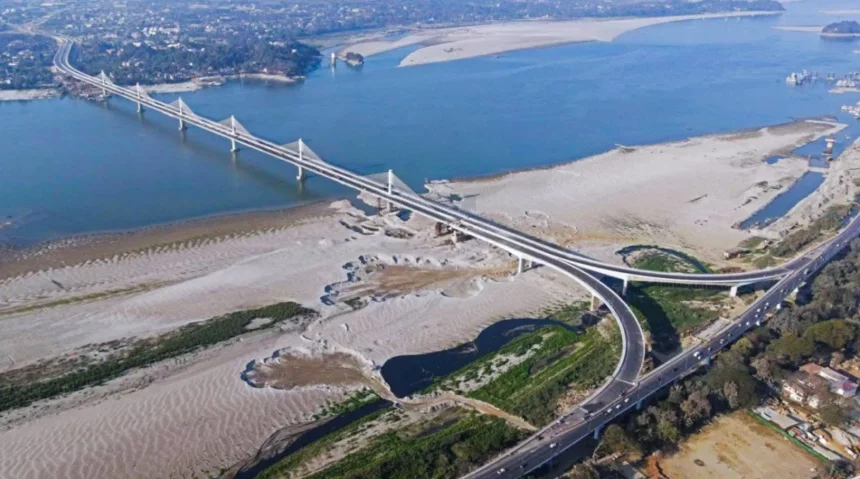
Prime Minister Narendra Modi is scheduled to inaugurate the Kumar Bhaskar Varma Setu on February 14, marking a significant milestone in Assam’s infrastructure development and urban connectivity. Spanning the mighty Brahmaputra, the six-lane bridge is expected to dramatically alter daily commuting patterns between the southern and northern banks of Guwahati. With an investment of approximately Rs 3,300 crore, the project represents one of the most ambitious urban connectivity initiatives undertaken in the region in recent years. Beyond its imposing physical presence, the bridge symbolizes a strategic push to integrate urban expansion, economic growth, and long-term planning in Assam’s rapidly growing capital region.
The most immediate and tangible impact of the bridge will be felt in travel time. What once took commuters anywhere between 45 minutes to over an hour, depending on traffic and weather conditions, will now be reduced to a swift 7 to 10-minute journey. For thousands of residents, office-goers, students, and transport operators, this change is not merely about convenience but about reclaiming time and predictability in daily life. The bridge stands as a response to years of congestion, limited crossing options, and the growing strain on Guwahati’s transport infrastructure as the city expanded in both population and economic activity.
Engineering Vision and Connectivity Corridor
The Kumar Bhaskar Varma Setu, a 1.24-kilometre-long extradosed bridge, is part of a broader 8.4-kilometre connectivity corridor designed to seamlessly link key urban and peri-urban areas across the river. Extradosed bridges, known for combining elements of girder and cable-stayed designs, offer both structural efficiency and visual elegance. In this case, the design has been carefully chosen to withstand the Brahmaputra’s challenging conditions, including strong currents, fluctuating water levels, and seasonal flooding.
For decades, Guwahati’s dependence on the aging Saraighat Bridge placed enormous pressure on a single crossing point. As vehicle numbers surged, bottlenecks became routine, particularly during peak office hours. The situation worsened during monsoon months, when heavy rainfall and swelling river levels slowed traffic and occasionally disrupted ferry services. Winter fog further added to uncertainty, often delaying or suspending river crossings altogether. The new bridge offers an all-weather alternative, ensuring uninterrupted connectivity regardless of seasonal challenges.
From a planning perspective, the bridge is not an isolated structure but a critical link in a network aimed at decongesting the city’s southern bank. By creating a high-capacity route to North Guwahati, authorities aim to redistribute traffic flows and reduce the chronic pressure on central Guwahati roads. This redistribution is expected to improve overall traffic efficiency, lower fuel consumption caused by idling vehicles, and contribute to reduced emissions over time.
The construction process itself has been a complex undertaking, involving advanced engineering techniques, extensive geotechnical studies, and coordinated efforts between central and state agencies. Building across one of Asia’s widest rivers required meticulous planning to ensure safety, durability, and minimal environmental disruption. The successful completion of the project underscores the growing capacity of Indian infrastructure agencies to deliver large-scale projects in challenging terrains.
Urban Expansion, Governance, and Historical Legacy
Beyond transportation, the bridge plays a crucial role in Guwahati’s long-term urban and administrative strategy. North Guwahati has been identified as a key zone for future expansion, with plans underway to shift major institutions, including the Guwahati High Court and several government offices, to the northern bank. This decentralization is intended to ease pressure on the overcrowded southern parts of the city while stimulating balanced development across the river.
Improved accessibility is central to making this shift viable. Without reliable and fast connectivity, relocating critical institutions would have placed additional burdens on commuters and administrators alike. The new bridge ensures that North Guwahati remains seamlessly connected to the city’s commercial hubs, residential areas, and transport nodes, making the transition both practical and sustainable.
The economic implications are equally significant. Enhanced connectivity is expected to boost real estate development, attract new businesses, and encourage investment in areas that were previously considered peripheral due to limited access. Improved logistics and reduced travel times can also benefit small traders, service providers, and tourism-related activities, contributing to a more diversified urban economy.
The bridge’s name carries deep historical resonance, honoring Kumar Bhaskar Varma, a celebrated ruler of the 7th-century Kamrupa Kingdom. His reign is remembered for fostering prosperity, cultural exchange, and political prominence for ancient Assam. By naming the bridge after him, the project draws a symbolic connection between Assam’s rich past and its aspirations for the future. It reflects an effort to embed cultural memory within modern infrastructure, ensuring that development does not come at the cost of historical identity.
In many ways, the Kumar Bhaskar Varma Setu represents a convergence of engineering ambition, urban planning, and cultural recognition. It addresses immediate practical challenges while laying the groundwork for long-term transformation. As Guwahati continues to grow as a gateway to the Northeast, the bridge stands poised to redefine how the city moves, expands, and connects, not just across the Brahmaputra, but toward a more integrated and forward-looking urban future.