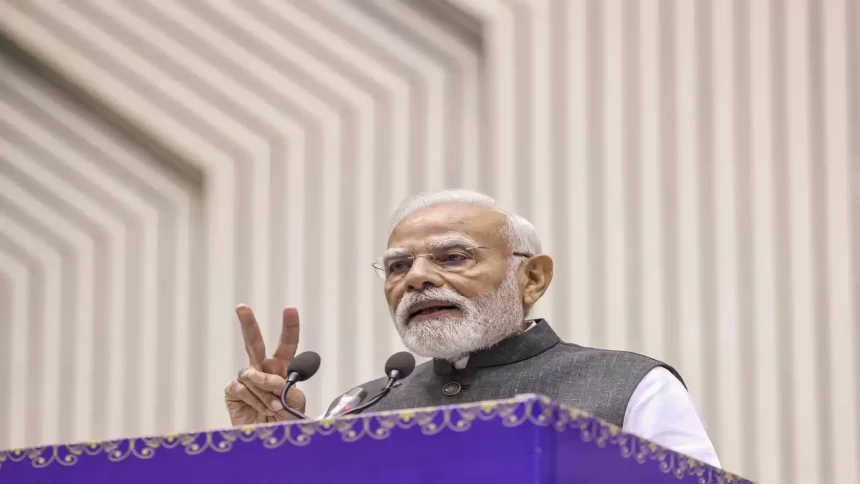
The inauguration of Navi Mumbai International Airport by Prime Minister Narendra Modi marks a historic milestone in India’s aviation landscape. With this development, Mumbai joins the ranks of a select group of global cities that boast multiple international airports, including London, New York, and Tokyo. Positioned as a game-changer in the country’s aviation ecosystem, this state-of-the-art airport is expected to redefine passenger experience through seamless digital integration and advanced infrastructure. Commercial operations are expected to commence in December, and the airport will serve as a critical hub connecting multiple cities and international destinations while also boosting the regional economy and employment generation.
A major milestone in India’s aviation sector
The Navi Mumbai airport has been developed under a public-private partnership model between Adani Airport Holdings and City and Industrial Development Corporation of Maharashtra Ltd. Built at an estimated cost of ₹19,650 crore, the project represents one of the most ambitious infrastructure undertakings in India’s recent history. Spanning across 1,160 hectares, the airport is designed to be India’s first fully digital airport, introducing a level of automation and connectivity that promises to transform the air travel experience for millions of passengers.
In its initial phase, the airport will operate with one runway and one terminal, handling 20 million passengers annually. This figure is expected to grow exponentially over the years, with the airport projected to accommodate 155 million passengers annually upon full expansion with four terminals and two runways. This capacity will position Navi Mumbai as one of the largest and busiest aviation hubs in the country, relieving the growing pressure on Chhatrapati Shivaji Maharaj International Airport in Mumbai and enabling smoother travel for both domestic and international passengers.
One of the most striking features of the new airport is its complete integration of digital and automated systems. From pre-booking parking slots to online baggage drop, automated immigration, and AI-enabled terminal operations, passengers will experience a seamless journey from entry to boarding. The airport aims to set new benchmarks in efficiency and passenger comfort, aligning with global standards.
The construction of this mega infrastructure project also has far-reaching economic implications. Beyond its aviation functions, the airport is expected to generate more than two lakh jobs across sectors such as logistics, IT, hospitality, and real estate. The surrounding region is likely to witness a surge in economic activity as businesses, developers, and service providers tap into the opportunities created by the airport’s operationalization. This integrated development aligns with India’s vision of becoming a global economic and transportation hub.
A digital-first airport designed for the future
What truly distinguishes the Navi Mumbai airport is its emphasis on digitalization and passenger convenience. This will be India’s first airport to offer fully integrated digital services, allowing travelers to manage several processes online even before stepping into the terminal. Vehicle parking slots can be pre-booked through mobile applications, while baggage drop, check-in, and immigration services are designed to be quick, automated, and paperless.
According to Arun Bansal, CEO of Adani Airport Holdings Ltd, the airport has been envisioned as an “anxiety-free airport,” minimizing passenger wait times and travel-related hassles. One of the standout technological features will be AI-enabled baggage tracking. Passengers will receive real-time updates on their baggage status through their mobile phones, eliminating uncertainty and reducing congestion around baggage carousels. This innovation, already being piloted in Ahmedabad, will now be fully operational in Navi Mumbai, positioning the airport as a technology leader in the Indian aviation industry.
The airport’s initial operational phase will see about 40 percent of its traffic coming from international flights, gradually increasing to 75 percent in the coming years. This strategic focus on international connectivity underscores Navi Mumbai’s potential to become a major global aviation hub. Airlines such as IndiGo, Air India Express, and Akasa Air have already announced their plans to commence operations at the new airport. The integration of multiple airlines will ensure that passengers have access to a wider network of destinations, improving overall connectivity from the Mumbai metropolitan region.
Another unique aspect of the airport’s operational plan is its initial 12-hour daily schedule, which will gradually be scaled up as passenger volumes increase. This staggered approach will allow authorities to monitor and fine-tune systems during the early stages of commercial operations, ensuring a smooth transition to full capacity over time.
The airport is also strategically designed to be an intermodal transport hub, connected to several modes of transportation including expressways, metro lines, suburban rail networks, and waterway services. This level of connectivity is unprecedented in India and mirrors the integrated transport systems of major global cities. By offering multiple access points, the airport will reduce travel time for passengers across the Mumbai metropolitan region and beyond, enhancing its attractiveness for both travelers and businesses.
A boost to connectivity, economy, and global positioning
The development of Navi Mumbai International Airport is not merely about expanding aviation infrastructure; it is part of a larger vision to strengthen India’s position as a major player in the global aviation sector. Mumbai has long been one of the busiest air traffic hubs in the country, with its existing airport operating at near-saturation levels. The addition of a second major international airport will ease operational pressure, enhance capacity, and improve the overall efficiency of the region’s air traffic management.
Moreover, the project represents a crucial step in transforming the Navi Mumbai region into an economic powerhouse. The airport is expected to drive investments in commercial real estate, logistics hubs, and hospitality infrastructure. Affordable housing projects have already been planned around the airport to cater to the expected influx of workforce and associated industries. The real estate market is poised to experience a significant upswing, further boosting the region’s development trajectory.
The airport’s economic multiplier effect is expected to be felt far beyond the aviation industry. As trade and travel increase, sectors like tourism, technology, and logistics will receive a strong push. The creation of over two lakh jobs will contribute to socio-economic development, while the improved connectivity will facilitate easier movement of goods and services across domestic and international routes.
This project also reflects India’s growing focus on sustainable and future-ready infrastructure. By incorporating advanced digital systems, automated processes, and efficient connectivity models, Navi Mumbai International Airport positions itself at the forefront of next-generation aviation hubs. It symbolizes a vision where airports are not just transportation nodes but integrated ecosystems that drive economic growth, technological innovation, and global competitiveness.
The inauguration of this landmark project by Prime Minister Modi signifies more than the opening of a new airport. It represents a bold statement of India’s ambitions in modern infrastructure development and its commitment to providing world-class facilities to passengers and industries alike. With commercial operations set to begin in December, the new airport is expected to quickly become a crucial part of India’s aviation network, linking domestic and international destinations with unmatched efficiency and comfort.
This development is set to reshape Mumbai’s connectivity landscape, offering travelers a new experience of flying that combines technology, convenience, and scale. As the country moves towards becoming one of the world’s largest aviation markets, the Navi Mumbai International Airport will stand as a model for how infrastructure can be reimagined to meet future demands.