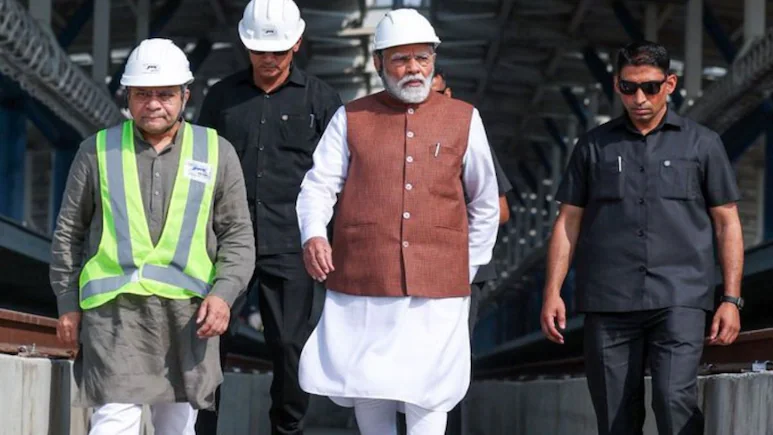
Prime Minister Narendra Modi visited the under-construction Surat Bullet Train Station in Gujarat, taking stock of India’s first high-speed rail project and interacting with engineers, workers, and officials to assess progress and adherence to timelines and speed targets. His visit underscored the government’s commitment to modernising India’s transportation infrastructure, promoting engineering excellence, and emphasising lessons learned for future large-scale projects. The Surat station, part of the Mumbai-Ahmedabad High-Speed Rail Corridor (MAHSR), represents a major milestone in India’s journey toward building world-class, rapid transit networks that combine efficiency, safety, and economic transformation.
Engaging with Workers and Engineers: National Service and Pride in India’s First Bullet Train
During his visit, Prime Minister Modi spent significant time engaging with the team of engineers, project managers, and workers overseeing India’s pioneering Bullet Train project. He inquired specifically about the project’s progress, ensuring that work on the corridor adhered to schedule and achieved speed targets. Officials and workers assured him that all construction was proceeding smoothly and without obstacles, reflecting the disciplined coordination across multiple teams. Modi’s interactions highlighted the central role of human dedication in delivering a national-scale infrastructure project and reinforced the broader vision of integrating innovation with national service.
An engineer from Kerala, working at the Noise Barrier Factory in Navsari, described her experience in deploying robotic units for welding rebar cages. When the Prime Minister asked about her personal experience, she reflected on the pride she felt in contributing to India’s first Bullet Train, calling it a “dream project” and a “moment of pride” for her family. This personal narrative resonated deeply with Modi, who emphasised that undertaking tasks that contribute to the nation instils unparalleled motivation and satisfaction, drawing parallels to India’s space journey and the pioneering scientists who launched the country’s first satellite. The Prime Minister stressed that such experiences, rooted in national service, inspire future generations and create a sense of purpose beyond individual accomplishments.
Another team member, Shruti from Bengaluru, who serves as Lead Engineering Manager, elaborated on the rigorous design and engineering control processes implemented throughout the project. She highlighted that at each stage, her team evaluates the pros and cons of every decision, explores multiple alternatives, and ensures that execution meets international standards. Modi observed that documenting these experiences, insights, and processes in a structured format—like a “Blue Book”—would allow India to avoid repeated experimentation, replicate successful practices, and accelerate the large-scale implementation of high-speed rail projects across the country. He emphasised that replication would be meaningful only if there is a clear understanding of why specific methods were adopted, cautioning against purposeless imitation.
During the interactions, Modi also praised the heartfelt contributions of workers who articulated their dedication in creative ways, including through poems celebrating their commitment to the project. These moments reflected the deep personal connection that employees feel toward India’s first high-speed rail corridor and underscored the Prime Minister’s recognition of their efforts as integral to national development. He reiterated that the lessons, experiences, and innovations arising from the Surat-Bilimora section should be carefully documented to guide future infrastructure projects and inspire students, engineers, and policymakers alike.
Technical Progress and Transformative Impact of the Mumbai-Ahmedabad High-Speed Rail Corridor
The Mumbai-Ahmedabad High-Speed Rail Corridor, spanning approximately 508 kilometres—352 km in Gujarat and Dadra & Nagar Haveli and 156 km in Maharashtra—is poised to revolutionise inter-city travel in India. Connecting major cities such as Sabarmati, Ahmedabad, Anand, Vadodara, Bharuch, Surat, Bilimora, Vapi, Boisar, Virar, Thane, and Mumbai, the corridor will dramatically reduce travel times, enhance passenger comfort, and stimulate economic activity along the route. Upon completion, the journey between Mumbai and Ahmedabad will take nearly two hours, transforming the way business, tourism, and regional commerce operate along this strategic corridor.
Advanced engineering techniques, adhering to international standards, characterise the project. Approximately 465 km, or about 85 percent of the route, has been constructed on viaducts, reducing land disturbance and enhancing safety. To date, 326 km of viaduct work has been completed, alongside the construction of 17 out of 25 river bridges. The Surat-Bilimora section, which covers roughly 47 km, is in an advanced stage, with civil works and track-bed laying completed. The meticulous execution reflects both technical expertise and the adoption of best practices, positioning India as a global player in high-speed rail infrastructure.
The Surat station, designed with inspiration from the city’s internationally renowned diamond industry, blends elegance with functionality. Passenger comfort has been prioritised, with spacious lounges, well-planned restrooms, retail outlets, and facilities designed for a seamless travel experience. The station also offers robust multi-modal connectivity, integrating the Surat Metro, city buses, and the Indian Railways network, ensuring ease of access for commuters and tourists alike. Such design choices emphasise the vision of creating not just a transport hub but a landmark of modern infrastructure, reflecting India’s ambition in both aesthetics and engineering.
Prime Minister Modi, while reviewing the progress, stressed the importance of systematic learning and knowledge transfer from this project. Documenting engineering practices, design decisions, and project management strategies would allow India to implement bullet train projects in other regions efficiently. By recording successes, challenges, and resolutions, future projects can avoid redundant trial-and-error approaches, accelerating the adoption of high-speed rail networks nationwide. The Prime Minister highlighted the critical intersection of technological excellence, disciplined execution, and visionary leadership in achieving transformative infrastructure outcomes.
Union Minister Ashwini Vaishnaw accompanied the Prime Minister during the visit, providing insights into technical aspects and policy frameworks that govern the corridor. The project, combining civil, mechanical, and electrical engineering advancements, is a testament to India’s growing capability to execute complex projects with world-class quality and precision. Modi underscored that replicating the learnings from Surat and other completed sections would contribute significantly to India’s larger vision of modern, high-speed, and sustainable transport infrastructure.
The strategic importance of the corridor extends beyond speed and comfort. The project is expected to catalyse regional development, attracting investment, promoting tourism, and fostering ancillary industries along the route. By linking major urban centres efficiently, the corridor is set to redefine urban-rural connectivity, facilitate economic integration, and encourage balanced regional growth. The bullet train project exemplifies India’s ability to merge technological innovation with social and economic impact, showcasing how infrastructure development can drive holistic progress.
Workers, engineers, and project managers emphasised that the collaborative environment, rigorous adherence to international standards, and focus on sustainable development were central to achieving project milestones. Modi’s engagement with these teams highlighted the human element in infrastructure achievement, reinforcing the philosophy that large-scale projects succeed not merely through capital investment but through meticulous planning, coordination, and a shared sense of national purpose. The project’s execution demonstrates India’s capacity for excellence in planning, engineering, and project management at a global scale.
As India progresses on its high-speed rail agenda, the Surat-Bilimora section, and the larger Mumbai-Ahmedabad corridor serve as exemplars of disciplined execution, innovation, and nation-building. The lessons learned here—spanning technical, managerial, and human resource domains—offer a blueprint for future projects, ensuring that India’s infrastructure growth is both rapid and sustainable. By combining technology, knowledge sharing, and strategic foresight, the bullet train project encapsulates a transformative chapter in India’s economic and transport history.