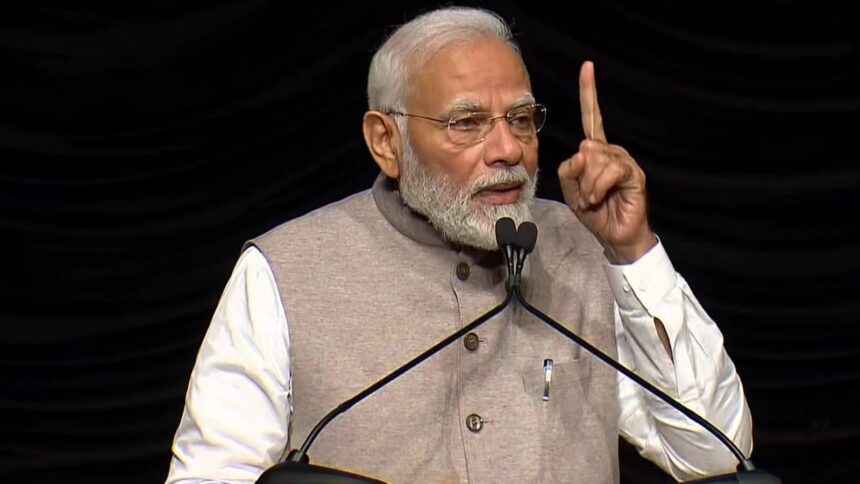
On the 50th anniversary of the Emergency, Prime Minister Narendra Modi recalled the turbulent 21-month period between 1975 and 1977 as one of the darkest chapters in India’s democratic history. Marking the day as Samvidhan Hatya Diwas, the Prime Minister said the Emergency was a direct attack on the Constitution and the rights of Indian citizens. Reflecting on his personal journey during the time as a young RSS volunteer, PM Modi said the anti-Emergency movement was a transformative experience that deepened his commitment to democratic values and the constitutional framework of the nation.
PM Modi calls Emergency a betrayal of Constitution
In a series of posts on social media platform X, PM Modi said, “Today marks fifty years since one of the darkest chapters in India’s democratic history, the imposition of the Emergency. The people of India mark this day as Samvidhan Hatya Diwas.” He emphasized that the declaration of Emergency by the then Congress government led to the suspension of fundamental rights, muzzling of the press, arrests of political leaders, social workers and students, and the stifling of Parliament and the judiciary.
PM Modi, who was an active member of the Rashtriya Swayamsevak Sangh (RSS) during that period, reflected on the 42nd Amendment brought during the Emergency, calling it a symbol of the excesses committed by the ruling party at that time. He said, “It was as if the Congress Government in power at that time placed democracy under arrest.” He added that the poor and marginalised were among the worst affected and that their dignity was trampled upon.
Tribute to those who resisted Emergency
The Prime Minister paid rich tributes to those who stood against the Emergency. “We salute every person who stood firm in the fight against the Emergency,” he said. PM Modi highlighted that this resistance came from people of various ideologies and backgrounds who came together with a shared goal: to restore democracy and uphold the values for which India’s freedom fighters had sacrificed their lives.
He further stated that this collective movement compelled the then Congress government to lift the Emergency and conduct general elections, which they lost. PM Modi said his government continues to honour those sacrifices by remaining committed to the ideals of the Constitution and ensuring that India evolves into a Viksit Bharat — a developed nation where the dreams of the poor and downtrodden are fulfilled.
PM Modi also mentioned The Emergency Diaries, a new book chronicling personal and political stories from that time. He revealed that reading it brought back powerful memories of the period. Encouraging those who lived through the Emergency or whose families were affected to share their experiences on social media, PM Modi said such stories can educate younger generations about the dangers of authoritarian rule.
Reflecting on his personal growth during the Emergency, PM Modi wrote, “For a young Pracharak, the anti-Emergency movement was a learning experience. It reaffirmed the vitality of preserving our democratic framework.” He said he had the opportunity to learn from leaders across the political spectrum and was glad that BlueKraft Digital Foundation had compiled these memories in book form. The foreword of the book, he noted, was written by former Prime Minister HD Deve Gowda, a veteran of the anti-Emergency struggle.