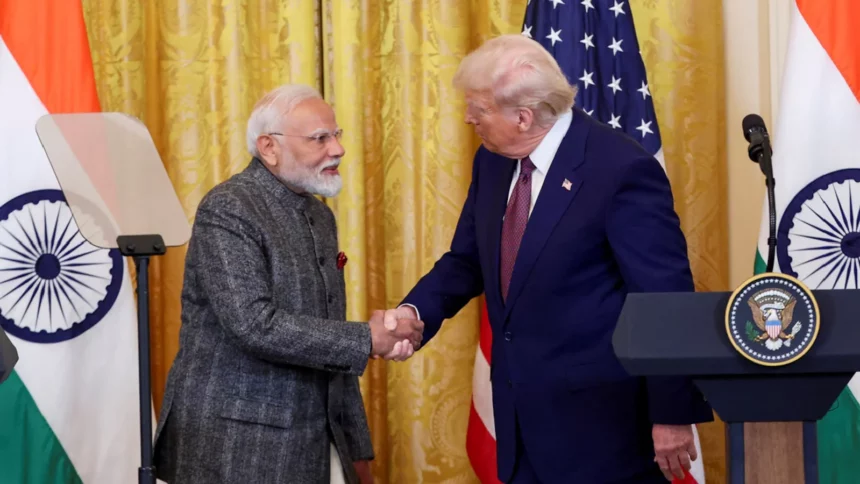
In a firm and unambiguous conversation, Prime Minister Narendra Modi told US President Donald Trump that India has never accepted third-party mediation on Kashmir and never will. The 35-minute phone call, held on Tuesday while PM Modi was in Canada for the G7 Summit, was requested by President Trump after the two leaders were unable to meet in person. During the call, PM Modi also clarified India’s stance on Operation Sindoor and rejected President Trump’s repeated claims of mediating a ceasefire between India and Pakistan.
India’s Stand on Kashmir and Operation Sindoor
Responding to President Trump’s questions about Operation Sindoor — India’s military retaliation to the Pahalgam terror attack — PM Modi explained that the mission was carefully executed and targeted only terrorist camps in Pakistan and Pakistan-occupied Kashmir. He emphasized that the operation was a response to terrorism, not an act of aggression against any country.
Foreign Secretary Vikram Misri, who briefed the press after the conversation, said that the Prime Minister reiterated India’s long-standing position: it has never accepted foreign mediation in bilateral matters with Pakistan. “There is complete political unanimity in India on this issue,” Misri said, underlining the national consensus.
This comes after President Trump repeatedly claimed that his intervention helped achieve a ceasefire between the two nuclear-armed neighbours — a claim India has consistently denied. PM Modi told President Trump that any cessation of hostilities happened solely at Pakistan’s request and through established military communication channels, with no external involvement.
No Role of Trade Talks and Declined US Visit
President Trump had also attempted to link the ceasefire with ongoing trade tensions, suggesting that threats of higher tariffs influenced both countries to de-escalate. PM Modi dismissed this notion and made it clear that the India-US trade deal played no part in the military pause.
The Prime Minister also declined an invitation from President Trump to visit the US after the G7 summit, citing prior commitments. The phone call served as a substitute for the missed bilateral meeting in Canada, which couldn’t take place due to President Trump’s early departure.
The call came at a strategically important time, just ahead of President Trump’s confirmed meeting with Pakistan Army chief General Asim Munir in Washington. Amid rising tensions in West Asia, and concerns of a broader conflict involving Iran, Pakistan’s role in the region has drawn renewed attention from the US administration.