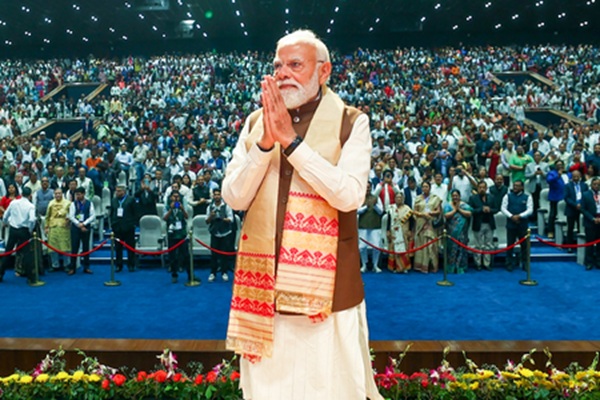
Prime Minister Narendra Modi launched a series of major development projects worth ₹47,600 crore in Assam during a two-day visit to the state, while also delivering a strong political message directed at the Congress party. Addressing a public gathering in Silchar, the Prime Minister accused Congress of misleading the youth of Assam during its years in power and pushing the state toward violence and instability. He said that Assam has now entered a new phase of growth and opportunity, driven by infrastructure development, investment and expanding economic prospects.
During his speech, the Prime Minister described the transformation of Assam as a shift from a period of political turmoil to an era defined by development and progress. According to him, the state has evolved into what he called an “ocean of opportunities,” offering new prospects in employment, technology and industrial growth.
He also criticised the Congress for allegedly following a “divide and rule” approach during its governance in the state. According to Modi, such policies created divisions and slowed the pace of development in Assam for many years. He said that the state is now moving forward with a more inclusive approach focused on economic progress and regional integration.
The Prime Minister’s visit included the launch and foundation-laying of numerous infrastructure projects aimed at improving connectivity, boosting economic activity and expanding opportunities for residents across Assam and the wider North-East region. These initiatives reflect the government’s broader strategy of strengthening infrastructure in the region while linking it more closely with the rest of the country.
Infrastructure Projects and Regional Connectivity Initiatives
A key focus of the Prime Minister’s visit was the launch of large infrastructure projects designed to enhance connectivity across the state and neighbouring regions. During the first day of his visit on March 13 in Guwahati, Modi inaugurated and laid the foundation stone for projects worth ₹24,250 crore.
On the second day of the visit, March 14, he continued the initiative in Silchar by launching and initiating projects worth ₹23,550 crore. Together, these projects amount to a combined investment of ₹47,600 crore aimed at accelerating development in Assam.
Among the major initiatives announced was the development of the first greenfield high-speed corridor in the North-East connecting Shillong and Silchar. The corridor is expected to significantly improve transportation between Meghalaya and Assam while reducing travel time and improving trade connectivity between the two states.
The Prime Minister also laid the foundation stone for projects under the Assam Mala 3.0 programme, which is designed to strengthen the road network across the state. The initiative aims to improve road infrastructure in both urban and rural areas, enhancing accessibility and supporting economic activity.
During his address, Modi described Silchar as the gateway to the Barak Valley and emphasised the importance of the region in the state’s development plans. According to him, the new connectivity projects will bring significant benefits to residents by improving transportation links and creating new opportunities for businesses and industries.
He also highlighted improvements in railway infrastructure across Assam, noting that more than 2,500 kilometres of railway lines in the state have been electrified. Electrification of railway routes is expected to increase efficiency, reduce operational costs and support environmentally sustainable transportation.
Improved rail connectivity is expected to play a key role in integrating the Barak Valley more closely with other parts of India. By strengthening transportation networks, the government aims to support trade, tourism and industrial development in the region.
The Prime Minister also emphasised that the North-East region is emerging as an important economic bridge connecting India with South-East Asia. According to him, improved connectivity and infrastructure will enhance the region’s role in regional trade and strategic partnerships.
Focus on Youth Opportunities, Farmers and Regional Development
In addition to infrastructure initiatives, Modi also spoke about programmes aimed at improving employment opportunities and economic prospects for young people in Assam. He said the state government has created new opportunities through government job recruitment, skill development programmes and scholarships.
Education, healthcare and skill development were described as central pillars of the government’s development strategy for the state. According to the Prime Minister, strengthening these sectors will help prepare the youth of Assam for emerging opportunities in technology, manufacturing and other modern industries.
Modi also highlighted the growing importance of Assam in India’s emerging technology sectors, including semiconductor manufacturing and next-generation industries. He said the state has the potential to become a key hub for technological innovation and industrial growth in the future.
During his address, the Prime Minister acknowledged the contributions of farmers and tea garden workers to the state’s economy. Assam is known for its extensive tea plantations, which provide employment to thousands of workers and contribute significantly to the state’s agricultural output.
Referring to the Pradhan Mantri Kisan Samman Nidhi scheme, Modi said that farmers in Assam have received more than ₹30,000 crore through the programme. According to him, around ₹20,000 crore has been transferred directly to farmers in the state over the past decade.
The Prime Minister contrasted this with previous governments, claiming that despite having a Prime Minister from Assam during earlier periods, the state did not receive adequate support for development.
He also praised the state government led by Chief Minister Himanta Biswa Sarma for recognising the contributions of tea garden workers and providing land rights to families associated with tea plantations. The allocation of land rights is expected to allow these families to access several government welfare schemes, including housing programmes, electricity connections, drinking water facilities and cooking gas connections.
According to Modi, such measures are aimed at improving the quality of life for workers and their families while ensuring that development reaches communities that have historically been marginalised.
The Prime Minister also emphasised the government’s approach toward border regions. He said that earlier administrations treated border villages as the last settlements in the country, whereas the current government considers them the first villages of India and prioritises their development.
Development initiatives in districts such as Cachar are intended to strengthen infrastructure, improve connectivity and expand opportunities for residents living near international borders.
During his speech, Modi also accused Congress of spreading fear and uncertainty at a time when global conflicts are affecting many parts of the world. He said the government is working to minimise the impact of international tensions on Indian citizens, while alleging that Congress leaders are attempting to create panic among people.
He also claimed that some political leaders are trying to damage India’s image internationally despite the country’s growing influence and global recognition. Referring to recent international technology summits hosted in New Delhi, Modi said such events demonstrate India’s rising role in the global economy.
According to the Prime Minister, the world is increasingly recognising India’s rapid progress and development. He urged the youth of Assam to remain vigilant against attempts to mislead them and to focus on opportunities created through development initiatives.
Concluding his address, Modi said the momentum of development in Assam and the North-East will continue in the coming years. He expressed confidence that the region will play a major role in India’s economic expansion and become a key centre of growth, connectivity and opportunity.