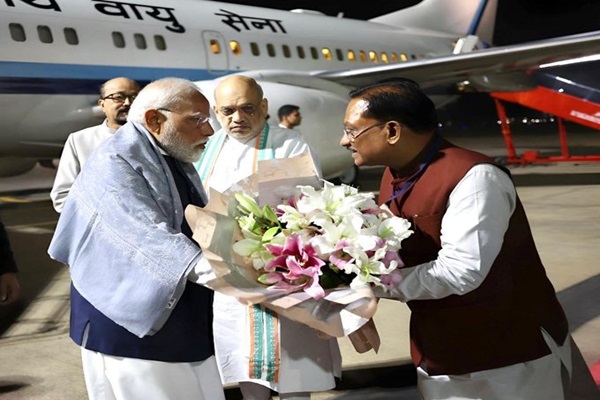
Prime Minister Narendra Modi arrived in Raipur on Friday evening to attend the 60th edition of the All India Conference of Directors General and Inspectors General of Police, marking Chhattisgarh’s first time hosting the high-level internal security conclave. The Prime Minister landed at Swami Vivekananda Airport at approximately 7:40 pm on board a special aircraft.
He was received at the airport by Union Home Minister Amit Shah, Governor Ramen Deka, Chief Minister Vishnu Deo Sai, and senior public representatives and officials. Shah had reached Raipur a day earlier to participate in the three-day conference, which began earlier on Friday at the Indian Institute of Management (IIM) Raipur.
The conference, held under the broad theme “Viksit Bharat: Security Dimensions”, brings together key national and state security leadership, including the National Security Adviser, Ministers of State for Home Affairs, state and Union Territory DGPs, and heads of central police organisations. Select officers of Deputy Inspector General (DIG) and Superintendent of Police (SP) ranks and state/UT home department heads have also been invited.
Chhattisgarh Hosts for the First Time, 2,000+ Cops Guard Multi-Layer Security Grid
The event is being held at the IIM Raipur campus in Nava Raipur, the state’s upcoming administrative and business hub. With the state hosting the DGP-IGP conference for the first time, authorities have put in place an extensive security cover across the venue city and adjoining areas.
Officials confirmed that over 2,000 police personnel have been deployed in a multi-layered security grid, with heightened vigil in and around IIM Raipur, Nava Raipur, and key transit corridors. The security architecture includes perimeter barricading, access control points, aerial monitoring, patrolling teams, quick response units, and intelligence-linked threat assessment cells. Combing operations and ongoing surveillance have also been intensified in sensitive pockets due to the participation of top internal security leadership.
Venue security involves vertical and horizontal layering, special protection group coordination, cyber command readiness, crowd management teams, transport route sanitisation, emergency medical support, and fire and disaster response units integrated into the policing grid.
Left Wing Extremism, AI in Policing, Women’s Safety to Dominate Discussions
Prime Minister Modi is scheduled to take part in the conference deliberations on November 29 and 30. The conference aims to assess progress on major policing challenges and frame a comprehensive roadmap to bolster internal security, aligned with the national vision of “Surakshit Bharat” (Safe India) and “Viksit Bharat” (Developed India).
Key discussion tracks will include Left Wing Extremism, counter-terrorism, disaster management, women’s safety, and the integration of forensic science and artificial intelligence in policing operations. Officials highlighted that the inclusion of technology-driven policing frameworks resonates with India’s push toward modernised internal security, faster evidence processing, predictive threat mapping, enhanced cybercrime response, and data-led law enforcement strategies.
The conference will also discuss capacity building for police forces, evolving counter-insurgency strategies in Naxal-affected regions, strengthening cross-border intelligence sharing, reforms in criminal tracking systems, national disaster resilience mechanisms, digital evidence frameworks, use of drones in law enforcement, integrating AI-based analytics in crime prevention, tech-assisted emergency response, improving police housing and welfare, cyber threat intelligence fusion, expansion of forensic infrastructure, national criminal database systems, police training reforms, anti-radicalisation frameworks, real-time policing platforms, and standard operating procedures for emerging security threats.
Women’s safety discussions will focus on safer urban mobility, crisis response helplines, police sensitisation, stronger enforcement against gender-based crimes, technology-assisted monitoring of crime-prone hotspots, timely FIR and investigation protocols, monitoring habitual offenders, integrating safety frameworks into smart city plans, self-defence programmes, monitoring workplace safety norms, strengthening juvenile crime response systems, improving police engagement with women-led civil society networks, and digitised grievance redressal for women.
Technology will cut across sessions, including AI-driven CCTV monitoring, automated facial recognition, crime-trend analytics, vehicle-tracking systems, expansion of state cyber units, digital readiness for police officers, evidence digitisation, forensic lab modernisation, AI-based intelligence dashboards, predictive policing through machine learning, crime analysis automation, cyber attribution frameworks, real-time data fusion across state police networks, and strengthening digital first response protocols.
President’s Police Medals to Be Conferred
During his engagements, Prime Minister Modi will award the President’s Police Medals for Distinguished Service, recognising exemplary contributions of police officers across the country.
The conclave underscores India’s attempt to unify traditional policing challenges with emerging security dimensions, placing technology, coordination, forensic expansion, women’s safety ecosystems, and insurgency response at the core of national law enforcement discourse.