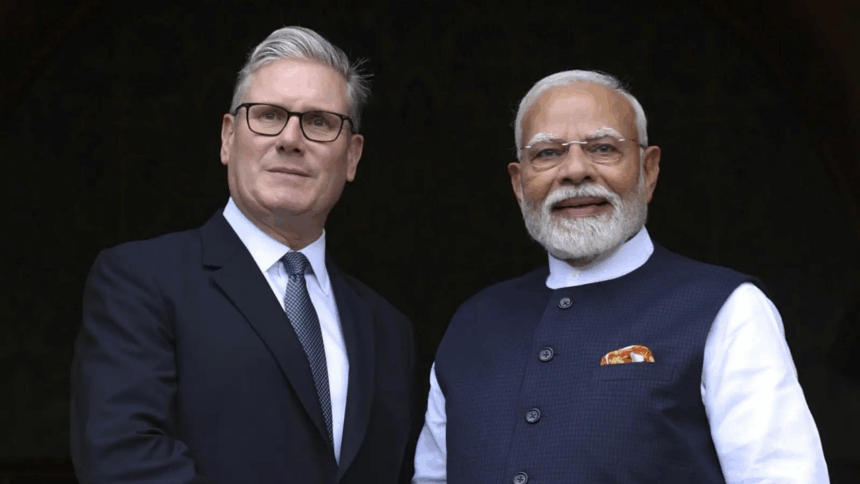
Prime Minister Narendra Modi welcomed British Prime Minister Keir Starmer to Mumbai on Thursday, marking a significant step in reinforcing the economic and technological partnership between India and the United Kingdom. Keir Starmer’s visit comes in the wake of a recently concluded Free Trade Agreement (FTA) signed in July 2024, which is expected to substantially increase trade between the two countries by £25.5 billion annually. Alongside discussions on commercial ties, the visit also focuses on collaboration in technology and national security, reflecting a broader vision of strategic cooperation. During this high-profile meeting, both leaders underscored the importance of mutual investments, technology exchange, and digital innovation as pillars for strengthening long-term bilateral relations. The occasion also highlights the growing economic influence of India globally and the United Kingdom’s interest in deepening its commercial and technological footprint in one of the world’s fastest-growing economies. The visit comes amid expanding bilateral engagements, following the UK’s largest-ever trade mission to India, which saw over 100 companies and organizations participate, signaling the UK’s commitment to fostering robust trade relations and promoting investment opportunities in India.
UK-India Trade and Investment: A Landmark Engagement
During the talks in Mumbai, Prime Minister Modi and Prime Minister Keir Starmer celebrated the deepening commercial ties between India and the UK, highlighting both the recently signed FTA and further avenues for investment. An official statement confirmed that 64 Indian companies would collectively invest £1.3 billion ($1.75 billion) in the United Kingdom. This announcement represents a continuation of momentum generated during the UK’s largest-ever trade mission to India, reflecting the increasing appetite of Indian firms to expand their global operations and leverage opportunities in developed markets. The Free Trade Agreement, signed in July 2024 during PM Modi’s visit to the UK, stands as the largest trade agreement India has ever executed and the most significant UK deal since its departure from the European Union. Analysts note that the FTA is expected to remove barriers to trade, lower tariffs, and facilitate smoother exchange of goods and services, further solidifying India-UK economic relations. The leaders emphasized that beyond monetary investments, this engagement signifies a broader commitment to building resilient supply chains, encouraging technological collaboration, and fostering sustainable economic growth. The discussions also explored joint ventures in key sectors such as digital infrastructure, energy, healthcare, and financial services, underlining the strategic importance of this partnership for both nations in a rapidly evolving global economy.
Additionally, Prime Minister Keir Starmer highlighted the unique nature of this FTA, describing it as a historic opportunity to bolster bilateral commerce. “This agreement is really important. It is the biggest deal we’ve struck since leaving the European Union and the largest deal India has ever made. It demonstrates our shared commitment to economic growth, innovation, and strategic partnership,” Keir Starmer stated during his interaction with Indian business leaders. The announcement of £1.3 billion investment from Indian companies further reinforces the confidence Indian investors have in the UK market, signaling an era of strengthened economic interdependence. The trade discussions also included deliberations on creating policies that enhance innovation, facilitate smoother regulatory processes, and enable the rapid movement of skilled labor, all of which are crucial for the successful implementation of the FTA. Experts suggest that such collaborations could pave the way for technology-driven growth and strengthen bilateral industrial relations, benefiting both countries in the long run.
Technology, Digital Innovation, and Strategic Cooperation
In addition to economic discussions, Keir Starmer’s visit focused heavily on technological collaboration and the potential adaptation of India’s national digital initiatives in the United Kingdom. Earlier on Wednesday, he met with Nandan Nilekani, the co-founder of Infosys Ltd. and the architect of India’s Unique Identification (UID) program, commonly known as Aadhaar. Keir Starmer sought guidance on implementing a similar digital identification system in the UK, aiming to enhance efficiency, security, and citizen access to government services. This dialogue reflects the broader trend of digital diplomacy and underscores the importance of knowledge transfer in strengthening governance mechanisms across borders. Keir Starmer’s interaction with Nilekani demonstrated the UK’s recognition of India’s leadership in digital innovation, particularly in the areas of digital identity, secure data management, and technology-driven public services.
The discussions also explored collaborative frameworks for cybersecurity, emerging technologies, and data protection, recognizing the growing intersection between trade, technology, and national security. Both leaders acknowledged that technology and digital infrastructure are critical drivers of economic growth and competitiveness in the 21st century. They emphasized the importance of developing joint initiatives that support innovation while safeguarding privacy, promoting responsible use of emerging technologies, and strengthening resilience against cyber threats. Keir Starmer’s visit serves as a platform to deepen bilateral cooperation in sectors such as artificial intelligence, fintech, healthtech, and smart urban development, fostering shared innovation ecosystems that benefit both countries.
Moreover, the UK-India partnership extends to educational exchanges, research collaborations, and startup ecosystems, reflecting a multifaceted approach to bilateral engagement. By leveraging India’s technological expertise and the UK’s global market access, both countries aim to create a model of sustainable economic growth that emphasizes digital transformation, trade expansion, and strategic collaboration. The two leaders agreed to institutionalize regular dialogues between their governments, industry leaders, and academic institutions to ensure continuity in technology transfer, capacity building, and policy alignment. This visit, therefore, represents a significant milestone in the India-UK relationship, signaling not only enhanced economic cooperation but also the establishment of enduring frameworks for innovation, knowledge sharing, and joint problem-solving.
Prime Minister Modi reiterated India’s commitment to being a reliable and long-term partner for the UK in trade, technology, and strategic initiatives. He highlighted the importance of ongoing engagement in promoting investment flows, strengthening industry linkages, and facilitating collaboration between startups and established enterprises. The discussions also touched upon the shared objective of advancing sustainable development goals, green technology, and climate-focused initiatives that align with global standards. By fostering an ecosystem of trust, transparency, and innovation, both countries aim to maximize the benefits of the FTA while ensuring that economic growth is inclusive, equitable, and environmentally responsible.
Keir Starmer’s visit to Mumbai reflects the broader global context, where economic diplomacy and technological collaboration are becoming increasingly vital to national competitiveness. Both leaders emphasized the significance of aligning regulatory frameworks, enhancing cross-border trade facilitation, and promoting strategic partnerships in areas such as financial technology, clean energy, and infrastructure development. Through these efforts, India and the UK aspire to build a resilient, diversified, and future-ready bilateral relationship capable of withstanding geopolitical uncertainties while delivering tangible benefits to citizens and businesses alike.
The two-day visit also included multiple engagements with industry representatives, policymakers, and thought leaders to ensure that the agreements and initiatives announced are translated into actionable outcomes. Discussions centered on creating opportunities for Indian firms in the UK, facilitating joint ventures, and exploring avenues for innovation-led growth. These efforts aim to bridge gaps in technology adoption, market access, and capacity building while fostering an environment conducive to long-term collaboration.
The India-UK Free Trade Agreement, technology cooperation initiatives, and continued dialogue signal a transformative phase in bilateral relations. The visit underscores the shared commitment of both nations to harness economic opportunities, technological innovation, and strategic alignment to strengthen cooperation in trade, industry, and digital governance. Analysts believe that these engagements will likely result in long-term economic, technological, and strategic gains, benefiting citizens, businesses, and governments in both countries.
Overall, the visit of UK PM Keir Starmer to Mumbai, his meetings with PM Modi, and interactions with technology leaders and business representatives exemplify the growing synergy between India and the United Kingdom. The discussions highlight the significance of the FTA, the expanding scale of bilateral investments, and the central role of digital innovation in shaping the next phase of India-UK relations. Both leaders reaffirmed their commitment to deepening economic and technological cooperation, ensuring that India and the UK emerge as strategic partners in trade, investment, and innovation on the global stage.