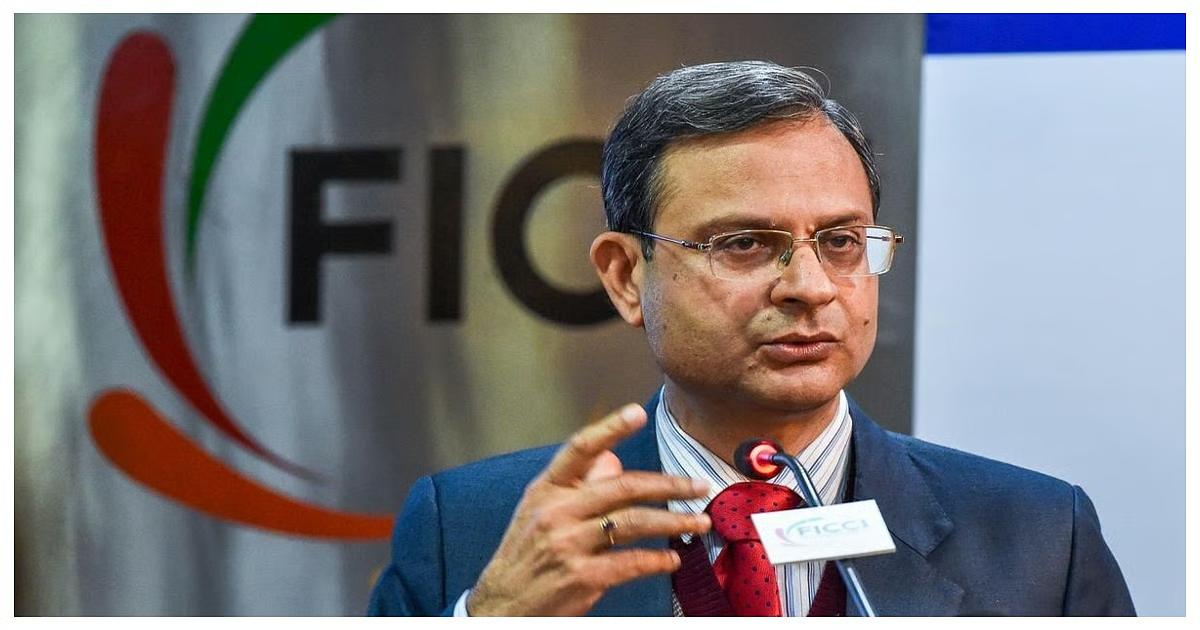
Reserve Bank of India Governor Sanjay Malhotra has urged the rapidly expanding Indian fintech ecosystem to prioritize financial inclusion, focusing on underserved and unaccessed sections of society while ensuring accessibility, trust, and technological innovation remain central to their operations. Speaking at the annual Global Fintech Fest in New Delhi, Governor Sanjay Malhotra highlighted the transformative potential of fintech in delivering affordable and scalable financial services, while emphasizing the critical importance of compliance, data security, and customer-centric innovations. He underscored that while catering to privileged and high-income segments may be lucrative, the real societal and economic impact lies in building systems that serve populations traditionally excluded from formal financial services, including senior citizens, digitally unskilled individuals, and specially-abled users. Sanjay Malhotra’s address reflected a vision where fintech is not merely a profit-making tool but a vehicle for inclusive growth, sustainable development, and broader economic empowerment.
Expanding Financial Inclusion and Prioritizing Accessibility
Governor Malhotra stressed that fintech companies have an unprecedented opportunity to deepen financial inclusion across India, a country where significant portions of the population still lack access to essential financial services. He urged fintech startups and established players alike to design products that are accessible, easy to use, and supported by assistive technologies that ensure no one is left behind. The emphasis was on catering to vulnerable groups such as the elderly, individuals with limited digital literacy, and the differently-abled, to ensure equitable access to financial services. Sanjay Malhotra underscored the principle of “Build for Inclusion,” highlighting that while deepening access to the affluent may yield higher profits, focusing on the unserved and underserved segments would create lasting social impact and foster inclusive growth.
He further emphasized the importance of extending credit to small businesses and individuals, highlighting the need to leverage the financial infrastructure developed over the past few years. By facilitating access to credit through digital platforms, fintechs can empower small enterprises, enable entrepreneurship, and drive local economic development. Sanjay Malhotra also encouraged fintech firms to adopt a user-centric approach that minimizes reliance on human customer service, thereby making financial services seamless, efficient, and scalable at a population level.
In addition to accessibility, the RBI Governor highlighted the critical role of trust, transparency, and regulatory compliance in the fintech ecosystem. He urged companies to embed strong data protection mechanisms, maintain transparency in operations, and provide safeguards for consumers at every touchpoint. With over 10,000 fintech companies now operating in India and collectively raising more than USD 40 billion over the past decade, the focus on compliance, ethical practices, and responsible innovation is more crucial than ever. Sanjay Malhotra reinforced that technology, when deployed responsibly, can serve as a force multiplier for sustainable economic development, allowing fintechs to deliver services at scale while keeping costs affordable for users.
Governor Sanjay Malhotra also addressed the issue of digital frauds, noting that they are increasingly becoming a challenge for the central bank. He highlighted the MuleHunter solution developed by an RBI arm, which has been adopted by 21 banks and has demonstrated a 90 percent success rate in identifying accounts used by bad actors for fraudulent transactions. The RBI Governor stressed that fintechs should integrate fraud detection technologies into their operations to safeguard users and maintain the integrity of the financial system.
Innovation, Technology, and Strategic Financial Infrastructure
Beyond financial inclusion, Governor Sanjay Malhotra emphasized that fintechs must embrace technological innovation to drive efficiency, interoperability, and enhanced customer experiences. He highlighted the need for 17 account aggregators in India to integrate more financial information and adopt interoperable features to create seamless experiences for users. Furthermore, the Reserve Bank is working on introducing standards to improve customer onboarding processes, enhance user interfaces, strengthen data security, and raise awareness under the account aggregator framework. These steps aim to ensure that fintech companies not only expand access but also build robust, secure, and trustworthy systems that can be widely adopted.
Sanjay Malhotra also spoke about the unmet credit demand in India and highlighted the potential of the recently launched unified lending interface to bridge this gap. He emphasized that credit is the “lifeblood” of inclusive growth and that fintechs can play a pivotal role in facilitating access to credit, particularly for small businesses and underserved communities. Additionally, the RBI has conceptualized the unified markets interface as a next-generation financial market infrastructure, which will have the capability to tokenize financial assets and settlements using wholesale central bank digital currency (CBDC). Early trials of this interface have shown encouraging results, indicating the potential for greater efficiency and transparency in financial transactions.
The Governor praised fintechs for delivering financial services at scale and at affordable costs, noting that technological solutions can drive population-level impact. He urged fintech companies to focus on creating inclusive systems that do not leave behind those with limited access to digital platforms, while also ensuring robust mechanisms for customer protection, privacy, and security. Sanjay Malhotra’s address reflected a vision where fintech is leveraged as a tool for social good, empowering all sections of society, and facilitating inclusive economic growth.
In parallel, Nandan Nilekani, co-founder and non-executive chairman of Infosys, discussed the upcoming ‘Finternet’ ecosystem, which is expected to go live in 2026. Finternet aims to create a unified, interconnected, and user-centric financial ecosystem, bringing together assets such as land, property, bonds, and financial investments on a single platform where they can be tokenized. Nilekani highlighted that the number of sign-ups for the platform is steadily growing, signaling widespread interest in a digital financial ecosystem that emphasizes transparency, accessibility, and efficiency.
Governor Sanjay Malhotra also recognized initiatives by the National Payments Corporation of India (NPCI) to innovate and enhance digital payment systems. These initiatives include AI-based UPI HELP powered by its Small Language Model (SLM), which assists users with payments, mandates, and dispute resolution. NPCI has also launched IoT-enabled UPI payments, enabling transactions directly from connected devices such as cars, smart TVs, and wearables, along with ‘banking connect,’ an interoperable net banking solution. Another significant innovation, ‘UPI Reserve Pay,’ allows users to securely block and manage credit limits for specific purposes across merchant and UPI apps.
Governor Sanjay Malhotra emphasized that fintech innovation must prioritize inclusivity, accessibility, and security, ensuring that digital financial systems cater to all sections of society while mitigating risks associated with fraud and misuse. By focusing on scalable, technology-driven solutions, fintech companies can contribute to broader financial literacy, inclusion, and economic empowerment. He also stressed the importance of embedding assistive technologies to support senior citizens, individuals with limited digital literacy, and specially-abled users, thereby making fintech solutions universally accessible.
The Governor underscored that fintech firms have a responsibility to leverage technology for social impact, particularly by extending credit to underserved populations and creating secure, reliable, and easy-to-use systems. By integrating robust compliance measures, transparent processes, and customer-centric approaches, fintech companies can strengthen trust and drive widespread adoption. Sanjay Malhotra also highlighted that fintechs can play a pivotal role in shaping India’s future financial ecosystem by fostering innovation, improving accessibility, and supporting sustainable economic growth.
Sanjay Malhotra’s remarks reflect a forward-looking vision where technology, regulatory compliance, and inclusive practices intersect to drive holistic financial development in India. The RBI Governor’s call to action is a reminder that fintech is not merely about profits but about creating meaningful impact by empowering unserved and underserved communities. Through innovations like the unified lending interface, account aggregator framework, and Finternet, India is poised to develop a robust, inclusive, and digitally advanced financial ecosystem that benefits all citizens, from urban centers to remote rural areas.
The emphasis on combining technological innovation, regulatory compliance, and inclusive financial practices demonstrates the evolving role of fintech in India’s economic growth story. By leveraging emerging technologies, embracing digital transformation, and focusing on accessibility, Indian fintechs can ensure that financial inclusion becomes a tangible reality. Governor Sanjay Malhotra’s address highlights the transformative potential of fintech when it is purpose-driven, secure, and aligned with the broader goals of national economic development.
Through his speech at the Global Fintech Fest, Sanjay Malhotra has articulated a clear roadmap for India’s fintech ecosystem, emphasizing that financial inclusion, responsible innovation, and accessibility must be at the core of every initiative. By focusing on unserved populations, leveraging cutting-edge technologies, and maintaining robust compliance frameworks, fintech companies can contribute to sustainable growth, strengthen economic resilience, and ensure equitable access to financial services for all segments of society.
Overall, Governor Sanjay Malhotra’s address underscores the immense potential of India’s fintech ecosystem to drive inclusive economic development while navigating the challenges of digital security, regulatory compliance, and accessibility. His message to fintech companies is clear: prioritize inclusion, embrace innovation, and build systems that empower the underserved, ensuring that technology serves as a catalyst for equitable growth, financial literacy, and long-term economic progress.