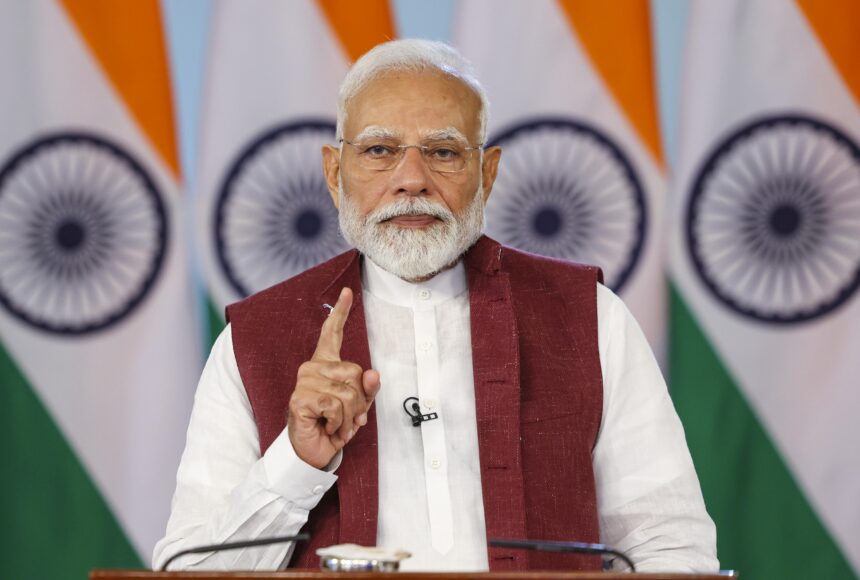
Prime Minister Narendra Modi, speaking on World Summit 2025, emphasized India’s remarkable progress in countering Maoist terrorism while criticizing the previous Congress-led government for fostering “Urban Naxals.” PM Modi outlined the transformative changes in the Red Corridor, highlighting the surrender of hundreds of Naxal operatives, the reduction of affected districts, and the reintegration of misguided youth into mainstream society. His remarks underscored the government’s commitment to restoring constitutional authority and ensuring safety and development in regions historically plagued by left-wing extremism. He portrayed this period as a turning point in India’s struggle against internal insurgency, promising a future where Naxalism would be eradicated from the nation.
Revival of Constitutional Authority and Reduction of Maoist Influence
PM Modi traced the historical context of Naxalism in India, noting that over the past five decades, Maoist terrorism had claimed thousands of lives, disrupted development, and undermined governance in large swathes of the country. At its peak, nearly 125 districts were affected by Maoist activity, creating zones where the Constitution’s authority was largely absent. Governments elected in these regions often had little practical power, while public officials and security personnel operated under constant threat. Schools, hospitals, and other essential infrastructure were regularly targeted, and young people were systematically deprived of opportunities, education, and security. This lawlessness represented not just a challenge to governance but a profound injustice to the youth, whose potential was stifled by the threat of violence and coercion.
Underlining the transformative impact of his government’s policies since 2014, PM Modi highlighted the dramatic reduction of Naxal-affected districts from 125 to just 11, with only three experiencing severe influence. In the past 75 hours alone, 303 Naxal operatives, some with bounties ranging from ₹5 lakh to ₹1 crore, surrendered to authorities, reflecting a growing trend of disillusionment among insurgents and the success of targeted counterinsurgency strategies. Modi emphasized that these were not ordinary foot soldiers but high-risk operatives who had long obstructed development and perpetuated fear in local communities. The Prime Minister stressed that these gains were the result of sustained intelligence-led operations, community engagement, and rehabilitation initiatives that provided alternatives for those who had been misled by extremist ideologies.
The reduction of Maoist influence has been accompanied by the restoration of law and order, enabling governments to assert real authority and citizens to engage in everyday activities without fear. PM Modi recounted the transformation in regions like Bastar, historically infamous for Naxal violence, now emerging as a hub of positive social activity exemplified by events such as the Bastar Olympics. This revival is not merely symbolic but a tangible demonstration of the state reclaiming control and fostering normalcy. Development projects, educational initiatives, and healthcare facilities are now operational, providing citizens with essential services previously obstructed by insurgent control. PM Modi underscored that such changes validate the government’s strategy of combining robust security measures with socio-economic development to address the root causes of extremism.
Critique of Congress and the Role of Urban Naxals
While recounting India’s progress, PM Modi directed pointed criticism at the previous Congress-led government, asserting that its tenure allowed an “ecosystem of Urban Naxals” to thrive. He argued that while national debates often centered around terrorism and Article 370, influential individuals labeled as Urban Naxals infiltrated key institutions, suppressing discussion about Maoist violence and obstructing efforts to address the problem effectively. PM Modi described how victims of Maoist attacks, including those who had suffered severe physical injuries, received little attention or acknowledgment due to the lack of political will and media coverage during Congress rule. He highlighted that the previous regime’s negligence contributed to the perpetuation of fear and the maintenance of extremist influence in several regions.
PM Modi emphasized the human cost of Maoist terrorism, reflecting on the thousands of lives lost and the persistent threat posed to young people whose education, employment, and security were jeopardized. The Prime Minister recounted incidents where insurgents destroyed hospitals, schools, and public institutions, leaving entire communities without access to basic amenities. Against this backdrop, he portrayed the current government’s efforts to rehabilitate misguided youth into mainstream society as a moral imperative, aimed at restoring hope, opportunity, and stability. These initiatives are framed as part of a broader strategy to not only neutralize immediate threats but also to prevent the emergence of new insurgents by addressing socio-economic grievances and providing education, vocational training, and community support.
PM Modi also described the psychological and societal impact of Naxalism, noting that citizens in affected regions lived under constant fear, with normal activities severely curtailed. He highlighted that public officials, security personnel, and ordinary citizens often required protective measures simply to conduct routine duties. This pervasive climate of fear hindered governance and development, leaving communities isolated and vulnerable. By restoring constitutional authority and ensuring law enforcement presence, the government has been able to re-establish societal norms, facilitate economic growth, and encourage civic engagement, thereby reinforcing the legitimacy of democratic institutions in historically troubled areas.
In recounting the recent successes against Maoist terrorism, PM Modi detailed the organized surrender of Naxal operatives, illustrating both the efficacy of security operations and the appeal of reintegration programs. These programs aim to provide former insurgents with education, employment, and social support, enabling them to contribute positively to their communities rather than returning to extremist activity. PM Modi underscored that addressing the ideological appeal of Maoism requires more than military action; it necessitates a comprehensive approach that combines security, governance, development, and rehabilitation. By adopting such a multifaceted strategy, the government aims to break the cycle of violence and create conditions for long-term peace and prosperity in affected regions.
The Prime Minister also addressed the symbolic importance of Naxal-affected areas regaining normalcy. He cited Bastar’s transformation as an example, where the region’s focus has shifted from insurgent activity to sports, culture, and community engagement. This shift represents not only a victory over violence but also a reclamation of space for constructive social and economic activity. PM Modi framed these developments as evidence that sustained government focus, combined with effective policing and inclusive policies, can successfully counter deeply entrenched extremist networks while improving quality of life for affected populations.
In emphasizing India’s progress, PM Modi highlighted the need for vigilance and continued commitment. While major reductions in Naxal influence have been achieved, he noted that a few districts remain under severe insurgent control. The government’s approach, he argued, must remain adaptive, blending intelligence-led operations with development initiatives and community outreach to address the evolving tactics of remaining insurgent elements. This ongoing commitment is crucial to ensuring that Naxalism is eradicated completely and that no region reverts to extremist dominance.
Finally, PM Modi projected confidence that India will soon be entirely free from Naxalism. He described the government’s work as not only a strategic imperative but also a moral responsibility to the nation’s youth, whose opportunities and security were historically undermined by extremist violence. By combining security operations, socio-economic development, and rehabilitation programs, the government has created conditions for long-term peace, stability, and prosperity in regions previously dominated by Maoist insurgents. PM Modi’s remarks served as both a reflection on past challenges and a promise of a future where India is fully liberated from the grip of Naxalism, ensuring that affected communities can thrive within the framework of the nation’s Constitution.
This narrative underscores the government’s strategy of addressing insurgency through a combination of robust law enforcement, rehabilitation, and development, highlighting both the progress made and the challenges that remain. By integrating security, governance, and socio-economic initiatives, the government aims to provide comprehensive solutions that protect citizens, restore state authority, and create sustainable conditions for peace in historically affected regions. Through these efforts, India is steadily moving toward a future where Naxalism is no longer a threat, reaffirming the nation’s commitment to the rule of law, human rights, and inclusive development.