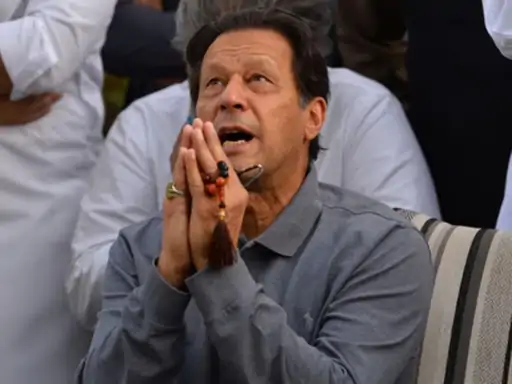
In one of the most direct and aggressive public attacks by the military on a former prime minister, Pakistan’s army leadership has labelled Imran Khan “mentally ill” and accused him of constructing dangerous narratives that undermine national security. The remarks, delivered by Director General of Inter-Services Public Relations Lieutenant General Ahmed Sharif Chaudhry, signal a deepening and openly hostile rift between the political establishment and the military at a time when Pakistan’s governance, economy and stability are already under severe strain.
Military Accuses Imprisoned Ex-PM of Spreading Anti-State Narratives and Threatening National Security
At a press conference held shortly after the inauguration of the newly established Chief of Defence Forces Headquarters, Lieutenant General Chaudhry launched a strongly worded critique of the former prime minister, who has been imprisoned since August 2023. Imran Khan, he claimed, has become a figure whose statements and political behaviour pose a direct threat to Pakistan’s stability and institutional order.
Displaying one of Khan’s tweets as evidence, Chaudhry described it as part of a “deliberate attempt” to craft anti-state narratives aimed at weakening public trust in the army. According to him, Imran Khan has crossed from political opposition into the realm of national security risk through rhetoric that allegedly encourages division between the military and the public.
The DG ISPR argued that Khan behaves as though the state cannot function without him, portraying his approach as self-centred and constitutionally irresponsible. He suggested that Khan’s political ambitions supersede any regard for Pakistan’s legal frameworks, national interests, or institutional integrity.
Chaudhry emphasised that no individual, regardless of their past office or current political influence, will be permitted to create discord between the army and citizens. He warned political actors against dragging the army into partisan disputes, insisting that the military’s institutional boundaries must be respected. His remarks reflected an underlying frustration within the armed forces over repeated attempts by political factions to frame the military as either an ally or an adversary depending on shifting political needs.
The press conference marked one of the most severe public condemnations of Imran Khan by the army since his arrest. While the military and Khan’s political party have clashed frequently both before and after his ouster in 2022, the vocabulary used by the DG ISPR—calling him “mentally ill” and a “national security threat”—signals a dramatic escalation. Such language suggests that the military no longer regards Khan as merely an adversarial political leader but rather as someone capable of destabilising Pakistan’s institutional cohesion.
A particularly pointed part of the press briefing revolved around the army’s accusation that Imran Khan, despite being in imprisoned custody, continues to create political narratives against the state. Lieutenant General Chaudhry questioned the legal basis that allows a convicted prisoner to meet people and formulate political strategies, asking publicly: “Which law permits a prisoner to meet individuals and prepare a narrative against the state and the armed forces of Pakistan?”
The army alleges that every time Khan is granted meetings—even within the confines of prison—he uses the opportunity to frame the military as oppressive and politically biased. According to Chaudhry, Khan leverages these interactions to cultivate public resentment against the armed forces, thereby violating not only legal restrictions but also ethical expectations of a prisoner.
Khan’s Pakistan Tehreek-e-Insaf (PTI) party has repeatedly dismissed such accusations as politically motivated attempts to suppress dissent and eliminate him from the political landscape. They argue that meetings within jail are granted under established legal procedures and that Khan’s communications reflect legitimate concerns about Pakistan’s democratic process, human rights conditions and military overreach.
However, the army’s statements indicate that the institution views Khan’s activities as part of a wider misinformation campaign designed to weaken public confidence in the military. While Khan’s supporters claim he has been targeted for refusing to toe the army’s line, the military insists that it is safeguarding national stability from narratives it considers inflammatory and reckless.
The ongoing confrontation between Imran Khan and the military has become one of the central tensions shaping Pakistan’s current political climate. Khan, once perceived as a political favourite of sections of the military leadership, fell out of favour after disputes over appointments and disagreements on foreign policy and internal governance. Since then, the PTI and the army have been locked in a prolonged struggle, culminating in Khan’s arrest and the dismantling of his party’s organisational structure.
The DG ISPR’s remarks may also reflect the army’s concern that Khan’s narrative continues to influence a large segment of Pakistan’s population, even from behind bars. Despite legal challenges, fragmentation of party leadership and extensive crackdowns on PTI supporters, Imran Khan remains a potent political symbol for millions frustrated with Pakistan’s economic collapse, rising inflation, deep governance failures and perceived authoritarian tactics.
The press conference raises new questions about the future of civilian-military relations in Pakistan. A serving general publicly calling a former elected prime minister “mentally ill” and accusing him of speaking “the language of traitors” underscores an exceptional level of hostility. Such rhetoric not only reflects the military’s entrenched position but also signals possible hardening of the state’s stance toward PTI leaders and supporters.
Observers note that these confrontations are not merely political disagreements but symptoms of a deeper constitutional crisis in Pakistan, where civilian authority and military power have long oscillated, creating an unstable governance structure. The military’s present dominance, combined with an internally divided political class, places Pakistan at a critical juncture.
The army’s message appears clear: Imran Khan’s political resurgence or narrative-building will not be tolerated if perceived as undermining the military’s authority or national cohesion. Meanwhile, Khan’s political movement continues to challenge the army’s stance, portraying itself as the only force capable of restoring democratic norms and freeing Pakistan from what it describes as military-led authoritarianism.
As tensions rise and public sentiments remain deeply polarised, Pakistan faces a mounting risk of prolonged political instability. The statements by the DG ISPR reveal that the conflict between Imran Khan and the military establishment is far from over—and may, in fact, be entering its most confrontational phase yet.