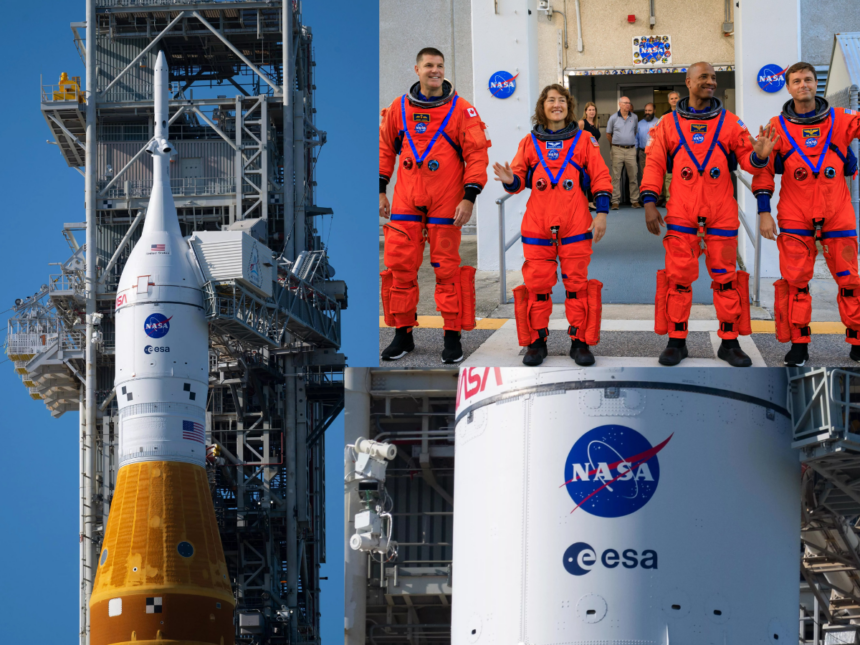
The NASA is preparing to launch one of the most historic missions of the modern space era — Artemis II — which will send humans around the Moon for the first time in more than 50 years. The mission signals a major milestone in humanity’s renewed push toward deep space exploration, following the groundbreaking achievements of the Apollo Program.
Scheduled for liftoff within an early April launch window, Artemis II will carry four astronauts aboard the powerful Orion spacecraft, launched atop the massive Space Launch System (SLS). This mission is not just a technological demonstration—it represents a symbolic return to human lunar exploration and the beginning of a new era in space travel.
More than five decades have passed since humans last ventured beyond low Earth orbit during the Apollo era. The last crewed lunar mission, Apollo 17 in 1972, marked the end of an ambitious period of exploration that defined the 20th century.
Artemis II aims to rekindle that spirit, but with a modern approach. Unlike Apollo missions, which were primarily driven by Cold War competition, the Artemis programme reflects a broader vision of international collaboration, sustainability, and long-term presence on the Moon.
This mission will not land astronauts on the lunar surface. Instead, it will perform a lunar flyby, allowing NASA to test systems critical for future missions that will eventually return humans to the Moon’s surface under Artemis III and beyond.
The Artemis II mission features a diverse and highly experienced team of astronauts, representing a new generation of space explorers.
Reid Wiseman will serve as Mission Commander, bringing leadership experience and prior spaceflight expertise. Victor Glover will take on the role of Pilot, responsible for key navigation and operational duties. Christina Koch will serve as Mission Specialist, marking a historic step as one of the first women to travel toward the Moon. Jeremy Hansen, representing Canada, will also serve as Mission Specialist, highlighting international collaboration.
This crew reflects NASA’s commitment to diversity and global partnership in space exploration. It represents a shift from the Apollo era, when missions were limited in representation and largely national in scope.
At the heart of the mission is the Space Launch System, the most powerful rocket ever developed by NASA. Standing approximately 32 storeys tall, the SLS is designed to carry heavy payloads beyond Earth’s orbit, enabling missions to the Moon, Mars, and beyond.
The rocket will first place the Orion spacecraft into Earth orbit. After system checks, a powerful engine burn will send the spacecraft on a trajectory toward the Moon. This phase is critical, as it determines the success of the entire mission.
The Orion spacecraft is designed as a next-generation crew vehicle capable of sustaining astronauts during deep-space missions. It includes advanced life-support systems, navigation tools, and safety features to protect the crew from radiation and extreme conditions.
During the mission, Orion will house the astronauts for nearly ten days, maintaining a controlled environment while traveling vast distances from Earth. The spacecraft will also test communication systems, onboard automation, and emergency protocols.
The mission profile of Artemis II has been carefully designed to test every critical phase of space travel. After launch, the crew will spend about a day in Earth orbit, ensuring all systems are functioning correctly.
Following this, the spacecraft will be propelled toward the Moon. It will perform a flyby, looping around the far side of the Moon before beginning its return journey to Earth. The mission will conclude with a splashdown in the Pacific Ocean, where recovery teams will retrieve the crew and spacecraft.
Although Artemis II does not include a lunar landing, its importance cannot be overstated. It is a foundational mission that will validate technologies and procedures required for future missions that aim to land humans on the Moon.
One of the most significant aspects of Artemis II is its role in shaping the future of space exploration. By testing systems in real conditions, NASA aims to minimise risks for upcoming missions, including Artemis III, which is expected to land astronauts on the lunar surface.
The mission also serves as a demonstration of human capability to travel beyond low Earth orbit, something that has not been done since the Apollo era. This achievement alone marks a turning point in modern space exploration.
The Artemis programme is also strategically important in the context of global competition. As countries like China expand their space ambitions, the race to establish a sustainable presence on the Moon has intensified.
NASA’s approach focuses not only on exploration but also on building infrastructure, such as lunar bases and orbital stations, which could support long-term missions. These efforts are seen as essential for future human missions to Mars.
International cooperation is another defining feature of the Artemis programme. Partnerships with space agencies from different countries enable shared expertise, resources, and technology, making missions more efficient and inclusive.
Compared to the Apollo era, Artemis represents a significant evolution in both technology and vision. Apollo missions were short-term and focused primarily on landing astronauts on the Moon. In contrast, Artemis aims to establish a continuous human presence.
Modern advancements in computing, materials, and engineering have made spacecraft safer and more capable. These improvements allow for longer missions and more complex objectives.
However, Artemis II is not without challenges. Deep-space missions involve significant risks, including exposure to radiation, technical failures, and unpredictable environmental conditions.
Weather conditions also play a crucial role in determining launch schedules. NASA has identified a launch window extending through the first six days of April. If conditions are not favourable, additional launch opportunities will be available later in the month.
Ensuring crew safety remains the top priority. Extensive testing and simulations have been conducted to prepare for every possible scenario, minimising risks as much as possible.
Looking ahead, Artemis II is only the beginning. Future missions will build on its success, moving closer to the goal of establishing a sustained human presence on the Moon.
These missions will also serve as stepping stones for even more ambitious objectives, including sending humans to Mars. The knowledge and experience gained from Artemis II will play a crucial role in achieving these goals.
As the countdown continues, the Artemis II mission represents hope, ambition, and progress. It is a reminder of humanity’s enduring desire to explore beyond our planet and push the boundaries of what is possible.
The success of Artemis II could redefine the future of space exploration, opening new opportunities for scientific discovery, technological innovation, and international collaboration.