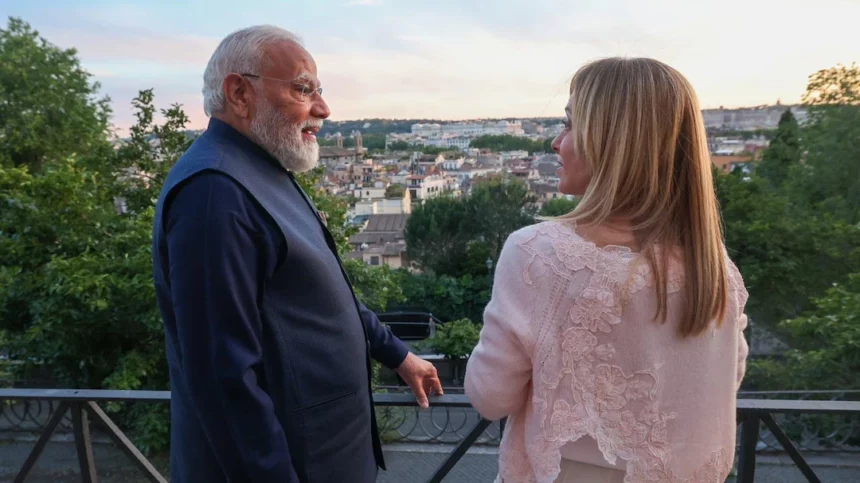
Prime Minister Narendra Modi’s visit to Rome has generated massive global attention after a light hearted interaction with Italian Prime Minister Giorgia Meloni turned into one of the most discussed diplomatic moments on social media. What appeared to be a simple exchange of a popular Indian toffee quickly evolved into a symbol of the growing warmth between India and Italy and highlighted the changing nature of modern diplomacy in the digital age.
During his visit to Italy, Prime Minister Modi presented Giorgia Meloni with a packet of a well known Indian chocolate toffee. The gesture carried deeper significance because it referenced the widely popular internet phrase associated with the two leaders. As soon as the video surfaced online, it rapidly went viral across multiple social media platforms, drawing millions of views and reactions from people around the world.
The video showed both leaders smiling and laughing while holding the packet of candy, creating a relaxed and informal diplomatic moment rarely seen in high level international engagements. The interaction immediately reignited online fascination with the chemistry between the two leaders, which has repeatedly become a topic of discussion during international summits and multilateral meetings.
Over the past few years, Narendra Modi and Giorgia Meloni have frequently attracted global attention because of their visibly warm interactions during diplomatic events. Their public appearances together have often appeared natural and spontaneous, helping create an image of personal rapport that resonates strongly in the age of digital communication and visual politics.
Political analysts believe the Rome moment reflects a broader transformation in international diplomacy, where personal communication styles, public engagement and symbolic gestures play an increasingly important role in shaping global perceptions. In a world driven by social media and instant visual communication, informal moments between world leaders often become powerful tools of soft diplomacy.
However, experts argue that the relationship between the Indian and Italian leaders extends far beyond internet trends or viral content. Beneath the public attention lies a rapidly expanding strategic partnership between two nations seeking stronger cooperation across trade, infrastructure, defence, energy and technology sectors.
India and Italy have significantly strengthened bilateral relations in recent years. Trade between the two countries has grown steadily, and both governments are actively working to expand economic cooperation further in the coming years. Key sectors identified for deeper collaboration include defence manufacturing, aerospace, clean technology, pharmaceuticals, machinery, textiles, agriculture and tourism.
Strategic experts increasingly view Italy as one of India’s most important partners in Europe. At a time when global supply chains and geopolitical alliances are undergoing major changes, both countries appear determined to strengthen economic and strategic connectivity between Asia and Europe.
One of the most important aspects of the growing partnership is the proposed economic corridor connecting India, the Middle East and Europe. The initiative is expected to create alternative trade routes and reduce dependence on existing infrastructure dominated by competing global powers. Italy is expected to play a central role in the European segment of this strategic network.
Observers note that the corridor represents not only an economic project but also a broader geopolitical vision aimed at strengthening democratic partnerships and ensuring more resilient global trade connectivity. India and Italy therefore view their partnership as part of a larger international strategic framework.
The Rome visit also highlighted the cultural dimension of India Italy relations. During the visit, Italian painter Giampaolo Tomassetti presented Prime Minister Modi with a painting inspired by Varanasi, one of India’s oldest and most spiritually significant cities. The artwork attracted considerable attention because of the artist’s long standing engagement with Indian culture and civilisational themes.
Prime Minister Modi publicly appreciated Tomassetti’s dedication to Indian heritage and acknowledged his decades of artistic work related to Vedic traditions and Indian epics. The gesture reinforced the idea that India and Italy are building ties not only through politics and economics but also through cultural and intellectual exchanges.
Another major highlight of the visit was the joint appearance of the two leaders at the historic Colosseum in Rome. Images of Prime Minister Modi and Giorgia Meloni walking through the iconic landmark quickly spread across international media and social platforms.
Experts believe the symbolism of the location added another layer to the diplomatic messaging. The Colosseum, representing one of Europe’s greatest historical civilisations, provided a dramatic backdrop for discussions between two leaders seeking to build a modern strategic partnership rooted in democratic values and historical identity.
International relations specialists argue that leadership personalities now influence diplomacy more than ever before. Public image, communication style and emotional relatability increasingly shape how global audiences perceive international partnerships. In that context, the public chemistry between Modi and Meloni has become an important element in strengthening people to people perceptions between India and Italy.
Social media users across different countries reacted enthusiastically to the viral clip from Rome. Many described the interaction as refreshing and genuine, while others saw it as evidence of stronger diplomatic trust between the two nations. The moment also demonstrated how modern diplomacy now operates simultaneously through formal policy discussions and highly visible public engagement.
Despite the playful nature of the viral moment, strategic analysts caution against dismissing it as merely symbolic entertainment. They argue that the growing partnership between India and Italy is driven by significant geopolitical and economic interests at a time of major global realignment.
Both countries are seeking stronger cooperation in areas such as energy security, manufacturing, trade diversification and technology investment. As geopolitical tensions reshape international alliances, India and Italy appear increasingly interested in building reliable long term partnerships based on shared democratic principles and economic opportunity.
The two leaders recently emphasised that relations between India and Italy have entered a decisive phase marked by unprecedented momentum and strategic depth. According to official statements, both governments are committed to expanding cooperation across multiple sectors while strengthening institutional and cultural engagement.
Prime Minister Modi’s Rome visit has therefore become one of the most visually and politically significant moments of his larger international tour. The images, videos and public interactions emerging from the visit have successfully combined diplomacy, cultural symbolism and digital communication into a powerful global narrative.
As India and Italy continue strengthening ties across economic, strategic and cultural domains, the viral Rome moment may ultimately be remembered not only as an internet sensation but also as a reflection of a rapidly evolving international partnership between two influential democracies.