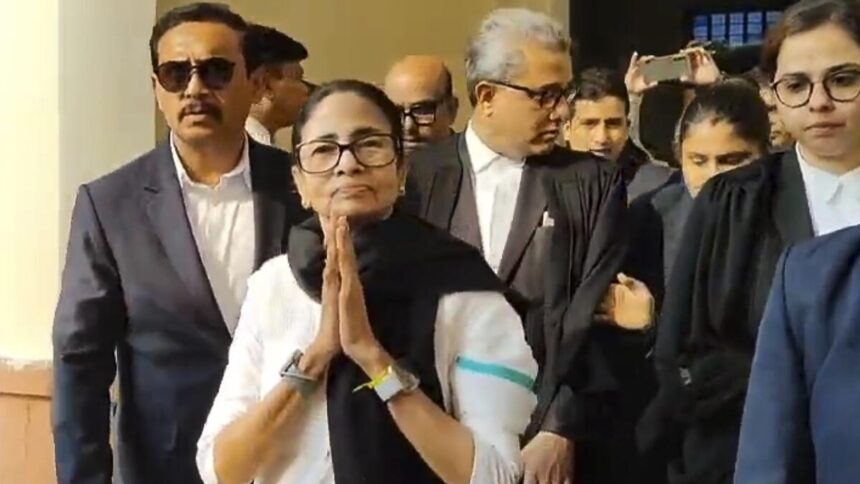
West Bengal Chief Minister Mamata Banerjee is set to return to the Supreme Court for a second high-stakes hearing over the controversial Special Intensive Revision (SIR) of electoral rolls in the state, marking a rare and politically charged confrontation between an elected state government and the Election Commission of India. The proceedings come after an unprecedented appearance last week in which Banerjee personally addressed the court, delivering an impassioned plea that framed the SIR exercise as a direct threat to democratic participation.
Her appearance, described by legal observers as historic in both tone and substance, elevated what might otherwise have been a procedural electoral dispute into a broader constitutional and federal debate. By alleging that over 1.36 crore voters face possible exclusion due to clerical discrepancies, administrative errors, and what she described as opaque processes, Banerjee has positioned the issue as one of mass disenfranchisement rather than technical correction.
The Supreme Court is now expected to examine the Election Commission’s formal response to these allegations. At the same time, the hearing takes place against the backdrop of counter-allegations from the poll body, which has raised serious concerns about the safety of its officials in West Bengal and has accused the Chief Minister of making statements that allegedly incite hostility toward constitutional authorities.
As the case returns to court, it is no longer confined to questions of voter lists. It has evolved into a broader test of institutional autonomy, the limits of executive protest, and the judiciary’s role as an arbiter between constitutional bodies and elected governments.
Electoral Roll Revision, Disenfranchisement Claims, and the Core of the Legal Challenge
At the heart of the dispute lies the Special Intensive Revision of electoral rolls currently underway in West Bengal. The Chief Minister has argued that the exercise, rather than correcting inaccuracies, risks excluding a vast number of legitimate voters. She has highlighted what she calls a “logical discrepancy list” containing approximately 1.36 crore names, which she claims includes voters flagged for minor issues such as spelling variations, changes in marital addresses, or documentation mismatches.
Banerjee has contended that such discrepancies are inevitable in a large and diverse electorate and that treating them as grounds for deletion amounts to administrative overreach. She has urged the Supreme Court to direct that the upcoming West Bengal Assembly elections be conducted on the basis of the existing 2025 voter list, rather than one revised through what she considers a flawed process.
Another central plank of her challenge concerns the deployment of thousands of micro-observers by the Election Commission. The Chief Minister has alleged that these officials, appointed by the central authority, are operating beyond their mandate by facilitating deletions without adequate safeguards or transparency. She has framed this as an intrusion into the state’s democratic space, raising questions about federal balance.
Banerjee has also sought specific remedies, including a direction that Aadhaar cards be accepted as sufficient proof of identity in discrepancy cases and that the list of disputed voters be made publicly available in a searchable digital format. According to her argument, transparency is essential to prevent arbitrary exclusions and to ensure that affected citizens can defend their voting rights.
The Supreme Court, while issuing notice on her petition, has thus far adopted a cautious approach. It has sought detailed responses from the Election Commission and has encouraged the Chief Minister to allow legal counsel to present arguments on her behalf. Today’s hearing is expected to focus on whether the Commission’s procedures meet constitutional standards of fairness and whether interim protections are necessary to prevent irreversible harm.
Institutional Clash, Safety Concerns, and the Judiciary’s Balancing Act
Parallel to Banerjee’s petition, the Supreme Court is also expected to hear submissions arising from concerns raised by the Election Commission regarding the safety of its officials in West Bengal. According to affidavits submitted earlier, several officers involved in the SIR process have allegedly faced intimidation, vandalism at hearing venues, and physical threats that have forced some to withdraw from duty.
The Commission has urged the court to acknowledge what it describes as a hostile environment for its personnel and has sought protective measures, including relocating hearings from local venues to safer locations. In these filings, it has also cited statements made by political leaders, including the Chief Minister, which it claims have contributed to heightened tensions.
Adding complexity to the proceedings is a separate petition seeking judicial protection for Election Commission officials, which the central government has requested be heard alongside Banerjee’s plea. This convergence places the Supreme Court in a delicate position, requiring it to weigh allegations of mass disenfranchisement against claims of institutional intimidation.
The case thus presents a rare scenario in which both an elected state government and a constitutional authority assert that democratic norms are under threat—each from the actions of the other. The judiciary’s task is not merely to adjudicate procedural compliance but to preserve public confidence in the electoral process itself.
As the hearing unfolds, the court is expected to scrutinize whether the Commission can convincingly assure that no legitimate voter will be unfairly excluded while also addressing its own duty to protect officials discharging constitutional functions. The outcome may not only determine the fate of the SIR exercise in West Bengal but also set broader precedents for how electoral revisions are conducted and contested across India.