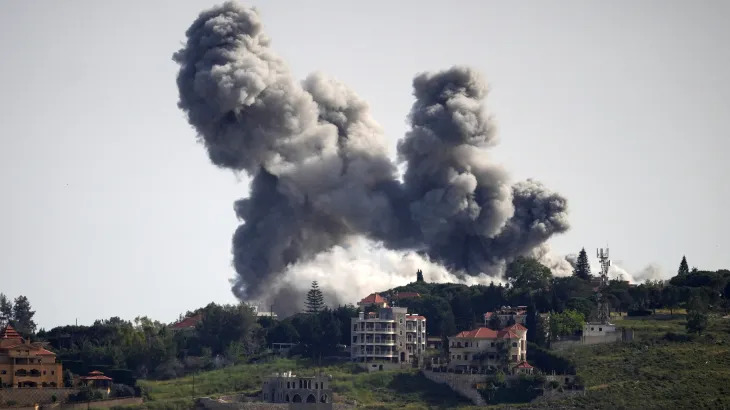
Tensions in the Middle East have intensified once again after Iran accused the United States of attempting to ignite a new conflict despite an existing ceasefire that halted weeks of devastating military confrontation. Strong warnings issued by senior Iranian leaders and military officials have raised fresh concerns that the fragile calm in the region may not last long, increasing fears of renewed instability with potentially severe global consequences.
Iranian chief negotiator Mohammad Bagher Ghalibaf delivered a sharply worded message accusing Washington of continuing to pursue military objectives even while diplomatic efforts remain active behind the scenes. According to Ghalibaf, the United States has not abandoned the idea of using military pressure against Iran and continues to believe that Tehran may eventually surrender under economic and political strain.
In an audio message carried by Iranian media outlets, Ghalibaf stated that American activities, both visible and covert, indicate preparations for renewed confrontation. He argued that despite diplomatic engagement and economic sanctions, the broader strategic posture of the United States still reflects an intention to maintain military leverage over Iran.
The Iranian leader also warned that Tehran was fully prepared to deliver what he described as a forceful response if any fresh attacks were launched against the country. His comments immediately intensified international concern because they came at a time when negotiations and mediation efforts are still underway following the ceasefire agreement implemented in April.
Political observers believe Ghalibaf’s remarks were aimed at multiple audiences simultaneously. Domestically, the statement reinforces Iran’s image of resistance against foreign pressure. Internationally, it serves as a warning that Tehran remains prepared for escalation if diplomatic channels collapse or military pressure increases again.
The ceasefire that took effect on April 8 temporarily ended weeks of direct and indirect confrontation involving Iran, the United States and regional allies. The conflict had severely disrupted global markets, maritime trade and energy flows across the Middle East, creating anxiety among governments and investors worldwide.
Although large scale military operations have stopped for now, the underlying tensions remain unresolved. Both Washington and Tehran continue exchanging warnings while maintaining military readiness, suggesting that the possibility of renewed confrontation has not disappeared.
The United States has also maintained a firm public posture throughout the ongoing crisis. President Donald Trump has repeatedly warned that military action could return if circumstances demand it. Meanwhile, Vice President JD Vance recently acknowledged that diplomatic progress was being made but simultaneously emphasized that American military forces remained fully prepared.
Analysts say the current situation reflects a dual strategy adopted by both sides. On one hand, negotiations and mediation efforts continue quietly through diplomatic channels. On the other hand, military signalling and public rhetoric are being used aggressively to maintain strategic pressure and deter adversaries.
Iran’s Islamic Revolutionary Guard Corps has further amplified concerns by issuing its own warning regarding the possibility of broader conflict. In a statement released through official military media, the organisation warned that any renewed aggression against Iran would lead to consequences extending far beyond the region itself.
The Guards also claimed that Iran had not yet fully deployed its military capabilities during the previous phase of confrontation. Such statements are being interpreted by experts as an attempt to project deterrence and demonstrate confidence in Iran’s regional military network and strategic resources.
International security analysts warn that another escalation in the Middle East could produce consequences reaching well beyond regional borders. Energy markets, shipping routes, food supply chains and financial systems remain deeply connected to stability in the Gulf region.
One of the biggest unresolved concerns remains the future of the Strait of Hormuz, one of the world’s most strategically important maritime corridors. A substantial share of global oil and liquefied natural gas exports passes through the narrow waterway every day, making it essential for international energy security.
Despite the ceasefire, maritime activity in the region has not fully returned to normal. Continued disruption and uncertainty surrounding the strait have already pushed global energy prices upward and increased fears regarding supply shortages.
Experts warn that prolonged instability in the Strait of Hormuz could severely impact countries heavily dependent on imported fuel. Rising energy costs may further intensify inflation, transportation expenses and industrial production challenges across multiple economies.
The United Nations Food and Agriculture Organization has also expressed alarm regarding the economic fallout linked to the ongoing tensions. The agency warned that disruption to maritime trade and higher transportation costs could trigger a serious global food price crisis.
According to international observers, rising fuel costs are already affecting several import dependent countries, particularly in Africa and Asia. Some nations have witnessed transport disruptions, while others are experiencing public protests linked to inflation and energy shortages.
Economic specialists note that the Middle East crisis is no longer viewed solely as a regional security issue. It has increasingly become a global economic concern capable of affecting food prices, industrial supply chains and household living costs across multiple continents.
Countries heavily dependent on energy imports, including major Asian economies, are closely monitoring developments in the Gulf region. Any sustained increase in oil prices could place additional pressure on inflation management and economic growth projections worldwide.
Reports suggest that diplomatic mediation efforts involving Pakistan and other international actors are continuing in the background. However, no major breakthrough has been publicly announced so far. Diplomats believe both Iran and the United States are attempting to balance domestic political messaging with strategic negotiations behind closed doors.
Despite ongoing talks, the overall atmosphere remains highly volatile. Military warnings, naval tensions and political distrust continue to create an environment where even limited incidents could quickly escalate into a larger confrontation.
Strategic experts argue that the current crisis reflects deeper shifts in global power dynamics and regional influence struggles. The Middle East has long served as a centre of geopolitical competition, and developments in the region frequently shape wider international political and economic trends.
The coming weeks are expected to be critical in determining whether diplomatic engagement can prevent another cycle of military escalation. Governments, markets and international organisations around the world are now watching closely as tensions between Iran and the United States continue to threaten regional stability and global economic confidence.