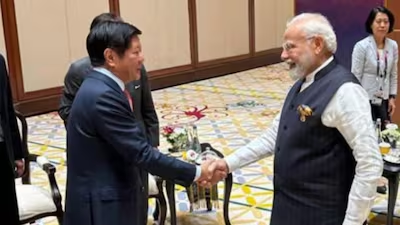
Philippines President Ferdinand “Bongbong” Marcos Jr. is set to embark on a significant state visit to India from August 4 to August 8, 2025. The visit, timed with the 75th anniversary of diplomatic relations between the two nations, is expected to reinforce longstanding partnerships and explore new avenues of cooperation across a wide spectrum. The agenda includes high-level bilateral talks with Prime Minister Narendra Modi, engagements with Indian leadership, and a symbolic visit to Bengaluru, signaling deepening ties in technology and innovation. The trip underscores India’s growing importance in the Philippines’ strategic outreach and also highlights India’s Act East Policy and Indo-Pacific vision.
Deepening Strategic and Economic Engagement
The five-day visit will begin on August 4, with President Bongbong Marcos accompanied by First Lady Louise Araneta Marcos and a high-level delegation that includes several key Cabinet Ministers, top government officials, and a business contingent. The delegation reflects the Philippine government’s intent to engage India not just diplomatically, but also economically and strategically.
On August 5, President Bongbong Marcos will hold bilateral discussions with Prime Minister Narendra Modi. These talks are expected to cover a broad range of issues, including trade, defence cooperation, healthcare, agriculture, maritime security, and technological collaboration. Discussions are also likely to touch upon regional challenges, digital transformation, and collaborative efforts in the Indo-Pacific region.
Bongbong Marcos will also call on President Droupadi Murmu during the visit, reflecting the ceremonial importance of the state visit. In addition, External Affairs Minister Dr. S. Jaishankar is scheduled to meet the Philippine President, further underlining the diplomatic depth of the engagement.
Over the last 75 years, India and the Philippines have steadily built a multi-dimensional partnership. From defence cooperation to pharmaceutical trade, both countries have discovered multiple synergies. The current visit is being viewed as a timely and strategic milestone, with the two sides now focusing on scaling up these engagements to match contemporary geopolitical realities.
Bengaluru Visit Signals Technology and Innovation Focus
Before concluding the visit, President Bongbong Marcos is scheduled to travel to Bengaluru—India’s technology and innovation hub. This visit is symbolic and strategic. Bengaluru represents India’s aspirations in startups, artificial intelligence, clean energy, and digital technologies. The Philippines, which is also expanding its tech infrastructure and digital economy, sees this as an opportunity to draw lessons and possibly enter into collaborative ventures with Indian firms and institutions.
The visit is particularly relevant in the context of the Philippines’ emerging digital agenda, where India’s experience in building scalable, inclusive digital public infrastructure could serve as a model. The trip to Bengaluru is also seen as a bridge to foster cooperation in education, innovation, and entrepreneurship.
India’s pharmaceutical capabilities are another area of deep interest for the Philippine delegation, especially in the backdrop of global health priorities. With India’s robust healthcare manufacturing base and the Philippines’ need for affordable, quality medicines, the discussions are likely to explore long-term trade frameworks.
While much of the focus will be on bilateral economic and security partnerships, the leaders are also expected to deliberate on global and regional challenges, including maritime stability in the South China Sea, cybersecurity cooperation, and collaboration in multilateral forums.
The Indian government, through its Act East Policy and its broader Indo-Pacific vision—Vision MAHASAGAR—has consistently emphasized its commitment to working with ASEAN countries like the Philippines. Bongbong Marcos’ visit gives fresh momentum to this policy, opening new pathways for strategic alignment and people-to-people engagement.
The Ministry of External Affairs highlighted that the visit is a significant opportunity for the two nations to not only celebrate a historic diplomatic milestone but also chart out a roadmap for future cooperation in a rapidly changing global environment.
President Bongbong Marcos’ engagements during this state visit are poised to reflect the growing alignment of India and the Philippines as democratic partners committed to a free, open, and inclusive Indo-Pacific, with cooperation rooted in mutual respect, shared goals, and complementary strengths.