The Pentagon has delivered one of its clearest messages yet regarding America’s diminishing role in European security architecture, particularly in relation to Ukraine’s future. At a time when Ukraine continues to fight an exhausting war against Russia, Washington’s stance is gradually tilting towards expecting Europe to take the lead in ensuring Kyiv’s long-term safety and stability. While symbolic displays of unity from US leadership remain visible, the underlying signals from defense officials indicate that the United States envisions a far more limited role for itself in the region, placing the onus on Europe to design and enforce security guarantees. This approach underscores a fundamental shift in transatlantic dynamics and raises important questions about how Europe will recalibrate its defense posture in an era of shrinking American engagement.
Washington’s New Position on Ukraine’s Security
The reassessment of America’s role became clearer during a recent closed-door meeting between senior US defense officials and top European military leaders. Elbridge Colby, the US Undersecretary of Defense for Policy, was directly questioned by European representatives about whether Washington would be prepared to commit troops or provide air support in any eventual peace enforcement agreement between Ukraine and Russia. His response was firm, leaving little ambiguity: the United States does not envision playing a dominant or expansive role in such a framework. Instead, Colby’s comments suggested that Washington expects European allies to step into the driver’s seat when it comes to implementing post-war security arrangements for Kyiv.
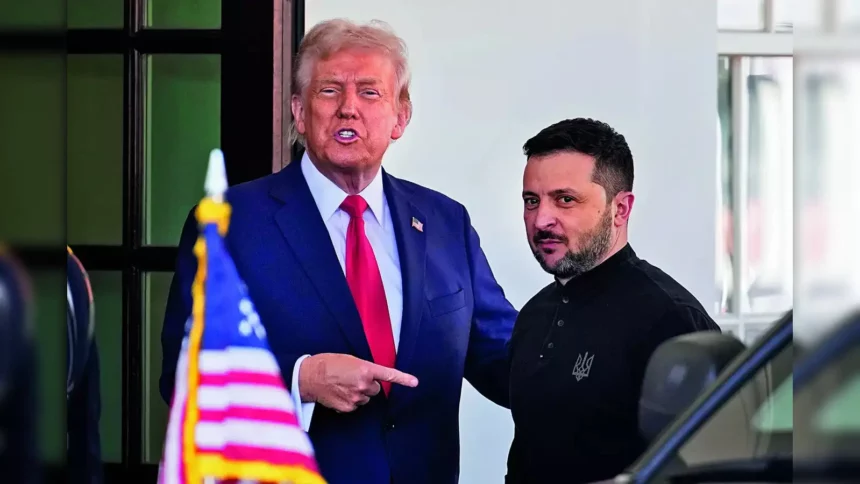
This statement comes at a particularly sensitive moment for Ukraine, as it continues to rely heavily on external assistance not only for military hardware but also for diplomatic and financial support. President Volodymyr Zelenskyy, during his recent visit to Washington, underscored this dependence by announcing Ukraine’s plans to purchase additional US-made arms. While this move was seen by some as part of a broader effort to secure sustained American involvement, it also highlighted the complex and sometimes contradictory signals emanating from Washington. On the one hand, the Trump administration continues to emphasize solidarity with Ukraine and its European allies; on the other, it is reluctant to provide concrete, long-term commitments that would bind the US militarily to the region.
The shift was further illustrated by President Trump’s own public statements. At the start of the week, he appeared willing to send US troops to Ukraine if necessary. Yet within 24 hours, his position softened, with the president suggesting instead that Washington might consider offering air support to European-led operations. This back-and-forth left many European officials confused and uncertain, reinforcing concerns that US policy towards Ukraine is being defined less by strategic clarity and more by political calculation.
For European leaders, the Pentagon’s position signals an inflection point. The expectation that Europe must shoulder the principal responsibility for Ukraine’s security reflects a deeper transformation in transatlantic relations—one where Washington’s focus increasingly tilts toward its competition with China in the Indo-Pacific, leaving Europe to manage its own neighborhood. As one NATO diplomat, briefed on the discussions, put it: “There’s the dawning reality that this will be Europe making this happen on the ground. The US is not fully committed to anything.”
Europe’s Growing Responsibility and the Emerging Security Framework
The implications of Washington’s recalibration are profound for Europe. NATO, long accustomed to American leadership and military guarantees, now faces the prospect of taking greater responsibility for its own security environment. NATO Secretary General Mark Rutte’s recent briefing to alliance members in Brussels underscores this urgency. Following his participation in the White House meetings, Rutte initiated discussions on a possible framework for Ukrainian security guarantees, tasking member states to develop actionable proposals that could later be considered by their political leaders.
This development places Europe at the center of a difficult balancing act. On the one hand, European states understand that supporting Ukraine is not merely a matter of solidarity but also of self-interest. A stable and sovereign Ukraine serves as a buffer against further Russian aggression, protecting the eastern flank of Europe. On the other hand, European governments face mounting domestic challenges—from energy insecurity and inflation to political divisions—that complicate their ability to sustain long-term military commitments.
The challenge is compounded by uncertainty about American intentions. While Washington continues to provide military equipment and maintains symbolic shows of support, such as hosting Zelenskyy and European leaders at the White House, the underlying reluctance to commit ground forces or establish binding guarantees creates unease among allies. Trump’s fluctuating statements—first suggesting troops could be deployed, then retracting the idea in favor of limited air support—have only deepened this unease. European officials, already navigating diverse national interests within the alliance, now face the added complexity of planning for a future in which US military leadership is no longer a given.
The urgency of developing a robust European-led security framework for Ukraine also reflects broader geopolitical shifts. With Washington focused on countering China and managing global hotspots beyond Europe, the continent can no longer rely on automatic American intervention. Instead, it must consider building capabilities that allow it to act independently when necessary. This may involve strengthening defense cooperation within the European Union, increasing contributions to NATO operations, and developing mechanisms that ensure Ukraine receives the necessary military, economic, and political backing to deter future aggression from Russia.
Complicating matters further is the political landscape within Europe itself. While some countries, particularly those along NATO’s eastern flank, strongly favor robust and immediate commitments to Ukraine, others remain cautious, concerned about provoking further escalation with Moscow. Bridging these differences while simultaneously building a credible security framework presents a daunting challenge. Nevertheless, as the Pentagon’s signals make clear, the responsibility increasingly lies with Europe to take decisive action.
The political symbolism of Zelenskyy’s recent announcements about purchasing US arms must also be considered within this broader context. For Ukraine, securing American weaponry not only provides practical military benefits but also symbolizes a continuing connection with Washington. However, if these arms deals are not coupled with firm commitments to long-term support, they risk becoming transactional gestures rather than components of a durable security strategy.
NATO’s deliberations in Brussels reflect the seriousness with which alliance members are now approaching this challenge. Rutte’s effort to initiate preliminary discussions on security guarantees highlights a recognition that the current ambiguity cannot last indefinitely. As European officials craft proposals, they will need to consider not only immediate military assistance but also longer-term measures—such as training programs, intelligence sharing, and joint exercises—that strengthen Ukraine’s integration into Euro-Atlantic security structures.
For the United States, this emerging European leadership could prove advantageous. By shifting responsibility to Europe, Washington can conserve resources and redirect strategic attention toward other global priorities, particularly in the Indo-Pacific. However, this approach carries risks. If European allies fail to provide sufficient support, or if divisions within NATO prevent coherent action, the absence of strong American backing could embolden Russia, undermining both Ukraine’s sovereignty and broader European stability.
In this shifting landscape, the role of diplomacy will be as critical as military commitments. The eventual architecture of Ukraine’s security will need to balance deterrence against Russia with the pursuit of a sustainable peace. This will require careful coordination not only between Europe and the United States but also among diverse European states themselves.