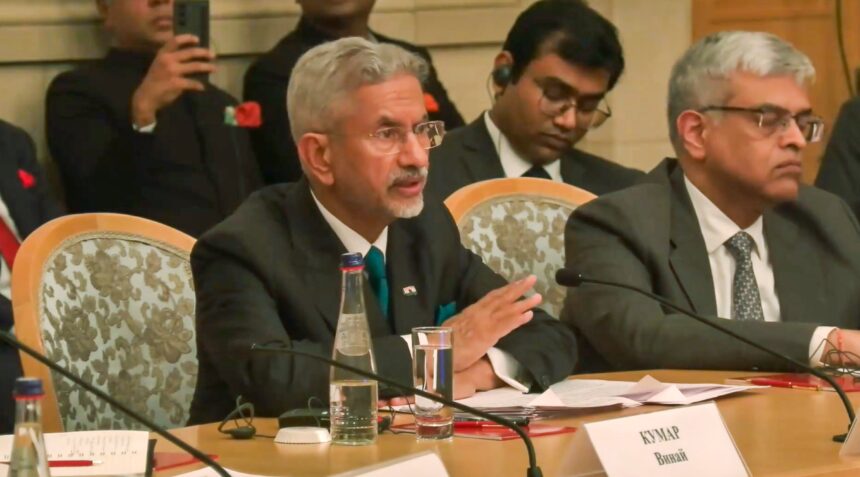
India’s External Affairs Minister, Dr. S. Jaishankar, during his visit to Moscow, strongly emphasized the urgency of deeper and more intensive economic collaboration between India and Russia. Addressing the India-Russia Business Forum, he highlighted India’s emergence as a $4 trillion economy and outlined the enormous opportunities that Russian businesses could tap into through greater involvement in India’s economic initiatives such as Make in India. Stressing that India’s rapid growth demands reliable partners across sectors, S. Jaishankar urged Russian firms to become more proactive in aligning with India’s development trajectory. His message not only reinforced the historical strength of India-Russia ties but also called for an upgrade in economic cooperation that matches the strategic depth of the bilateral relationship.
Expanding Trade Opportunities and the Call for Dependable Partnerships
S. Jaishankar’s remarks came at a time when India’s economy continues to grow at a robust pace, making it one of the most dynamic economies in the world. He underscored the fact that with India’s GDP crossing $4 trillion and projected to grow steadily at around 7 percent for the foreseeable future, the need for dependable sources of investment, supply, and collaboration has never been greater. According to him, India is not merely looking for sporadic cooperation but rather for consistent, long-term partners who can contribute to its economic transformation.
Highlighting the areas of immediate requirement, S. Jaishankar pointed out essential products such as fertilizers, chemicals, and machinery where Russia could become a dependable supplier. He noted that India’s rapidly growing infrastructure sector alone presents a multitude of opportunities for Russian enterprises with proven expertise in their domestic markets. In his view, India’s scale and pace of urbanization, modernization, and rising consumption patterns have created new avenues for global players, and Russian companies must seize these opportunities before others do.
The minister also emphasized how flagship initiatives such as Make in India have opened windows of opportunity for foreign companies. These initiatives are designed not only to boost domestic manufacturing and employment but also to encourage global firms to collaborate in creating localized solutions for India’s unique needs. He framed this as an invitation—an explicit call for Russian companies to engage more intensively with Indian counterparts, stressing that such collaboration would not only diversify trade but also balance the bilateral economic relationship.
In the backdrop of rising protectionism and trade barriers from other global partners, particularly the imposition of tariffs by the United States on Indian goods, S. Jaishankar’s speech carried added weight. He made it clear that India’s reliance on dependable partners is not merely a matter of choice but of necessity, given the turbulence in global trade. Thus, Russia’s role as a consistent and trustworthy ally could translate into significant economic advantages for both sides if harnessed effectively.
Strengthening Historical Ties Through Modern Economic Collaboration
Beyond trade and investment, S. Jaishankar also reflected on the broader context of India-Russia relations. He noted that the two countries have nurtured one of the steadiest and most resilient bilateral relationships in modern international politics. Despite shifts in global alliances and pressures from major powers, India and Russia have maintained a partnership grounded in mutual respect, trust, and strategic convergence. Yet, as S. Jaishankar candidly admitted, this stability has not automatically translated into equally strong economic cooperation.
The minister highlighted that while trade volumes between the two countries have seen growth in recent years, they remain limited in scope and heavily imbalanced, with a persistent trade deficit. This imbalance, he stressed, urgently requires corrective measures through diversification and balancing of trade. For him, this is not only essential to achieve higher trade targets but also to sustain current levels in a volatile global economic climate.
In this context, S. Jaishankar welcomed the signing of the Terms of Reference (ToR) for a Free Trade Agreement (FTA) between India and the Eurasian Economic Union, of which Russia is a leading member. He expressed optimism that the eventual conclusion of this FTA could serve as a catalyst for stronger and more comprehensive economic integration. Such agreements, he argued, would provide the structural framework necessary to encourage joint ventures, attract significant investments, and facilitate greater mobility of skilled professionals between the two nations.
S. Jaishankar also drew attention to the importance of aligning government-to-government dialogues with business-to-business actions. He stressed that while official discussions and agreements are vital, their success ultimately depends on businesses stepping forward with confidence and seizing the opportunities presented. He urged Russian firms not to wait for conditions to become “perfect,” but instead to proactively build partnerships that can adapt to changing market conditions.
The minister also underlined the complementary nature of Indian and Russian economic strengths. While India provides a vast market, a skilled workforce, and robust economic growth, Russia brings in strengths in energy, natural resources, heavy machinery, and technology. Together, the two countries can create a partnership that not only benefits their economies but also strengthens their global standing as independent and resilient players in an uncertain international order.
S. Jaishankar’s remarks were also notable for their emphasis on people-to-people and professional linkages. He pointed out that India’s skilling and mobility initiatives are already beginning to create new channels for cooperation, enabling Indian professionals to contribute to Russian industries and vice versa. This human capital exchange, he suggested, could deepen the trust and familiarity that form the bedrock of long-term economic cooperation.
At its core, S. Jaishankar’s address in Moscow was more than just a diplomatic speech. It was a strategic call for action—an appeal for Russian companies to rise to the challenge of partnering with India at a pivotal moment in its growth story. By aligning their investments, expertise, and resources with India’s developmental priorities, Russian firms have the chance to play a defining role in shaping the trajectory of one of the world’s most dynamic economies.
The meeting in Moscow thus symbolized not only the enduring friendship between India and Russia but also the urgency of translating that friendship into tangible economic outcomes. As S. Jaishankar made clear, the future of the bilateral relationship will depend not just on historical goodwill but on the ability of both nations to build resilient, mutually beneficial, and future-oriented economic partnerships.