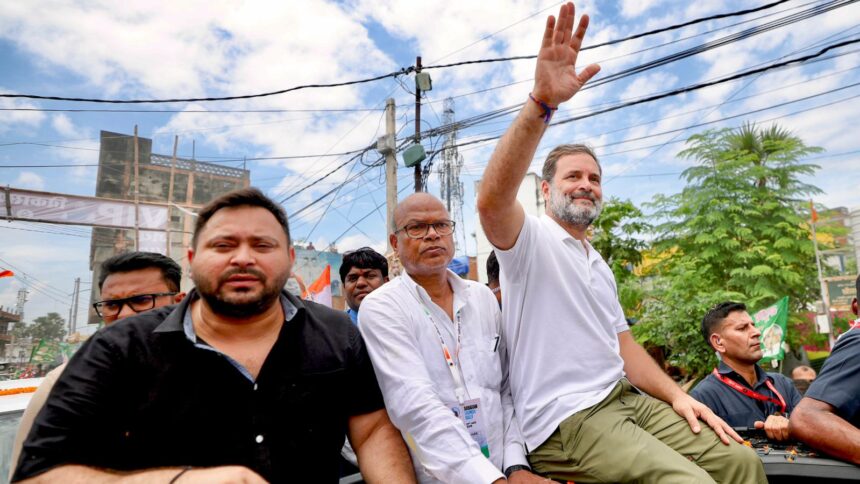
The fragile unity within the Indian Opposition, projected under the banner of resisting the Bharatiya Janata Party’s dominance, has once again been tested. What was meant to be a demonstration of growing warmth and collaboration among diverse political forces has been overshadowed by a premature declaration from Rashtriya Janata Dal leader Tejashwi Yadav. His statement that he would like to see Rahul Gandhi as Prime Minister in 2029 has not only stirred unease across the Opposition bloc but also sharpened the existing differences between parties already struggling to maintain a united front. While Rahul Gandhi is viewed as the Congress party’s natural candidate for leadership, the question of whether other regional leaders would accept his projection remains a thorn in Opposition dynamics. The reactions to Yadav’s statement highlight the delicate and often fractured nature of coalition politics in India, particularly when it comes to the critical question of leadership.
Tejashwi Yadav’s Declaration and Its Immediate Fallout
Tejashwi Yadav’s remark, made with a tone of loyalty and fraternity by referring to Rahul Gandhi as his “elder brother,” was not in itself unusual. Leaders often make symbolic gestures of solidarity to signal alignment with larger parties. Yet, the timing and explicitness of his comment have made it problematic. The Opposition had only recently managed to put on a show of strength by coming together to push forward a candidate for the Vice-Presidential election. That symbolic victory, aimed at projecting an alternative to the BJP’s dominance, has now been overshadowed by the uncomfortable debate over who should lead the bloc in the 2029 general election—five years away.
The reactions came swiftly. Aam Aadmi Party leader Arvind Kejriwal, never known for mincing words, openly signaled his dissent. According to sources, Kejriwal was already wary of formally aligning with the INDIA bloc. His agreement to support former ISRO scientist Sudershan Reddy for the Vice President post came only after an appeal from West Bengal Chief Minister Mamata Banerjee. Even then, Kejriwal reportedly told Trinamool Congress’s Derek O’Brien that while he was willing to back an Opposition candidate, he would not support one explicitly tied to the INDIA grouping. This subtle but telling distinction indicated his broader reluctance to embrace the collective Opposition banner.
The Trinamool Congress’s response was more muted but no less significant. While Mamata Banerjee herself has ambitions that extend beyond Bengal, her nephew Abhishek Banerjee, currently spearheading the party’s coordination within Parliament, has cultivated cordial relations with Rahul Gandhi. Nevertheless, Tejashwi Yadav’s statement was seen as premature and disruptive. Sources close to the party revealed that Abhishek Banerjee, though respectful of Gandhi’s stature, believes that the Opposition’s immediate priorities lie elsewhere—namely, in state elections such as Bihar’s assembly polls later this year and the upcoming contests in Bengal and Assam. Raising the issue of the Prime Ministerial candidate for 2029, in his view, not only distracts from more pressing concerns but also risks fracturing the tentative unity that has been painstakingly assembled.
The Trinamool’s hesitation is not unfounded. In Bengal, the Congress remains a political rival, and Mamata Banerjee has made clear that her willingness to participate in any broader Opposition arrangement hinges on the Congress severing its alliance with the Left, particularly the CPM, her primary adversary in the state. Without this concession, any talk of broader cooperation risks remaining rhetorical rather than practical. Tejashwi’s declaration, therefore, has the potential to reopen old wounds and further complicate an already fragile equation.
Opposition Unity: Promise and Peril in a Fractured Political Landscape
The dream of Opposition unity in India has always been fraught with contradictions. Unlike the BJP, which benefits from a centralized command structure and an ideological glue provided by the Sangh Parivar, the Opposition is an amalgamation of regional and ideological forces with varying priorities and ambitions. At times of electoral urgency, these forces can converge, as seen in the vice-presidential election. Yet, beneath these gestures lies a deep mistrust, competing egos, and divergent political compulsions.
Tejashwi Yadav’s comment has highlighted the central dilemma: who will lead the Opposition in 2029? For the Congress, the answer is obvious—Rahul Gandhi. As the scion of the Nehru-Gandhi dynasty and a national-level figure with pan-India visibility, Rahul Gandhi represents continuity and brand recognition. Yet, for regional leaders like Kejriwal and Mamata Banerjee, endorsing him means subordinating their own political ambitions and potentially ceding space to the Congress in states where they are rivals.
This tension is particularly pronounced in Bengal. Mamata Banerjee’s Trinamool Congress has grown by displacing the Left and diminishing the Congress’s relevance in the state. Any acknowledgment of Congress’s national leadership risks undermining her authority in her home turf. Similarly, Arvind Kejriwal, whose Aam Aadmi Party is expanding beyond Delhi and Punjab, sees himself as a national contender. For him, aligning behind Rahul Gandhi forecloses his own chances of emerging as a credible prime ministerial face.
The situation is further complicated by the Congress’s alliance with the Left in Bengal, which Mamata has consistently opposed. Her stance has been unequivocal: Trinamool is willing to engage in Opposition unity at the national level, but only if the Congress divorces itself from the CPM in Bengal. Until then, the possibility of a genuine, functional alliance remains elusive.
Abhishek Banerjee’s discomfort with Tejashwi’s statement also reflects this larger reality. Though he has made efforts to maintain a constructive relationship with Rahul Gandhi, his immediate political calculations revolve around upcoming state elections and parliamentary strategies. According to sources, he believes that issues such as the revision of the Bihar voter list and the question of statehood for Kashmir demand urgent attention, far more than the symbolic debate over a prime ministerial candidate years away.
This pragmatism underscores a critical truth: the Opposition cannot afford to get ahead of itself. The road to 2029 is long and uncertain, with multiple state elections and the 2024 Lok Sabha results yet to shape the political environment. Prematurely naming a candidate risks alienating potential allies and fracturing the coalition before it has fully taken form.
Yet, the temptation to anoint Rahul Gandhi is understandable. His Bharat Jodo Yatra and subsequent engagements have revitalized his image and given the Congress a renewed sense of purpose. For leaders like Tejashwi Yadav, whose own political fortunes are tied to countering the BJP in Bihar, aligning with Rahul Gandhi symbolizes a broader ideological alliance against what they see as the BJP’s authoritarian tendencies. In his eagerness to demonstrate loyalty and strengthen bonds with the Congress, however, Tejashwi has inadvertently exposed the fault lines within the larger Opposition.
The Road Ahead: Between Symbolism and Strategy
The fallout from Tejashwi’s statement may not immediately dismantle the Opposition’s efforts, but it has undoubtedly injected new complexities into the ongoing project of unity. For now, dissenters like Kejriwal and Mamata Banerjee may choose to remain silent or measured in their responses, focusing instead on the immediate electoral contests ahead. Yet, the underlying question of leadership will continue to hover like a shadow over every alliance negotiation, every electoral strategy, and every symbolic display of solidarity.
The 2024 general election will serve as the first real test of Opposition cooperation. While the BJP enters with organizational strength and Prime Minister Narendra Modi’s towering presence, the Opposition must find a way to present a coherent, credible alternative. Whether that alternative will be anchored around Rahul Gandhi or emerge from a consensus among regional leaders remains an open question.
Tejashwi Yadav’s statement serves as both a reminder and a warning. It reminds us of the enduring appeal of dynastic continuity in Indian politics, where family legacies still carry weight in political imagination. At the same time, it warns of the perils of premature declarations in a landscape defined by fragile alliances and shifting loyalties. The task before the Opposition is formidable: to forge unity not merely in rhetoric but in strategy, to reconcile ambitions with realities, and to prepare for the long, uncertain road that lies ahead.