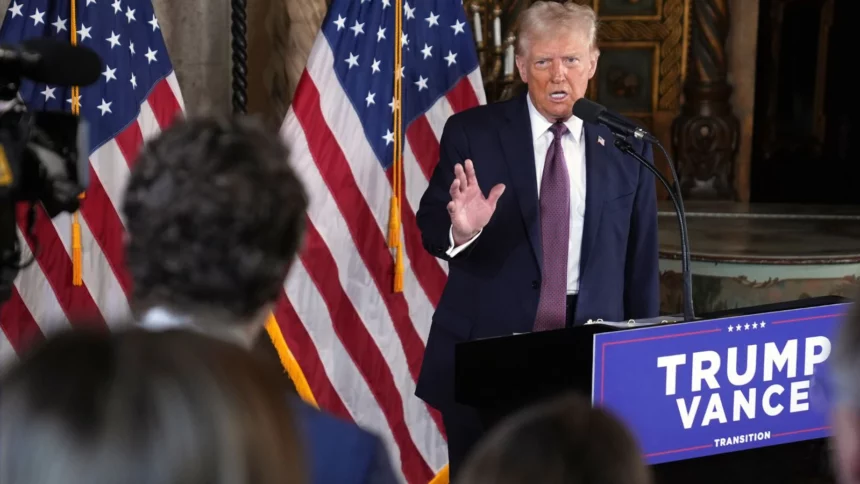
The head of the Panama Canal Authority, Ricuarte Vasquez Morales, expressed strong concerns over U.S. President-elect Donald Trump’s recent demands for preferential treatment for American ships passing through the Panama Canal. In a statement on Wednesday, Vasquez Morales stated that granting Donald Trump’s request would not only disrupt the neutral operations of the canal but could also cause significant chaos in international trade.
“Rules are rules, and there are no exceptions,” Vasquez Morales told the Wall Street Journal in an interview. He emphasized that the canal must remain neutral, and any deviation from the established policies would violate the neutrality treaty and international laws governing the waterway. “We cannot discriminate against the Chinese, or the Americans, or anyone else,” he added. The CEO warned that granting preferential treatment to U.S. ships would undermine the neutrality of the canal, potentially destabilizing international maritime operations and setting a dangerous precedent.
The Panama Canal, a vital artery for global trade, has long been a point of political tension between the U.S. and Panama. Originally built, owned, and operated by the United States, the canal was handed over to Panamanian control following a 1977 treaty negotiated by U.S. President Jimmy Carter. This transfer of control, which gradually occurred over the following decades, has been a source of contention for some U.S. politicians, including Donald Trump, who has voiced dissatisfaction with the deal.
Donald Trump has raised concerns about the canal’s management, particularly accusing Panama of allowing China to exert significant influence over its operations. He has criticized Panama’s agreements with Chinese companies that operate two ports at either end of the canal. However, Vasquez Morales strongly refuted these accusations, calling them “unfounded.” He reiterated that China has no direct involvement in the canal’s operations, which remain under the control of the Panama Canal Authority, an independent agency.
The CEO also clarified that U.S. ships are not subject to higher rates than those of other nations, emphasizing the fairness of the canal’s fee structure. The only exception to this rule is for U.S. Navy vessels, which are given priority in accordance with the 1977 agreement that grants them expedited transit through the canal for military purposes.
Donald Trump’s proposals have raised the possibility of military action to assert U.S. control over the canal or to alter the terms of the 1977 treaty, including potentially using economic leverage against neighboring countries such as Canada. The President-elect’s controversial rhetoric has raised alarms in Panama and beyond, with critics warning that his stance could lead to unintended consequences for global trade and U.S.-Panama relations.
The Panama Canal, linking the Atlantic and Pacific Oceans, has long been a critical infrastructure asset in world trade, providing a shortcut for ships that would otherwise need to navigate around the southern tip of South America. It handles approximately 12% of global maritime trade, making it a strategic and highly sensitive asset. The canal’s neutrality is fundamental to its continued success, as it must be accessible to all nations without political bias or preferential treatment.
The Panama Canal Authority has consistently maintained that its operations are based on established rules and regulations that ensure fairness and transparency. Any attempt to alter these policies, particularly under political pressure, could have far-reaching consequences for international shipping, potentially leading to disruptions in global supply chains.
The current debate over the canal underscores the growing tensions surrounding international trade routes and geopolitical influence. As President-elect Donald Trump prepares to take office, his stance on the Panama Canal could become one of the early foreign policy challenges he faces. While the controversy surrounding the canal continues to unfold, Vasquez Morales and the Panama Canal Authority remain committed to upholding the neutrality and stability of this crucial global waterway.