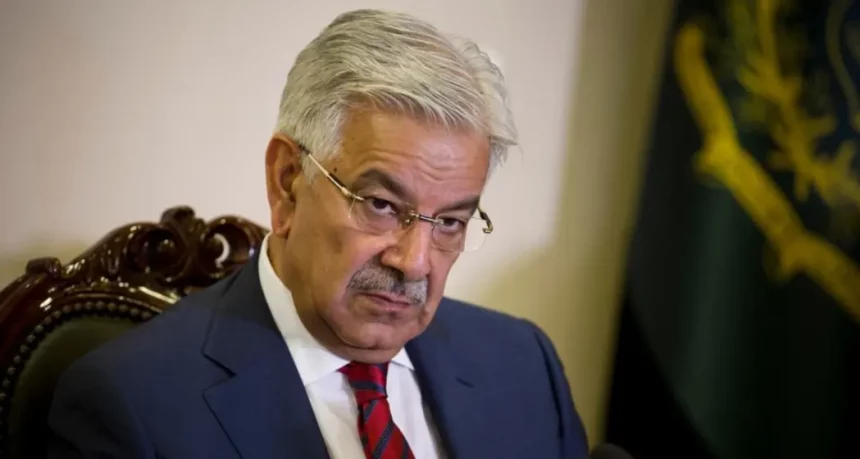
Amid escalating tensions with Afghanistan, Pakistan’s Defence Minister Khawaja Muhammad Asif has issued a sharp warning, claiming the country is prepared for a “two-front war” as it faces a volatile security situation along the Afghan border. Asif alleged that India could exploit the ongoing conflict by “playing dirty” at the border. His remarks, made in a television interview, reflect Islamabad’s growing anxiety over simultaneous military pressure on both eastern and western fronts and an increasingly unstable regional environment.
Khawaja Asif’s Warning and the Two-Front War Narrative
Khawaja Asif responded to questions about whether India could initiate aggressive action along the border while Pakistan remains engaged in heightened tensions with the Afghan Taliban. He asserted that Pakistan cannot rule out such a possibility and that the country’s armed forces are fully prepared for a two-front confrontation if required.
“Absolutely, you cannot rule it out. Absolutely, there is a possibility of this,” Asif said during the interview, though he provided no evidence to support the claim. The minister recalled an earlier “encounter” with India “some months ago,” referring indirectly to the heightened military situation that followed Operation Sindoor—an operation India carried out targeting terror camps in Pakistan and Pakistan-occupied Kashmir. He emphasized that Pakistan’s troops were not moved away from the Afghan border during that period, suggesting that the military is capable of handling simultaneous security challenges.
“The situation is not very good,” Asif admitted, pointing to Pakistan’s deteriorating security landscape. He painted a picture of rising threats from multiple directions, noting that the country’s western border with Afghanistan has become a flashpoint once again. The minister also claimed that discussions and strategic planning have already taken place at the highest levels of government to prepare for any such eventuality involving both India and Afghanistan.
When asked if he or Prime Minister Shehbaz Sharif had convened a high-level meeting to assess the situation and formulate a two-front war strategy, Asif confirmed the existence of a detailed plan. “There is a strategy for this. Publicly, we are not discussing it at this time, but we are prepared for any eventuality. We are prepared for that. There is absolutely no doubt about it,” he said. The minister reiterated the claim that India could take advantage of Pakistan’s current position, although no concrete evidence was presented.
His remarks came just days after reports emerged that Pakistan had carried out airstrikes inside Kabul, targeting the chief of the Tehreek-e-Taliban Pakistan (TTP), Noor Wali Mehsud. This action, which Afghanistan condemned as a violation of its sovereignty, has significantly escalated tensions between the two neighbors. Kabul accused Islamabad of undermining diplomatic channels and resorting to unilateral military actions.
Pakistan has for months faced mounting security concerns along its western frontier, where Afghan Taliban forces and TTP militants have increased their activities. The relationship between Islamabad and Kabul has grown increasingly strained since the Taliban returned to power in Afghanistan in 2021. Pakistan, once seen as a key backer of the Taliban, now finds itself facing frequent border clashes, militant infiltration, and diplomatic friction.
The current flare-up has intensified domestic pressure on Pakistan’s civilian and military leadership to respond decisively to cross-border violence. The government’s warnings about a potential Indian move appear to be an attempt to emphasize the seriousness of the situation and rally public support around the armed forces.
India’s Stand and the Regional Security Equation
As Pakistan projects a two-front war narrative, India has openly supported Afghanistan in the ongoing border tensions. On Thursday, India’s Ministry of External Affairs strongly criticized Islamabad for what it described as its longstanding practice of sponsoring terrorism and shifting blame to its neighbors. The statement came after clashes erupted on the Afghanistan-Pakistan border during a visit to India by Amir Khan Muttaqi, the Taliban foreign minister. Muttaqi sought to reassure New Delhi that Kabul would not allow Afghan soil to be used against foreign countries, signaling an attempt to ease security concerns.
Randhir Jaiswal, spokesperson for India’s Ministry of External Affairs, said New Delhi is closely monitoring the developments along the Afghanistan-Pakistan frontier. “India remains fully committed to the sovereignty, territorial integrity and independence of Afghanistan,” RandhirJaiswal stated during a weekly press briefing. He added that the ongoing situation had been triggered by Islamabad’s actions.
RandhirJaiswal outlined three key points in his remarks: first, that Pakistan continues to host terrorist organizations and support terrorist activities; second, that it has a longstanding practice of blaming neighbors for its internal failures; and third, that Islamabad is angered by Afghanistan asserting its sovereignty. These comments underline India’s increasingly assertive position in regional security matters, particularly as its ties with Afghanistan have remained cautiously functional despite the Taliban takeover.
India has maintained its diplomatic presence and humanitarian engagement with Afghanistan since the fall of Kabul, adopting a pragmatic approach that prioritizes security concerns and regional stability. By extending support to Afghanistan in this latest border flare-up, India has sent a clear message to Islamabad about its willingness to counter Pakistan’s narratives.
The Pakistan-Afghanistan border has historically been a hotspot of instability. The disputed Durand Line remains a source of persistent friction, with frequent cross-border clashes and accusations of militant movement. India’s involvement in the narrative, even indirectly, adds a new layer of strategic complexity to an already volatile situation.
Amir Khan Muttaqi’s visit to India was seen as a significant diplomatic signal, as the Taliban regime attempts to secure greater recognition and address security concerns of regional powers. While New Delhi remains cautious about officially recognizing the Taliban government, its engagement reflects a strategic effort to maintain influence and ensure that Afghan territory is not used for anti-India activities.
The developments also highlight India’s evolving regional strategy, which increasingly involves positioning itself as a counterweight to Pakistan’s security posturing. For Islamabad, this creates the prospect of dealing with pressure on both its borders — a scenario that Khawaja Asif openly acknowledged in his remarks.
Shehbaz Sharif’s Call for Talks with Afghanistan
Even as Khawaja Asif projected an aggressive posture, Prime Minister Shehbaz Sharif struck a somewhat conciliatory tone on the same day. Addressing the ongoing clashes along the Pakistan-Afghanistan border, Sharif said Islamabad was ready to hold talks with Kabul under “legitimate and mutually respectful conditions.” He announced that Pakistan had agreed to a 48-hour ceasefire at Afghanistan’s request, emphasizing that the next step lay with Kabul.
“We have shown our willingness for dialogue. Now the ball is in their court,” Sharif said. “We want this issue to be resolved through peaceful means. Pakistan is ready to address these matters at the dialogue table.” His comments indicated a dual-track approach — one that involves military preparedness and diplomatic engagement simultaneously.
This strategy reflects Pakistan’s broader dilemma. On one hand, the security establishment faces intense pressure to act decisively against cross-border militant activities and perceived threats from India. On the other, the civilian leadership recognizes the need for dialogue to prevent further escalation that could strain the country’s already fragile economy and overstretched military.
The Afghan Taliban government, meanwhile, has shown no signs of backing down. Kabul has accused Pakistan of violating its sovereignty through airstrikes and has warned against any further unilateral actions. The situation remains tense, with both sides reinforcing their positions along the border.
For Pakistan, the evolving dynamic poses a serious challenge. Years of backing the Taliban have not translated into strategic leverage. Instead, the TTP — ideologically aligned with the Taliban but operating independently — has intensified its campaign against Pakistani forces, making the western border increasingly unstable.
India’s support for Afghanistan in this standoff has added further diplomatic pressure on Islamabad. By aligning itself with Kabul on the issue of sovereignty and security, New Delhi is signaling that it intends to remain a significant player in the regional security landscape. For Pakistan, this means any border escalation with Afghanistan now carries the potential of reverberating along its eastern frontier with India.
As Khawaja Asif’s comments reveal, Pakistan’s defense establishment is acutely aware of this shifting regional calculus. While his claims about Indian “dirty tactics” remain unsubstantiated, they reflect genuine apprehensions within the Pakistani leadership about being strategically encircled at a time of growing internal fragility.
The unfolding situation underscores the high-stakes nature of South Asia’s security environment. With Afghanistan asserting sovereignty, India stepping up its diplomatic engagement, and Pakistan facing unrest on multiple fronts, the region stands at a delicate juncture. The coming weeks will be critical in determining whether tensions give way to diplomacy or spiral into a deeper confrontation.