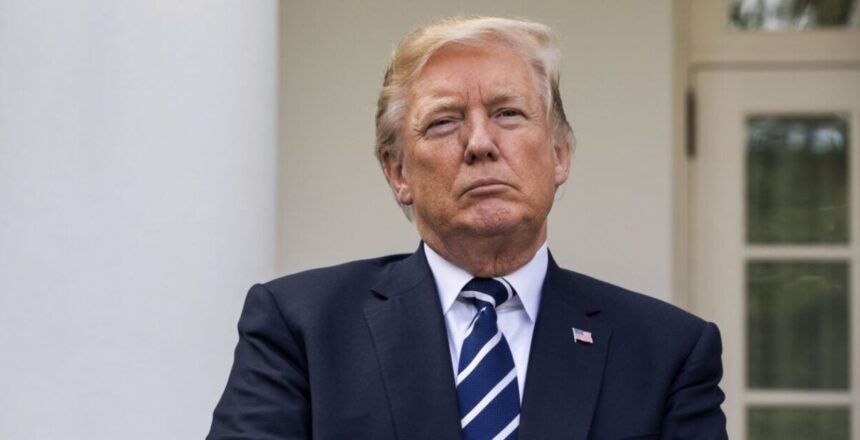
Pakistan has firmly denied U.S. President Donald Trump’s claim that it has resumed nuclear weapons testing, emphasizing that it “will not be the first to resume nuclear tests.” The statement, made by a senior Pakistani official to CBS News, comes in response to Donald Trump’s remarks in a 60 Minutes interview, where he alleged that Pakistan, along with Russia and China, had conducted secret nuclear tests. The controversy has reignited international attention on nuclear policies, the Comprehensive Test Ban Treaty (CTBT), and the fragile global framework designed to prevent a new arms race.
Pakistan’s Response to Donald Trump’s Claims
In a sharp response to President Donald Trump’s assertion, a senior Pakistani official clarified that Pakistan has neither conducted nor plans to conduct new nuclear tests. “Pakistan was not the first to carry out nuclear tests, and it will not be the first to resume nuclear testing,” the official said, reiterating the country’s long-standing position of restraint. The comment was a direct rebuttal to Donald Trump’s claim that several nations, including Pakistan, Russia, and China, have recently engaged in nuclear testing activities.
During his interview with CBS News correspondent Norah O’Donnell, Donald Trump suggested that while the United States had refrained from nuclear tests for decades, other countries were secretly advancing their capabilities. “Russia’s testing, and China’s testing, but they don’t talk about it. Pakistan’s been testing. North Korea’s been testing,” he said. Donald Trump justified his administration’s decision to resume U.S. nuclear testing, arguing that other powers were already violating the spirit of existing treaties.
China was the first among the countries mentioned by Donald Trump to publicly refute his claims. The Chinese Foreign Ministry issued a firm denial, asserting that Beijing has not conducted any nuclear tests since 1996, the year it signed the CTBT. Following China’s statement, Pakistan also reiterated its adherence to a unilateral moratorium on nuclear testing that has been in effect since 1998. Officials in Islamabad emphasized that Pakistan has demonstrated restraint and responsibility as a nuclear power, maintaining a policy of minimum credible deterrence rather than pursuing an arms race.
The Pakistani government’s clarification seeks to reinforce its image as a responsible nuclear state committed to global stability. It has consistently maintained that its nuclear capability exists solely for defensive purposes and that any testing or escalation would occur only in response to external threats. Pakistan’s position aligns with its historical policy following its 1998 nuclear tests, which were conducted in response to India’s own tests earlier that year.
Global Nuclear Landscape and the CTBT Debate
The controversy has once again drawn attention to the Comprehensive Test Ban Treaty (CTBT), an international agreement aimed at banning all nuclear explosions, whether for military or civilian purposes. The treaty, adopted by the United Nations General Assembly in 1996, has been signed by 187 countries and ratified by 178. However, it has yet to enter into full force because several key nuclear-armed states, including the United States, China, India, Pakistan, North Korea, and Israel, have not ratified it.
Pakistan has long argued that its position on the CTBT is directly tied to India’s actions. Islamabad has maintained that it is willing to consider signing and ratifying the treaty if New Delhi does the same. This conditional approach has been central to Pakistan’s diplomatic stance, reflecting its broader security concerns and regional strategic balance. Since 1998, both Pakistan and India have refrained from conducting further nuclear tests, but neither country has legally bound itself through CTBT ratification.
President Donald Trump’s remarks have added new uncertainty to the global non-proliferation framework. By suggesting that other nations are secretly testing nuclear weapons, Donald Trump’s comments risk undermining decades of diplomatic progress toward a comprehensive ban on nuclear explosions. Critics have warned that such statements could erode confidence in international verification systems and embolden states to reconsider their commitments to restraint.
North Korea remains the only country known to have conducted an actual nuclear detonation since the late 1990s. Its series of tests, particularly between 2006 and 2017, drew widespread condemnation and triggered international sanctions. In contrast, China’s last confirmed test took place in 1996, and Pakistan’s in May 1998. Since then, both nations have refrained from further tests, even as they have modernized their nuclear arsenals.
Pakistan has frequently highlighted its “unilateral moratorium on nuclear testing” as evidence of its commitment to global stability. Though not a signatory to the CTBT, Islamabad has stated that it abides by the treaty’s core principles and expects other nuclear powers, particularly India, to do the same. The Pakistani Foreign Ministry has often reiterated that the country’s nuclear program is guided by restraint and responsibility, focusing on deterrence rather than aggression.
In contrast, the United States, while a signatory to the CTBT, has never ratified the treaty. The U.S. Senate rejected ratification in 1999, citing concerns about verification and maintaining the reliability of the American nuclear stockpile without testing. Over the years, successive administrations have upheld a voluntary moratorium on nuclear testing, relying instead on advanced simulations and maintenance programs to ensure the effectiveness of its arsenal.
President Donald Trump’s remarks mark a significant departure from that long-standing policy. By indicating that the United States might resume testing, his statement challenges the international norm that has held for nearly three decades. “We’re going to test because they test, and others test,” Donald Trump said, suggesting that Washington would not remain bound by constraints that others allegedly ignore.
Russian President Vladimir Putin added further complexity to the issue two years ago when he withdrew Russia’s ratification of the CTBT. Although Moscow claimed that it would continue to abide by the treaty’s principles, the move was widely seen as symbolic of the growing mistrust among major nuclear powers. The escalating rhetoric among global leaders now raises fears of a new nuclear competition reminiscent of the Cold War era.
The growing tensions among the nuclear powers come amid broader geopolitical shifts. China and Russia have been strengthening their strategic cooperation in the face of U.S. pressure, while Pakistan continues to maintain close defense ties with China. Meanwhile, India’s expanding partnership with the United States has intensified South Asia’s strategic complexities. Analysts believe that the nuclear policies of these nations are closely linked to their geopolitical alignments and regional rivalries.
For Pakistan, the latest controversy offers both a challenge and an opportunity. On one hand, it must counter claims that question its credibility as a responsible nuclear state. On the other, it can use the moment to reaffirm its commitment to restraint and responsible conduct. Pakistani officials have repeatedly emphasized that their country’s nuclear policy is transparent, credible, and solely defensive in nature.
International observers note that Pakistan’s stance on nuclear testing is consistent with its diplomatic messaging over the past two decades. Islamabad has maintained that it would not resume testing unless provoked or unless regional stability is severely undermined. Its continued adherence to this policy, despite political and strategic pressures, has been acknowledged by several global experts as a positive indicator of restraint.
However, the broader implications of Donald Trump’s comments cannot be ignored. If the United States were to resume nuclear testing, it could trigger a domino effect, prompting other nations to follow suit. Such a development could effectively dismantle the existing non-proliferation architecture and usher in a new era of global insecurity.
The international community now faces a renewed test of its commitment to preventing nuclear escalation. The United Nations, through its Comprehensive Nuclear-Test-Ban Treaty Organization (CTBTO), has built a global monitoring system capable of detecting even the smallest nuclear explosions. To date, this system has successfully verified that no new nuclear detonations have occurred since North Korea’s last test. Yet, political will remains the ultimate determinant of whether nations will continue to honor their commitments.
As debates intensify, Pakistan’s statement stands as a clear reminder that the path toward global stability depends on mutual restraint. By reaffirming its moratorium, Islamabad has sought to project itself as a responsible stakeholder, even as major powers question each other’s intentions. The unfolding narrative underscores the fragility of international trust — and the enduring challenge of maintaining peace in a world still shadowed by nuclear ambitions.