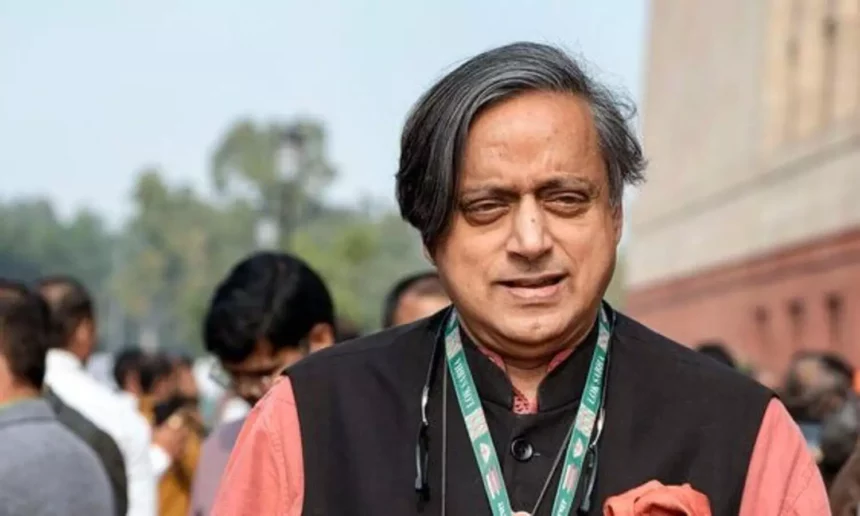
A major political controversy has erupted within the Congress party after senior MP Shashi Tharoor’s remarks on dynastic politics and lineage-based leadership triggered heated reactions from his colleagues. In an opinion piece that has sparked intense debate, Shashi Tharoor examined how family-driven politics can undermine governance and meritocracy. His comments, which made indirect references to the Nehru-Gandhi family, gave the BJP a new opportunity to attack the Congress, reviving the long-standing debate on nepotism and merit in Indian politics.
The controversy centers around Shashi Tharoor’s article published on the opinion portal Project Syndicate on October 31. In the piece, he reflected on the pervasive nature of dynastic politics in India and its impact on democratic systems. While he acknowledged the Nehru-Gandhi family’s historical contribution to India’s independence and leadership, he also wrote that such lineage-based politics often weakens governance by prioritizing birth over competence. His views were quickly picked up by the BJP, which alleged that Shashi Tharoor had indirectly targeted Rahul Gandhi and even Bihar’s RJD leader Tejashwi Yadav, describing them as products of political inheritance.
Congress Leaders Respond to Shashi Tharoor’s Observations
The remarks prompted a range of reactions within the Congress, highlighting an internal divide over the sensitive issue of dynastic politics. Although the party’s official communication channels have so far avoided a formal response, several senior Congress leaders have publicly expressed their opinions, either defending the Gandhis or expanding the discussion to include the broader social reality of inherited privilege in India.
Congress leader Udit Raj dismissed the idea that dynastic politics was unique to the Congress, arguing that the phenomenon extends across all sectors of Indian society. He compared politics to professions like medicine and business, where children often follow in their parents’ footsteps. “A doctor’s son becomes a doctor, a businessman’s child continues in business, and politics is no exception,” he said, adding that such continuities reflect societal structures rather than the failure of democracy. Raj also asserted that if politicians with criminal backgrounds or strong family ties receive party tickets, it mirrors the social and cultural realities of the country rather than merely political opportunism.
Expanding his argument, Udit Raj cited several examples of dynastic influence beyond the Congress. “From Naidu to Pawar, from DMK to Mamata Banerjee, and even Amit Shah’s son, Jay Shah, there are many examples of family-based continuity in Indian politics. The real problem is that opportunities remain confined to families, and deserving individuals from outside struggle to find space,” he said. His remarks attempted to neutralize the BJP’s criticism by showing that the issue of inheritance in politics cuts across party lines.
Another Congress MP, Pramod Tiwari, strongly defended the Gandhi family’s legacy, emphasizing their contribution to the nation’s history and sacrifice for the country. He argued that leadership in the Congress has traditionally come from merit and service, not just lineage. “Pandit Jawaharlal Nehru was one of the most capable prime ministers India ever had. Indira Gandhi proved her strength and dedication by sacrificing her life for the nation. Rajiv Gandhi also gave his life while serving the country,” Tiwari stated. He questioned whether any family in Indian politics, including those in the BJP, had shown similar levels of sacrifice and commitment. His comments underlined the sentiment within a significant section of the Congress that the Gandhi family’s prominence stems from their historical and emotional bond with the people, not merely inheritance.
Congress veteran Rashid Alvi also defended the principle of democratic choice, stressing that political lineage cannot be used to disqualify individuals from public life. “In a democracy, the public makes the decisions. You cannot stop someone from contesting elections just because their father was an MP,” Alvi said. He added that such patterns exist in every field, and attempting to restrict individuals based on family history would contradict democratic freedom. “This is happening in every profession. How will you find a way to prevent it in politics?” he asked, suggesting that voters, not critics, should have the final say on who deserves to lead.
These reactions show the diversity of thought within the Congress party on the issue of nepotism and meritocracy. While some leaders acknowledge the systemic nature of family influence in Indian society, others see attacks on the Gandhi family as politically motivated attempts to weaken the Congress’s moral authority. The debate has once again drawn attention to the complex relationship between history, loyalty, and leadership in Indian politics.
Shashi Tharoor’s Critique of Nepotism and Governance Quality
In his Project Syndicate article, Shashi Tharoor offered a nuanced critique of dynastic politics and its impact on the quality of governance. He began by tracing the historical significance of the Nehru-Gandhi family, acknowledging their deep connection to India’s freedom struggle and their role in shaping the country’s modern political identity. However, he also argued that the same legacy has perpetuated the idea that political leadership can be treated as a birthright, weakening democratic competition and merit-based politics.
“The influence of the Nehru-Gandhi dynasty, including independent India’s first prime minister, Jawaharlal Nehru, prime ministers Indira Gandhi and Rajiv Gandhi, and current opposition leaders Rahul Gandhi and Priyanka Gandhi Vadra, is bound up with the history of India’s freedom struggle. But it has also cemented the idea that political leadership can be a birthright,” Shashi Tharoor wrote. His words reflected both recognition and concern — acknowledging the family’s contributions while warning against the dangers of lineage-driven leadership.
Shashi Tharoor argued that when political power becomes dependent on family connections rather than competence, commitment, or grassroots engagement, governance suffers. He wrote, “When political power is determined by lineage, rather than ability, commitment, or grassroots engagement, the quality of governance suffers. It is especially problematic when candidates’ main qualification is their surname.” This observation, though general in tone, was interpreted by political opponents and sections of the media as a direct comment on the Gandhi family, leading to the current controversy.
The timing of Shashi Tharoor’s remarks has added to their political weight. The Congress is currently engaged in an intense campaign in Bihar, where questions of leadership and generational change are central themes. BJP leaders were quick to use Shashi Tharoor’s words to reinforce their long-standing criticism of the Congress as a party dominated by dynastic politics. Several BJP spokespersons claimed that Shashi Tharoor had “exposed” internal dissent and had “directly attacked” Rahul Gandhi, whom they labeled as India’s “original nepo kid.” They also linked the remarks to Bihar’s RJD leader Tejashwi Yadav, calling him a “chhota nepo kid,” to highlight what they described as the deep-rooted culture of entitlement within opposition parties.
Within the Congress, Tharoor’s stance has once again reignited the debate about his independent positioning and relationship with the party leadership. His earlier selection by the government to lead the Operation Sindoor delegation — despite the Congress not recommending his inclusion — had already drawn criticism from some party colleagues. Udit Raj, one of the sharpest critics of Shashi Tharoor within the party, even termed him the BJP’s “super spokesperson” after he publicly praised the 2015 Uri strike during his visit to Panama.
The latest controversy deepens the perception that Shashi Tharoor continues to walk a fine line between being an intellectual voice within the Congress and an independent thinker willing to challenge the party’s orthodoxies. For many Congress leaders, his comments were ill-timed, especially when the party is striving to project unity ahead of crucial state and national elections. Yet, for others, Shashi Tharoor’s willingness to engage with uncomfortable truths represents the intellectual introspection the Congress must embrace if it seeks to reinvent itself.
The unfolding episode thus captures both the ideological and generational crossroads at which the Congress finds itself. While the Gandhis remain the emotional and organizational anchors of the party, figures like Shashi Tharoor symbolize a growing demand for merit-based politics and open debate within its ranks. The tension between legacy and reform, reverence and realism, continues to define the Congress’s internal discourse — a balancing act that will shape its future identity in a changing political landscape.